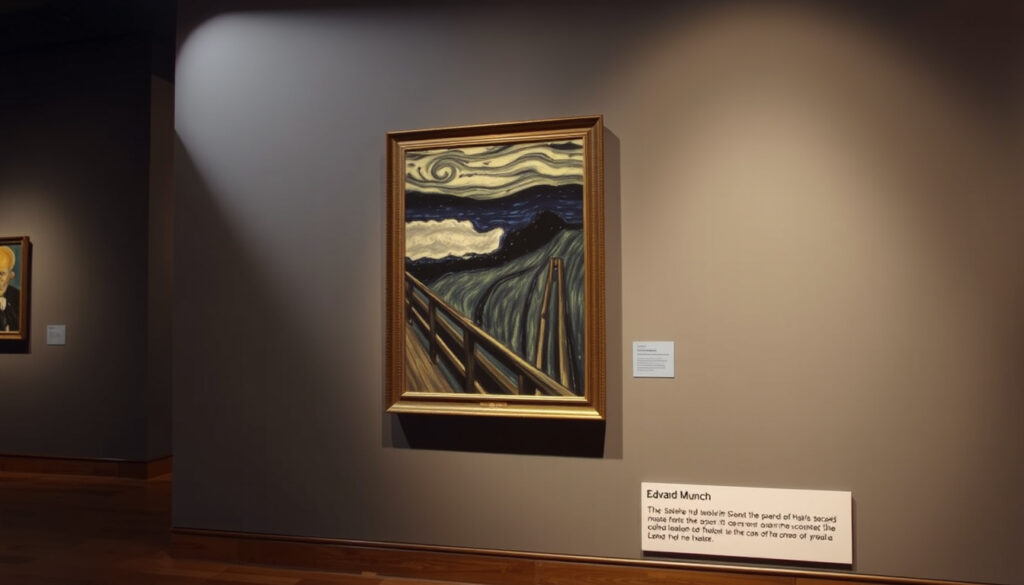
Edvard Munch: Controversy, Tragedy, and The Scream
There are artists whose lives read like the blueprint for their work. Edvard Munch’s story — marked by early loss, inherited anxiety, and a relentless need to paint his inner storms — produced some of the most haunting images in modern art. By the time he finished The Scream in 1893, he had already lost his mother and sister to tuberculosis and was navigating his own fragile mental health. This guide connects the biography to the canvas, showing how the personal tragedies shaped the masterpieces.
Born: December 12, 1863, Løten, Norway · Died: January 23, 1944, Oslo, Norway · Known for: Expressionist painter, The Scream · Art movement: Expressionism, Symbolism · Notable work: The Scream (1893) · Artworks surviving: Over 1,800 paintings, 4,500 drawings, 18,000 prints
Quick snapshot
- Munch’s mother died of tuberculosis when he was five (Britannica)
- He created four versions of The Scream between 1893 and 1910 (PMC (National Institutes of Health))
- His 1892 Berlin exhibition closed early due to public outrage (Christie’s)
- Exact diagnosis of Munch’s mental illness (records describe “hysteria”)
- Identity of the model in Madonna
- Specific inspiration for every element of The Scream beyond his diary
- Mother dies (1868) (Britannica)
- Sister Sophie dies (1877) (Britannica)
- The Sick Child painted (1885) (Tate)
- The Scream painted (1893) (Tate)
- Munch dies (1944) (Tate)
- Munch Museum in Oslo preserves his legacy (Wikipedia)
- The Scream remains one of the most reproduced artworks globally (Wikipedia)
- Scholars continue to analyze connections between his biography and symbolism (The Art Story)
Six facts that define Munch’s life and career:
| Attribute | Detail |
|---|---|
| Full name | Edvard Munch |
| Birthplace | Løten, Norway |
| Birth date | December 12, 1863 |
| Death date | January 23, 1944 |
| Movement | Expressionism, Symbolism |
| Most famous work | The Scream (1893) |
Why was Edvard Munch controversial?
Munch’s treatment of sexuality and death
- Munch’s paintings frequently portrayed sexual encounters, illness, and death — subjects considered scandalous in Victorian Europe (The Art Story (modern art history resource)).
- Works like Madonna (1894–1895) and The Dance of Life (1899–1900) combined eroticism with mortality, breaking the decorum of the era.
- He once said, “Without anxiety and illness, I should have been like a ship without a rudder.” (Christie’s (auction house and art authority))
Reception by 19th-century critics
- His first solo exhibition in Berlin in 1892 caused a public uproar and was shut down because of the radical colors and brooding subject matter (Christie’s).
- Critics called his work “immoral” and “an insult to the art world.” The exhibition closure propelled Munch into notoriety across Europe.
Munch’s choice to expose his own psychological fractures on canvas — rather than hide them — is what made his work both scandalous and enduring. The same vulnerability that cost him a Berlin gallery in 1892 later made him a pioneer of Expressionism.
The Scream and public shock
- The Scream (1893) was first exhibited under the German title Der Schrei der Natur (“The Scream of Nature”) (PMC (National Institutes of Health)).
- According to Wikipedia, the painting is widely interpreted as an image of existential dread or modern anxiety.
- The visceral depiction of a figure screaming under a blood-red sky shocked audiences and remains a cultural touchstone for raw emotional expression.
The implication: Munch deliberately broke the rules of decorum to force viewers into uncomfortable psychological spaces — a move that earned him condemnation in the short term and canonization in the long term.
What was the tragedy of Edvard Munch?
Loss of mother and sister
- Munch’s mother died of tuberculosis when he was five (Tate (UK national art museum)).
- His sister Sophie died of the same disease at age 15 in 1877 (Britannica (encyclopedia)).
- The loss of his mother and sister left deep marks on his psyche and became recurring subjects in his art (Smithsonian Magazine (history and culture publication)).
Father’s strict religious upbringing
- After his mother’s death, Munch’s father, a deeply religious man, imposed a strict Christian household filled with fear of sin and damnation.
- Munch later wrote about the oppressive “hell” of his childhood, which fueled his rebellion against moral conventions (Tate).
Mental health struggles
- Munch suffered from depression, anxiety, and what was then diagnosed as “hysteria” (Smithsonian Magazine).
- He experienced a nervous breakdown in 1908 and was hospitalized in Copenhagen (Britannica).
- He wrote extensively about his “inherited madness,” fearing it would overtake him.
The pattern: Every major personal loss became a raw material for Munch’s art. He didn’t paint around his grief — he painted straight through it, making the tragedy the bedrock of his creative identity.
The very illness and anxiety that Munch feared would ruin him became the engine of his most iconic works. As he himself put it, “Without anxiety and illness, I should have been like a ship without a rudder.”
Why is Edvard Munch so famous?
Iconic status of The Scream
- The Scream (1893) is among the most reproduced images in art history (Wikipedia (open encyclopedia)).
- Four versions exist, including two paintings and a lithograph (Smarthistory (art history educational resource)).
- Its universal theme of existential anxiety resonates across cultures and generations.
Influence on Expressionism
- Munch is widely regarded as a pioneer of Expressionist art (Britannica).
- His use of bold color, distorted figures, and emotional symbolism directly influenced German Expressionists like Ernst Ludwig Kirchner (The Art Story).
Munch’s psychological depth
- His recurring themes — anxiety, love, jealousy, sickness, death — address universal human experiences (Britannica).
- The “Frieze of Life” series, a collection of works about the cycle of human emotion, cemented his legacy as a deeply psychological artist.
Why this matters: Munch’s fame rests not just on one iconic painting but on his ability to articulate feelings many people share but rarely see expressed — especially the darker, less acceptable ones. That emotional honesty is what keeps audiences returning to his work.
What was Edvard Munch’s famous quote?
The most famous quote from Munch’s diary
- Munch wrote in his diary on January 22, 1892: “I was walking along the road with two friends – the sun was setting – suddenly the sky turned blood red – I paused, feeling exhausted, and leaned on the fence – there was blood and tongues of fire above the blue-black fjord and the city” (Tate).
Context behind the quote
- This passage is directly tied to the inspiration for The Scream (PMC (National Institutes of Health)).
- Munch recorded the memory after experiencing a panic attack during a walk in Kristiania (now Oslo) (Tate).
Link to The Scream
- The diary entry captures the exact sensory overload that became the emotional core of the painting.
- Munch’s writing reveals that the “scream” was not a sound from his external surroundings but an internal experience — “an infinite scream passing through nature.”
The takeaway: The famous quote isn’t just a description — it’s the blueprint for one of art history’s most recognizable images. Munch’s words give us the raw feeling behind the painted figure’s open mouth.
What is the saddest painting of all time?
Munch’s The Sick Child
- The Sick Child (1885–1886) is often cited as one of the saddest paintings ever created (Britannica).
- It depicts his sister Sophie at the time of her death from tuberculosis (Tate).
- Munch worked on six versions of this painting, returning obsessively to the memory of her pale face and labored breathing.
Death in the Sickroom
- Another heart-wrenching work, Death in the Sickroom (1893), shows the family gathered around Sophie’s deathbed.
- The painting conveys collective grief with stark, expressionist distortion — figures are frozen, the room is suffocating.
Comparison to other emotional works
- While many artists have painted sorrow — Picasso’s Guernica, Rembrandt’s late self-portraits — Munch’s work stands out for its direct autobiographical source.
- Critics and viewers often rank The Sick Child above others because it is not a general sadness but a specific, remembered loss.
The trade-off: The same obsessive memory that haunted Munch for decades also gave him the tools to create images of extraordinary emotional force. His saddest works are simultaneously his most personal and his most universal.
Timeline: Key events in Edvard Munch’s life
- 1863: Edvard Munch born in Løten, Norway (Tate).
- 1868: Mother dies of tuberculosis (Britannica).
- 1877: Sister Sophie dies of tuberculosis (Britannica).
- 1885: Paints The Sick Child, inspired by Sophie’s death (Tate).
- 1889: Father dies; Munch receives state grant to study in Paris (Britannica).
- 1892: Berlin exhibition closes early due to public outrage (Christie’s).
- 1893: Paints The Scream (Tate).
- 1908: Suffers nervous breakdown; hospitalized in Copenhagen (Britannica).
- 1944: Dies in Oslo (Tate).
The pattern: Munch’s life was punctuated by loss and controversy, each event feeding into his artistic output.
What we know and what remains unclear
Confirmed facts
- Munch’s mother died when he was five (Britannica).
- He suffered from depression and anxiety (Britannica).
- The Scream was inspired by a panic attack during a walk (Tate).
- He bequeathed all his works to the city of Oslo (Britannica).
What’s uncertain
- Exact nature of Munch’s mental illness (diagnosed as “hysteria” at the time).
- Whether the woman in Madonna is a specific model.
- The precise inspiration for every element in The Scream, beyond his diary account.
- Exact influence of his father’s strict religious upbringing on his artistic themes.
The implication: While many facts are solid, the subjective interpretation of Munch’s work remains open.
In Munch’s own words: Key quotes
I was walking along the road with two friends – the sun was setting – suddenly the sky turned blood red – I paused, feeling exhausted, and leaned on the fence – there was blood and tongues of fire above the blue-black fjord and the city.
— Edvard Munch, diary entry, January 22, 1892 (Tate)
Without anxiety and illness, I should have been like a ship without a rudder.
— Edvard Munch, in a letter (Christie’s)
Munch once reflected that the 1892 Berlin exhibition was so scandalous it was closed, and the public fury over his violent colors and morbid subjects made him known across Europe. (Paraphrased from historical accounts, The Art Story)
For audiences today, Munch’s work remains a mirror for their own anxieties. The choice for viewers is clear: either confront the discomfort Munch painted so honestly, or turn away from one of the most emotionally honest artists of the modern era. For collectors and museums, preserving his legacy is a commitment to keeping that raw human experience accessible — not sanitized, not softened, but raw as he intended.
The takeaway: Munch’s own words confirm his internal experience as the source of his art.
To fully understand the raw anguish captured in The Scream, one must explore Munchs lifelong struggles with illness and personal loss.
Frequently asked questions
What is Edvard Munch’s most famous painting?
The Scream (1893) is by far his most famous work, recognized globally as an icon of existential dread.
Where can I see Edvard Munch’s artworks?
The Munch Museum in Oslo, Norway, holds the largest collection, with over 1,800 paintings, 4,500 drawings, and 18,000 prints. Other works are in the National Gallery, Oslo, and museums worldwide.
How did Edvard Munch’s childhood affect his art?
The early deaths of his mother and sister, combined with a strict religious upbringing, instilled a lifelong preoccupation with illness, death, and anxiety — all central themes in his work.
What art movement was Edvard Munch part of?
Munch is considered a pioneer of Expressionism, though his early work also shows Symbolist influences.
How many versions of The Scream did Munch paint?
He completed four versions between 1893 and 1910, including two paintings, a pastel, and a lithograph (PMC).
Did Edvard Munch have a mental illness?
He suffered from depression and anxiety, and was hospitalized after a nervous breakdown in 1908. Contemporary diagnoses described “hysteria.”
What is the value of The Scream painting?
One pastel version sold for nearly $120 million at auction in 2012, making it one of the most expensive paintings ever sold.
More related posts
 Protein Powder: Benefits, Risks, and How to Choose the Best One
 Scott Pendlebury Lawsuit: Legal Battle and AFL Career Update
 Dejounte Murray Injury, Kids, and Salary 2025
 Scooby-Doo Shaggy: Origin, Personality, and Fan Theories
 Guy Montgomery: Biography, Shows, Podcast & Updates
 Sherlock Holmes: Facts, Fiction, and FAQs (Updated Guide)
 James Acaster: His Condition, Partner, Breakdown and Net Worth
 Charles Perkins: Civil Rights Activist and Soccer Player
