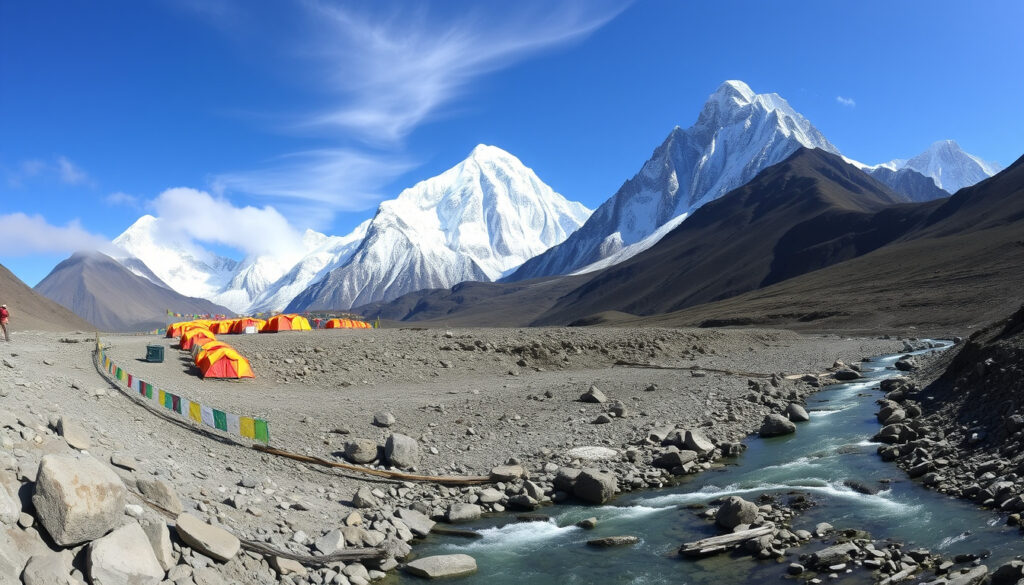
Everest Base Camp Trek: Beginner’s Guide & Costs
For anyone who has ever stared at a photo of Mount Everest and wondered “Could I actually go there?” — the answer is probably yes. The Everest Base Camp trek is one of the world’s most iconic hiking routes, and it’s entirely doable for beginners who prepare properly. This guide cuts through the noise with real cost figures, altitude facts, and safety signals so you can decide if this is your next adventure.
Altitude of Everest Base Camp (South): 5,364 m (17,598 ft) ·
Average trek duration: 12–16 days ·
Success rate for reaching Base Camp: Over 90% ·
Typical cost range: $1,000–$5,000 ·
Best season: Spring (April–May) and Autumn (October–November)
Quick snapshot
- South Base Camp elevation is 5,364 m (Wikipedia)
- Trek duration 12–16 days (Intrepid Travel (tier 2 operator))
- Best seasons: spring and autumn (Magical Nepal (trekking specialist))
- Exact cost varies by operator, season, and group size (Himalayan Glacier (trekking company))
- Success-rate numbers are estimates and can vary by year (Himalayan Glacier (trekking company))
- Temperature extremes are unpredictable; averages are given (Himalayan Glacier (trekking company))
- Spring (March–May): prime season, stable weather
- April–May: busiest summit window
- Autumn (Sept–Nov): second best, clear skies
- Winter: very cold, many teahouses closed
- Book permits and flights well in advance
- Plan a 14–16 day itinerary with acclimatization stops
- Budget $1,000–$5,000 depending on service level
Five key facts, one pattern: nearly every beginner-friendly source agrees the trek is tough but achievable with preparation. The table below lays out the essential logistics.
| Attribute | Details |
|---|---|
| Location | Khumbu Region, Nepal |
| Nearest Airport | Lukla (Tenzing-Hillary Airport) |
| Permits Required | Sagarmatha National Park entry fee and TIMS card |
| Accommodation | Teahouses along the route |
| Guided vs Independent | Both possible; guided recommended for beginners |
The catch: permits have changed recently, so always double-check current fees with an official source.
Can a beginner hike to Everest Base Camp?
The short answer is yes — with caveats. The Everest Base Camp trek is a non‑technical walking route, meaning you don’t need ropes, crampons, or climbing experience. What you do need is cardiovascular fitness, mental resilience, and a solid acclimatization plan.
What are the biggest risks at base camp?
- Altitude sickness (acute mountain sickness, AMS): the primary threat. Ascent above 3,000 m should not exceed 300–500 m per day, according to Magical Nepal (Khumbu trekking specialists).
- Weather: sudden snow, low visibility, and cold can turn a clear day dangerous.
- Physical injury: knee pain and exhaustion are common on the rocky descents.
Is Everest Base Camp trekking safe?
When proper precautions are taken, yes. Over 90 % of trekkers reach base camp without major incident. Safety depends on listening to your body, using a guide if you’re inexperienced, and having travel insurance that covers helicopter evacuation.
What is the success rate for beginners?
Reliable data is scarce, but multiple trekking operators estimate a success rate above 90 % for basic fitness levels. Failures typically stem from altitude sickness, injury, or running out of time — not lack of skill.
A beginner who spends 14–16 days on the trail, follows the “climb high, sleep low” rule, and stays hydrated has an overwhelming chance of success. The risk is not in the route but in skipping acclimatization.
The implication: if you can walk uphill for six hours a day and don’t ignore warning signs, you belong on this trek.
How much does the Everest Base Camp trek cost?
Cost is the biggest variable for first-time trekkers. Budget packages start around USD 850, luxury expeditions can exceed USD 4,500, and the all‑in total for an international traveler often lands between USD 2,500 and 3,500.
What is included in the cost?
- Guided packages: typically cover accommodation, meals, permits, guide/porter, and airport transfers. Standard itineraries run USD 1,200–1,500 per person, reports Adventure Great Himalaya (Nepal trekking operator).
- Permits: combined cost for Sagarmatha National Park entry (≈NPR 3,000) and Khumbu Pasang Lhamu Municipality entry (≈NPR 2,000) totals about USD 60, per DestiNet (travel advisory platform).
- Flights to Lukla: round‑trip typically USD 350, notes Best Heritage Tour (trekking guide).
How to budget for the trek?
A realistic budget for a first‑time trekker from Europe or North America, including flights, insurance, visa, and operator fees, sits at USD 2,500–3,500, according to EBC Trek Guide (financial planning resource).
Cost factors: guided vs independent
- Guided: USD 1,200–2,500 for a standard package. Includes guide (USD 400–600) and porter (USD 45–55/day combined).
- Independent: lower upfront cost (≈USD 850–1,000 for accommodation and meals at USD 30–40/day), but you arrange permits and logistics yourself.
Paying for a reputable guide reduces uncertainty and improves safety. Independent trekkers save money but carry higher risk if they don’t know the terrain or how to handle altitude symptoms.
The pattern: every operator’s price range overlaps at roughly USD 1,200–1,500, which is the sweet spot for a solid standard package. Anything below USD 1,000 likely cuts corners on accommodation or guide quality.
How many days does the Everest Base Camp trek take?
The classic 14–16 day itinerary is the gold standard for beginners. It includes built‑in acclimatization stops that dramatically reduce the risk of altitude sickness.
Standard itinerary 12–16 days
- Day 1–2: Fly to Lukla, trek to Phakding and Namche Bazaar (3,440 m).
- Day 3: Acclimatization day at Namche — hike to Everest View Hotel.
- Day 4–6: Trek to Tengboche, Dingboche (4,410 m).
- Day 7: Second acclimatization day at Dingboche — climb Chhukung Ri.
- Day 8–10: Continue to Lobuche and Gorak Shep, reach Base Camp (5,364 m).
- Day 11–14: Return via same route to Lukla.
Acclimatization days
Spending two full days at 3,400–4,400 m allows your body to produce more red blood cells and adjust to lower oxygen. Skipping them can lead to severe AMS or HAPE (high altitude pulmonary edema).
Alternative routes
Some operators offer 12‑day “express” itineraries, but these reduce acclimatization. Intrepid Travel (adventure travel operator) recommends a minimum of 14 days for safety and enjoyment.
An itinerary shorter than 13 days may save time but doubles the risk of serious altitude illness. Beginners should never book anything under 14 days.
What this means: the extra days are not padding — they are your best insurance against having to turn back.
What is the altitude of Everest Base Camp?
Two base camps serve Mount Everest: South in Nepal and North in Tibet. The South Base Camp (the one most trekkers visit) sits at 5,364 m (17,598 ft) above sea level.
South Base Camp altitude
5,364 m — confirmed by Wikipedia (encyclopedic source). That’s higher than any peak in Europe or North America outside Alaska.
North Base Camp altitude
5,150 m (16,900 ft) on the Tibetan side. Access requires a permit from China and is less common for independent trekkers.
Comparison with Everest summit
The summit of Mount Everest is 8,848 m (29,029 ft) — a staggering 3,484 m higher. Base Camp altitude is enough to cause hypoxia symptoms in unacclimatized individuals.
The catch: even at 5,364 m, oxygen in the air is about half of what it is at sea level. That’s why every successful trekker respects the altitude.
What is the temperature at Everest Base Camp?
Temperature swings are extreme — daytime sun can feel warm, but nights and wind chill can drop well below freezing even in the “good” seasons.
Seasonal temperature ranges
- Spring (April–May): daytime 5–15 °C, night –5 to 5 °C.
- Autumn (October–November): similar to spring, with crisp mornings.
- Winter (December–February): daytime around –5 °C, night as low as –20 °C. Many teahouses closed.
- Monsoon (June–August): daytime 10–20 °C but heavy rain, leeches, and clouded views.
Average daytime and nighttime temperatures
During the best trekking windows, expect a 10–15 °C diurnal range. Pack layers: a warm down jacket for evenings, a sun‑protective shirt for midday.
Wind chill
Exposed sections — particularly Gorak Shep to Base Camp — can feel 5–10 °C colder due to wind. Magical Nepal (Khumbu trekking experts) advises wind‑proof outer layers as essential gear.
The implication: the temperature is manageable with the right gear. The bigger risk is not packing for the worst case — a sudden snowstorm in May can drop the wind chill below –10 °C.
Does anyone live at Everest Base Camp?
No one lives permanently at Base Camp. It is a seasonal, temporary settlement that springs up twice a year for the climbing and trekking seasons.
Seasonal population
During spring (March–May) and autumn (October–November), several hundred people — trekkers, guides, porters, and cooks — occupy the camp. Outside those windows the site is abandoned.
Sherpa community
Sherpa guides and support staff spend weeks at a time at Base Camp during expeditions. They live in shared tents and rely on food and equipment carried up from villages like Namche Bazaar. Their expertise is the backbone of every commercial trek.
Temporary camps for climbers
Summit aspirants establish higher camps (Camp 1,2,3,4) above Base Camp. Those are purely functional — no one stays longer than necessary.
Why this matters: if you’re expecting a mountain village with tea shops, you’ll be disappointed. Base Camp is a rocky glacier with tarps, tents, and a medical post — atmospheric but austere.
Pros and Cons of the Everest Base Camp Trek
Upsides
- No technical climbing skills required
- Well‑established teahouse infrastructure along the route
- Stunning Himalayan scenery and cultural immersion in Sherpa villages
- High success rate for prepared beginners
- Life‑changing sense of achievement
Downsides
- Altitude sickness is a real and serious risk
- Cost can be high once flights, insurance, and gear are included
- Physical demands — long days of walking, cold nights, basic hygiene
- Weather can disrupt flights from Lukla, causing delays
- Overcrowding in peak season (April–May) on the trail
The pattern: the trek offers an unmatched experience but requires realistic expectations.
Timeline: Best Seasons for Everest Base Camp
- Spring (March–May): Prime climbing season; pre‑monsoon stable weather. Base Camp is busiest. Magical Nepal (trekking specialist) recommends late April for the best balance of conditions.
- April–May: Everest summit season — base camp is at its most crowded but also most vibrant.
- June–August: Monsoon; heavy rain, limited views, leeches on lower trails. Not recommended.
- Autumn (September–November): Second best season; clear skies, moderate temperatures, fewer crowds than spring.
- Winter (December–February): Very cold, snow, many teahouses closed. Only for experienced, well‑equipped trekkers.
The trade-off: spring offers the best weather but the busiest trails. Autumn gives you almost as good conditions with more solitude.
Clarity Check: What We Know vs What’s Uncertain
Confirmed facts
- Everest Base Camp (South) is at 5,364 m altitude.
- The trek typically takes 12–16 days.
- Spring and autumn are the best trekking seasons.
- Over 90 % of trekkers reach Base Camp.
- Permits cost roughly USD 60 in combined fees.
What’s unclear
- Exact cost varies by operator, season, and group size.
- Success‑rate numbers are estimates and can vary by year.
- Temperature extremes are unpredictable — averages are given.
- Flight delays from Lukla depend on weather windows.
What this means: the information is reliable but not absolute; trekkers should verify current conditions.
Expert Perspectives on the Trek
Everest Base Camp is a rudimentary campsite at the base of Mount Everest, used by climbers and trekkers as a staging point for summit attempts and the final destination for most trekkers.
Our 15‑day small‑group trek includes two acclimatization days and is designed for first‑time trekkers. You’ll stay in cozy teahouses, walk through rhododendron forests, and stand at the foot of the world’s tallest mountain.
These perspectives underscore the importance of preparation and experienced guidance.
Summary: Should You Book the Everest Base Camp Trek?
The Everest Base Camp trek is not a walk in the park — it demands physical prep, financial planning, and respect for altitude. But for a beginner who trains for a few months, budgets realistically (think USD 2,500–3,500 all‑in), and commits to a 14‑day itinerary with proper acclimatization, the odds of standing at 5,364 m are overwhelming. For the traveler dreaming of the Himalayas, the choice is clear: prepare, go, and don’t underestimate the mountain.
nepaleverestbasecamp.com, himalayanrecreation.com, bestheritagetour.com, nepalecoadventure.com, sherpaexpeditiontrekking.com, himalayanrecreation.com, havenholidaysnepal.com
Frequently asked questions
What is the 2pm rule in Everest?
The “2pm rule” is a safety guideline used in high‑altitude mountaineering: if you haven’t reached your turnaround point by 2 p.m., you turn back regardless of how close you are. It prevents climbers from descending in darkness or worsening weather.
Why do planes not fly over Everest?
Commercial jets avoid flying directly over Everest because the mountain’s height (8,848 m) leaves little margin for emergency descent. Turbulence and low‑oxygen conditions in the event of decompression also make it risky.
What is the oldest body still on Mount Everest?
The oldest known body on Everest is that of George Mallory, who died in 1924. His remains were found in 1999 at around 8,155 m.
What is the best season for the Everest Base Camp trek?
Spring (April–May) and autumn (October–November) offer the most stable weather, clear skies, and moderate temperatures. These are the recommended windows.
Do I need a permit to trek to Everest Base Camp?
Yes. You need a Sagarmatha National Park entry permit (≈NPR 3,000) and a Khumbu Pasang Lhamu Municipality entry permit (≈NPR 2,000). Total is about USD 60.
What physical fitness level is required?
You should be comfortable walking 5–7 hours a day on uneven terrain. Cardiovascular training, stair‑climbing, and leg‑strength exercises for 2–3 months beforehand are recommended.
Can I trek to Everest Base Camp without a guide?
Yes, it is possible. The trail is well marked and teahouses are plentiful. However, a guide provides safety, logistics support, and cultural insight — especially valuable for first‑time visitors to Nepal.
More related posts
 AC/DC: Surviving Members, Name Meaning, Songs Refused
 Melissa Benoist: Supergirl Career, Kids, Net Worth
 All Road Lead to Rome: Meaning, Origin, and U e
 Trey Parker’s Net Worth, Voices, and South Park Legacy
 Kirk Pengilly: Life After INXS, Cancer Recovery, and Net Worth
 Betty Boop: Story, Controversy, Symbolism, and Public Domain
 Aimee Garcia Biography: Age, Ethnicity, and Movies
 Danielle Fishel: Cancer Diagnosis, Career, and Life
