Ancient Egypt History: Facts, Symbols, and Language
Most people picture ancient Egypt through Hollywood lenses — towering pyramids, golden masks, and epic chariot battles. But the real story is more intimate. The Egyptians called their writing medu netjer, “the gods’ words” (World History Encyclopedia), and they expressed love with a verb that still echoes in modern Arabic. This guide unpacks the everyday curiosities behind one of history’s longest-running civilizations.
Duration: over 3,000 years · Pharaohs: more than 170 · Pyramids: over 130 · Writing: hieroglyphs (over 700 signs)
Quick snapshot
- Pyramids built as tombs for pharaohs (World History Encyclopedia)
- Hieroglyphic writing used over 700 symbols (Smarthistory)
- Pharaohs considered living gods (National Geographic Kids)
- Exact method of pyramid stone transport remains debated (World History Encyclopedia)
- Full pronunciation of many ancient Egyptian words unknown (Smarthistory)
- c. 3100 BCE: Unification of Upper and Lower Egypt (Wikipedia)
- 332 BCE: Alexander the Great conquers Egypt (World History Encyclopedia)
- Ongoing excavations continue to reveal new tombs and artifacts (National Geographic Kids)
Among the many facets of ancient Egypt, five quick facts stand out for anyone seeking a snapshot.
| Fact | Detail |
|---|---|
| Capital | Memphis, later Thebes |
| Known For | Pyramids, Sphinx, mummies, hieroglyphs |
| Population (peak) | estimated 3–4 million |
| Language | Egyptian (hieroglyphic, hieratic, demotic) |
| Currency | Barter system; later copper and silver units |
The pattern: the Egyptians structured their state around what the Nile made possible, and the table above shows how that shaped their daily life.
What is ancient Egypt in history?
The meaning of ‘Kemet’
- Ancient Egyptians called their land Kemet (“the black land”) after the dark, fertile soil left by the Nile’s annual flood (World History Encyclopedia).
- The surrounding desert was Deshret (“the red land”), a natural barrier against invaders.
The name itself reveals how central the Nile was: the black strip of soil was everything, the red desert the hostile other. That geographical split shaped the Egyptian worldview for millennia.
Geography and the Nile
No Nile, no Egypt. The river’s annual floods deposited rich silt, enabling agriculture in an otherwise arid region. Settlements clustered along the lower reaches, from modern Aswan to the delta. The river also served as the main highway for trade and communication (Smarthistory).
Main periods of ancient Egypt
- Old Kingdom (c. 2686–2181 BCE): Pyramid-building era, strong central government.
- Middle Kingdom (c. 2055–1650 BCE): Reunification, expansion into Nubia.
- New Kingdom (c. 1550–1069 BCE): Empire, Valley of the Kings, famous pharaohs like Hatshepsut and Ramses II.
- Late Period and Ptolemaic: 664–332 BCE, ended with Alexander’s conquest.
The pattern: when the Nile cooperated and the pharaoh held authority, Egyptian civilization flourished. When either faltered, the kingdom fractured.
The Nile wasn’t just a water source — it was the engine that made large-scale organisation possible. Without it, the pyramids would never have risen.
How did ancient Egypt begin?
Prehistoric Egypt
- Small farming villages appeared along the Nile as early as 5500 BCE (World History Encyclopedia).
- These settlements gradually merged into larger polities, with the two most powerful being Upper Egypt (in the south) and Lower Egypt (in the delta).
Unification under Narmer
Around 3100 BCE, King Narmer (also called Menes) unified Upper and Lower Egypt, creating the first dynastic state. The Narmer Palette, a ceremonial object dating to this period, depicts him wearing the crowns of both regions (Wikipedia).
The role of the Nile
The river did more than water crops: it enabled centralised administration. Pharaohs could levy taxes, move armies, and distribute food along the Nile’s predictable current. The annual flood became a calendar for the entire civilisation.
The implication: unification wasn’t a military accident — it was the political expression of a geography that demanded coordination.
Unification may have happened more gradually than the Narmer Palette suggests. Some historians argue that the palette commemorates an already long-standing union rather than a single conquest.
What are 5 facts about ancient Egypt?
Pyramids were tombs
Over 130 pyramids have been discovered in Egypt, most built as tombs for pharaohs during the Old Kingdom. The Great Pyramid of Giza contained a king’s burial chamber, though it was looted in antiquity (World History Encyclopedia).
Hieroglyphic writing
Egyptian writing used more than 700 signs, combining logograms (whole words) and phonetic signs. The script was called medu netjer — the gods’ words (Smarthistory).
Mummification
Mummification preserved bodies for the afterlife by removing internal organs and drying the corpse with natron. The process could take 70 days (National Geographic Kids).
Pharaohs as divine rulers
Pharaohs were considered living gods, intermediaries between the people and the deities. Their authority was absolute in theory, though in practice they relied on a network of viziers and priests.
Polytheistic religion
Egyptians worshipped a vast pantheon. Major gods included Ra (sun god), Osiris (god of the afterlife), Isis (goddess of magic), and Horus (sky god). Temples were centres of both worship and economy.
The trade-off: the immense resources poured into temples and tombs often strained the state’s finances, especially in later periods.
What does 𓆥 mean?
The Sedge (Upper Egypt)
- The sedge plant (swt) was the heraldic symbol of Upper Egypt.
- It appears in the royal title Nesut Bity, meaning “King of Upper and Lower Egypt.”
The Bee (Lower Egypt)
- The bee (bity) symbolised Lower Egypt.
- Together, the sedge and bee represent the dual kingship: one ruler over the two lands (World History Encyclopedia).
Combination in royal titles
The combined symbol 𓆥 is read as “He of the Sedge and the Bee.” It appeared in the fivefold titulary of every pharaoh from the Middle Kingdom onward, a constant visual reminder of national unity.
What this means: every hieroglyphic symbol carried political weight. The sedge and bee weren’t decorative — they were the constitutional foundation of the state.
How did Egyptians say ‘I love you’?
The phrase in hieroglyphs
In ancient Egyptian, “I love you” was expressed with the verb mr (to love) combined with pronouns. A common formulation is mr.y ib, literally “my heart loves” (Smarthistory).
Love poetry in ancient Egypt
New Kingdom papyri contain passionate love poems: “My heart is not yet free from your love / Your voice is sweet as the sound of a breeze / I adore you more than the world.” These verses show that romantic love was as intense in antiquity as today.
Modern Egyptian Arabic difference
Modern Egyptian Arabic uses ana bahebik (to a female) or bahebak (to a male). The root h-b-b is related to the ancient verb ḥb (to desire), showing a linguistic thread that survived across 4,000 years.
The pattern: while the script changed from hieroglyphs to Arabic letters, the emotional vocabulary remained remarkably stable.
Timeline of ancient Egypt
- c. 5500–3100 BCE: Predynastic period — farming villages, small settlements (World History Encyclopedia)
- c. 3100 BCE: Unification of Upper and Lower Egypt under Narmer (Wikipedia)
- c. 2686–2181 BCE: Old Kingdom — pyramid building, strong central government
- c. 2055–1650 BCE: Middle Kingdom — reunification, expansion into Nubia
- c. 1550–1069 BCE: New Kingdom — empire, Valley of the Kings
- 332 BCE: Alexander the Great conquers Egypt
- 30 BCE: Egypt becomes a Roman province
Clarity: what we know and what we don’t
Confirmed facts
- Egyptians built pyramids as tombs for pharaohs during the Old Kingdom (World History Encyclopedia)
- Hieroglyphic writing was used for religious and monumental texts (Smarthistory)
- The symbol 𓆥 represents the dual kingship of Upper and Lower Egypt
- Mummification involved removal of internal organs and drying with natron (National Geographic Kids)
What’s unclear
- Exact method used to transport and place pyramid stones (World History Encyclopedia)
- Meaning of some hieroglyphic symbols remains debated (Wikipedia)
- Full pronunciation of many ancient Egyptian words (only consonants known) (Smarthistory)
Voices from the past
“The Egyptians believed that the heart was the seat of intelligence and emotion. In love poetry, the heart is always involved.”
— Bob Brier, Egyptologist (World History Encyclopedia)
“We are still only scratching the surface. Every season brings new discoveries that rewrite what we thought we knew.”
— Zahi Hawass, former Egyptian Minister of Antiquities (National Geographic Kids)
“Then Isis spoke: ‘I am Isis, the great goddess, the lady of magic. I have come to heal the child of the king.'”
— Westcar Papyrus (translation)
Ancient Egypt wasn’t a single, static civilisation — it evolved over three millennia, adapting to political change, foreign influence, and environmental shifts. For anyone trying to understand human history, it’s the longest case study we have. For the modern reader, the lesson is clear: the Nile still flows, but the society that mastered it has lessons about resilience, creativity, and the power of shared belief that remain relevant today.
For a deeper dive into the civilization’s enduring legacy, readers can explore this comprehensive guide to ancient Egypt covering its history, symbols, and frequently asked questions.
Frequently asked questions
How long did ancient Egypt last?
The ancient Egyptian civilisation lasted from about 3100 BCE to 332 BCE — over 3,000 years.
Who built the Great Pyramid?
The Great Pyramid of Giza was built for Pharaoh Khufu (Cheops) around 2560 BCE by a workforce of thousands of skilled labourers.
What is the Rosetta Stone and why is it important?
The Rosetta Stone, created in 196 BCE, carries the same decree in Egyptian hieroglyphs, demotic, and Greek. It was key to deciphering hieroglyphs in 1822.
How did ancient Egypt end?
Egypt’s independence ended after the conquest by Alexander the Great in 332 BCE, followed by the Ptolemaic dynasty and later Roman annexation in 30 BCE.
What were ancient Egyptian cats?
Cats were highly revered, associated with the goddess Bastet. Killing a cat could be a capital offence.
What was the purpose of the Sphinx?
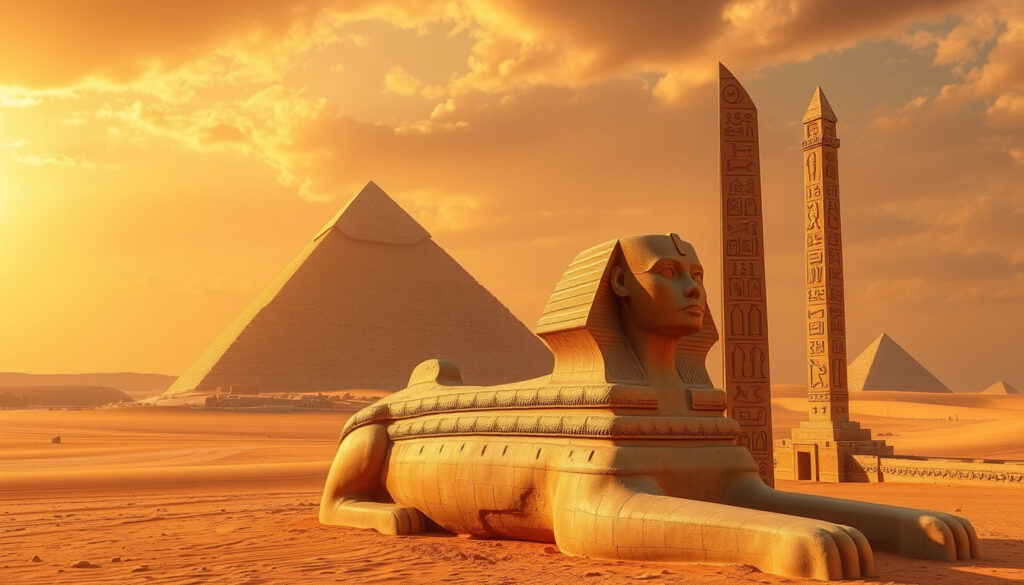
The Great Sphinx of Giza likely served as a guardian statue for the pyramid complex, possibly associated with Pharaoh Khafre.
Did ancient Egyptians use makeup?
Yes, both men and women wore eye makeup (kohl) for cosmetic and protective purposes, believing it warded off evil.
What was the Book of the Dead?
A collection of spells and instructions to help the deceased navigate the afterlife. Papyrus copies were placed in tombs from the New Kingdom onward.
More related posts
 Bryan Johnson: Wealth, Diet, and Biological Age
 Amazon Prime Day 2025-2026: Dates, Deals & Black Friday Guide
 Stephen Crichton: Age, Wife, Contract, Religion, News
 Trey Parker’s Net Worth, Voices, and South Park Legacy
 Adam Simpson: What He Does Now, Net Worth, and Hungry Jacks
 Client Case Aelftech.com: What Is Verified and What Is Missing
 Oona Chaplin: Biography, Family, Career of Spanish Actress
 Khabib Nurmagomedov: Undefeated Record, Net Worth & Retirement
