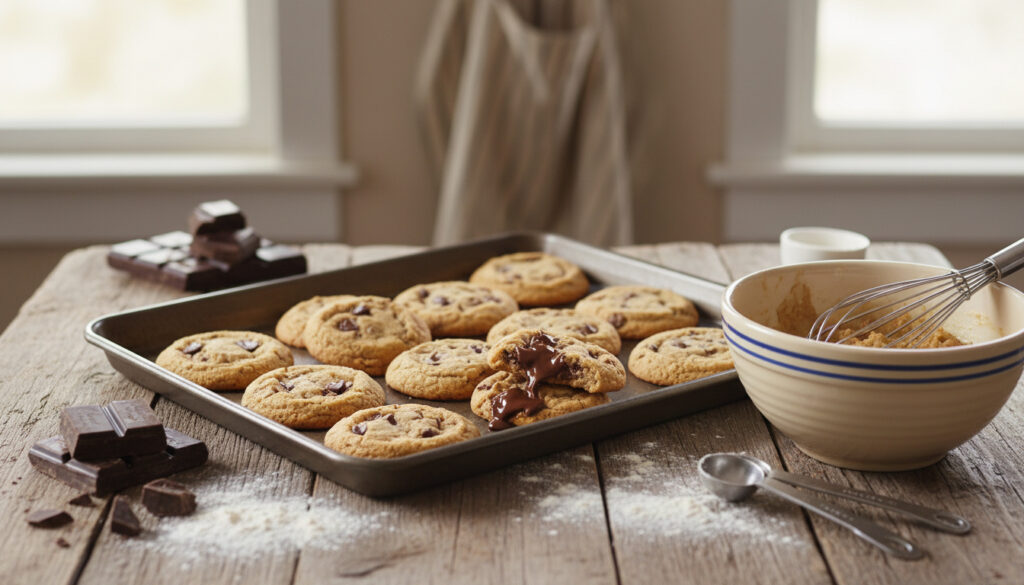
Chocolate Chip Cookie Recipe – Original Toll House Formula
The chocolate chip cookie stands as America’s most iconic homemade dessert, a recipe invented by accident in 1939 that has since become the standard by which all other cookies are judged. Ruth Wakefield, proprietor of the Toll House restaurant in Whitman, Massachusetts, created the first batch when she added broken pieces of Nestlé Semi-Sweet chocolate to her dough expecting them to melt, but instead the chocolate pieces held their shape and softened to a creamy texture, creating the first chocolate chip cookie according to Nestlé’s historical records.
That original recipe, published in a Boston newspaper shortly after its creation, remains the foundation for modern variations. This guide examines the classic Toll House formula, the science behind achieving perfect texture, and the facts verified through decades of home baking.
Whether you seek bakery-style thickness or the classic thin-and-chewy profile, understanding the verified ratios and methods makes the difference between good cookies and exceptional ones.
What Is the Best Chocolate Chip Cookie Recipe?
The definitive chocolate chip cookie recipe traces directly to the 1939 original, though variations accommodate different textures and dietary preferences. The classic formula balances specific ingredient ratios to achieve the signature taste and texture that made the Toll House cookie the most popular of all time.
Classic Drop Cookies
Yield: 5 dozen
Time: 9-11 min at 375°F
Tweak: Standard tablespoons of dough
Thick & Chewy
Yield: 3-4 dozen
Time: 10-12 min at 375°F
Tweak: Chill 30-60 min, larger scoop
Bar Cookie Version
Yield: 24 bars
Time: 25-30 min at 375°F
Tweak: 9×13 inch pan, dark golden top
Nut-Free Adaptation
Yield: 5 dozen
Time: 9-11 min at 375°F
Tweak: Add 1 cup extra chips or 2 tbsp flour
Essential Insights
- Ruth Wakefield invented the chocolate chip cookie in 1939 at the Toll House restaurant in Whitman, Massachusetts.
- The original recipe specifies 2¼ cups all-purpose flour balanced against 1 cup softened butter.
- Chilling dough for 30-60 minutes prevents excessive spreading and promotes thickness.
- Nestlé Toll House Semi-Sweet Chocolate Morsels are specifically formulated to hold shape while softening.
- Brown sugar contributes to chewiness through its molasses content.
- Baking at 375°F for 9-11 minutes produces the characteristic golden-brown finish.
- Cooling cookies on the baking sheet for 2 minutes before transferring to a wire rack prevents breakage.
Recipe Snapshot
| Attribute | Specification |
|---|---|
| Origin | 1939, Toll House Restaurant |
| Inventor | Ruth Wakefield |
| Standard Yield | 5 dozen cookies |
| Oven Temperature | 375°F (190°C) |
| Prep Time | 15-20 minutes |
| Chill Time | 30-60 minutes (optional) |
| Bake Time | 9-11 minutes |
| Cooling Method | 2 minutes on sheet, then wire rack |
| Primary Flour | 2¼ cups all-purpose |
| Butter Content | 1 cup (2 sticks), softened |
| Chocolate | 2 cups (12 oz) semi-sweet morsels |
Ingredients List
The original Nestlé Toll House chocolate chip cookie recipe requires precise measurements:
- 2¼ cups all-purpose flour
- 1 teaspoon baking soda
- 1 teaspoon salt
- 1 cup (2 sticks) softened butter
- ¾ cup granulated sugar
- ¾ cup packed brown sugar
- 1 teaspoon vanilla extract
- 2 large eggs
- 2 cups Nestlé Toll House semi-sweet chocolate chips (12 oz package)
- 1 cup chopped nuts (optional)
Step-by-Step Instructions
The standard preparation method follows this sequence:
- Preheat oven to 375°F and line baking sheets with parchment paper or silicone baking mats
- In a medium bowl, combine flour, baking soda, and salt
- In a large mixing bowl, cream butter, granulated sugar, and brown sugar until combined
- Add vanilla extract and eggs one at a time, beating well after each addition
- Gradually beat in the flour mixture
- Stir in chocolate chips and nuts (if using)
- Drop rounded tablespoons of dough onto baking sheets, spacing cookies 2-2.5 inches apart
- Bake for 9-11 minutes until golden brown
Alternative preparation methods confirm these steps produce consistent results across different kitchen environments.
What Makes Chocolate Chip Cookies Chewy and Thick?
Texture in chocolate chip cookies depends primarily on ingredient chemistry and temperature control. The interplay between butter consistency, sugar types, and dough temperature determines whether cookies spread thin or maintain substantial height.
Chilling the Dough
Refrigerating the dough for 30-60 minutes before baking solidifies the butter, allowing cookies to set structure before spreading occurs. This technique proves essential for achieving bakery-style thickness.
Chilling firms the butter, allowing cookies to maintain their structure during the initial minutes of baking rather than spreading immediately on the hot sheet.
Butter and Sugar Ratios
The equal parts granulated and brown sugar create distinct textural effects. Granulated sugar promotes crispness and spread, while the molasses in brown sugar retains moisture, producing chewiness. The 1:1 ratio in the original recipe balances these properties.
Using a larger cookie scoop—approximately 2 tablespoons or ¼ cup of dough per cookie—creates bigger, thicker cookies that bake more slowly, allowing edges to crisp while centers remain soft.
How Long to Bake Chocolate Chip Cookies?
Timing varies based on cookie size and desired texture, though specific parameters ensure consistent results across standard home ovens.
Baking Times by Size
For standard rounded tablespoon portions, 9-11 minutes at 375°F produces golden brown edges with set centers. Larger cookies requiring ¼ cup dough may need additional time, though visual cues prove more reliable than timers alone.
Oven Tips
Proper spacing—2-3 inches between dough balls—prevents cookies from merging during the spread phase. Preheating to exactly 375°F ensures the leavening activates at the correct rate.
Cookies continue cooking from residual heat after removal from the oven. Removing them when they appear slightly underdone ensures proper texture once cooled on the sheet for 2 minutes.
What Kind of Chocolate for Chocolate Chip Cookies?
Chocolate selection fundamentally affects both taste and texture. The original recipe specifies semi-sweet morsels for specific structural reasons.
Nestlé Toll House Semi-Sweet Chocolate Morsels remain the standard choice, designed specifically to hold their shape during baking while softening to a creamy texture. This property creates the distinct pockets of melted chocolate characteristic of authentic Toll House cookies.
Combining semi-sweet and mini chocolate chips creates varied texture distribution throughout the cookie, offering different chocolate-to-dough ratios in each bite.
Can You Freeze Chocolate Chip Cookie Dough?
Available research does not contain specific information regarding freezing dough storage methods, thawing procedures, or shelf-life duration for Toll House cookie dough. While home bakers commonly report freezing success, these practices have not been verified against the original recipe documentation. For specific freezing protocols, additional authoritative sources would be required.
How Did the Toll House Recipe Evolve?
- : Ruth Wakefield invents the chocolate chip cookie at the Toll House restaurant in Whitman, Massachusetts
- : Recipe published in a Boston newspaper, establishing the standard formula
- Present: Recognized as the most popular cookie of all time, with the original ratios remaining unchanged in the official Toll House formulation
What Is Definitively Known About Chocolate Chip Cookies?
| Established Facts | Uncertain or Unverified Information |
|---|---|
| Invented 1939 by Ruth Wakefield | Exact nutritional content per cookie |
| Original recipe uses 2¼ cups flour | Freezing and storage methods |
| 375°F for 9-11 minutes standard | Gluten-free adaptations |
| Chilling 30-60 minutes prevents spread | Browned butter variations |
| Semi-sweet chocolate specified | Specific science of spreading |
| Cool 2 minutes on baking sheet | Cake flour substitutions |
Why Did Ruth Wakefield Create the Chocolate Chip Cookie?
The invention was accidental. Wakefield expected the broken chocolate pieces to melt into the dough, creating a chocolate cookie. Instead, the Nestlé Semi-Sweet chocolate retained its shape while softening, creating a new dessert category entirely.
The recipe’s publication in a Boston newspaper shortly after its invention spread the concept rapidly. The How Old Am I – Exact Age Calculator by Birth Date helps place this invention in historical context, occurring during the late 1930s in Massachusetts.
What Primary Sources Document the Original Recipe?
The original Toll House recipe derives from two primary sources: Ruth Wakefield’s own documentation at the restaurant and the subsequent newspaper publication. Nestlé’s corporate archives preserve the recipe’s formulation, which has remained consistent since 1939.
“Wakefield added broken pieces of Nestlé Semi-Sweet chocolate to her cookie dough expecting them to melt, but instead the chocolate pieces held their shape and softened to a creamy texture, creating the first chocolate chip cookie.”
Nestlé Historical Documentation
What Is the Secret to Perfect Chocolate Chip Cookies?
The secret lies in respecting the original ratios while controlling temperature. Precise measurement of the 2¼ cups flour to 1 cup butter foundation, combined with optional chilling to prevent spread and careful timing at 375°F, produces consistent results. For those exploring other cultural phenomena from different eras, see Life of Chuck – Plot, Cast, Ending Explained.
Frequently Asked Questions
Why do chocolate chip cookies spread?
Research indicates that chilling dough for 30-60 minutes prevents excessive spreading, while proper spacing of 2-3 inches between dough balls accommodates natural expansion. The specific scientific mechanism depends on butter temperature and flour hydration levels.
What temperature do you bake chocolate chip cookies?
The original Toll House recipe specifies 375°F (190°C) for standard drop cookies, producing golden brown results in 9-11 minutes.
Can I omit nuts from the recipe?
Yes. If omitting nuts, add an extra 1 cup of chocolate chips for 3 cups total, or add 2 tablespoons of additional flour to maintain proper dough consistency.
How do I know when chocolate chip cookies are done?
Remove cookies when they appear golden brown, typically at 9-11 minutes. They should look slightly underdone in centers, as they continue cooking on the hot baking sheet for 2 minutes after removal.
What type of flour works best?
The original recipe specifies 2¼ cups all-purpose flour. Alternative flours such as cake flour or gluten-free blends are not documented in the original research.
How should I cool chocolate chip cookies?
Cool cookies on the baking sheet for 2 minutes after removing from the oven before transferring to a wire rack to cool completely. This prevents breakage while allowing structure to set.
More related posts
 Rute Cardoso: Diogo Jota’s Widow, Age, and Current Life
 Aaron Hernandez: Crimes, CTE, Death, and Aftermath
 Leigh Matthews: Why He Never Won a Brownlow and His Life Now
 Queensland Premier David Crisafulli: Biography & Facts
 Abby Lee Miller 2025: Health, Legal Case, and Tour
 AI Chat: Free Platforms, Privacy, and How They Work
 Philips Coffee Machine Guide: Best Models, Problems & Lifespan
 Luis Enrique: Football Career, Tragedy, and Legacy
