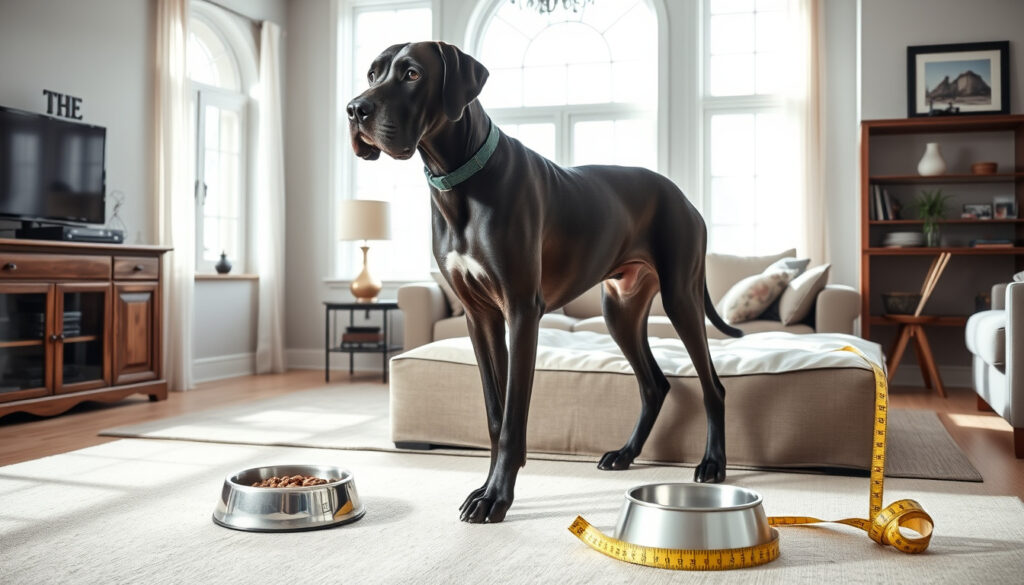
Great Danes: Size, Temperament, Health, and Ownership Costs
Few dogs make strangers cross the street for a pat quite like a Great Dane. They are enormous, elegant, and famously sweet-tempered — the breed standard calls them “spirited, courageous, friendly, and dependable” (Great Dane Club of America (parent club)) — and this guide is the practical version of that reputation: what it costs, what the health risks are, and whether the “gentle giant” label survives real-world family life.
Height: 71–81 cm (28–32 in) at the shoulder (Encyclopaedia Britannica (reference publisher)) ·
Weight: 110–175 lb typical adult range (Encyclopaedia Britannica (reference publisher)) ·
Temperament: Gentle, affectionate, and friendly — “the gentle giant” (Great Dane Club of America (parent club)) ·
Life Expectancy: Typically 7–10 years
Quick snapshot
- Great Danes are a giant working breed with roots in German boar hunting and estate guarding (Great Dane Club of America (parent club)).
- The breed standard requires adult males to be at least 30 inches and adult females at least 28 inches at the shoulder (Great Dane Club of America (parent club)).
- Individual training results and temperament are shaped by upbringing, and Encyclopaedia Britannica (reference publisher) notes the breed may not respond as quickly as smaller, more eager-to-please dogs. (American Kennel Club (US purebred registry))
- The 1876 “national breed” claim rests on an American Kennel Club (US purebred registry) historical account rather than a primary legal document.
- The American Kennel Club first made Great Danes registrable in 1887 (American Kennel Club (US purebred registry)).
- The Great Dane Club of America traces its parent club to 1891 (Great Dane Club of America (parent club)). (American Kennel Club (US purebred registry))
- Before bringing a puppy home, owners should learn the warning signs of gastric dilatation-volvulus, or bloat, because the condition can be fatal and needs urgent care (Encyclopaedia Britannica (reference publisher)).
- Budgeting for food, veterinary care, and giant-breed equipment matters as much as the purchase price.
Six facts, one pattern: Great Danes are built like working guardians, but their temperament is softer than their frame suggests.
| Label | Value |
|---|---|
| Breed Group | Working |
| Height | Males at least 30 in, females at least 28 in; typical range 28–32 in (Great Dane Club of America (parent club); Encyclopaedia Britannica (reference publisher)) |
| Weight | 110–175 lb typical adult range (Encyclopaedia Britannica (reference publisher)) |
| Life Span | Typically 7–10 years |
| Temperament | Spirited, courageous, friendly, dependable; not timid or aggressive (Great Dane Club of America (parent club)) |
| Shedding Level | Low to moderate |
Are Great Danes Friendly?
Temperament with family members
- The breed standard describes Great Danes as “spirited, courageous, friendly, and dependable” (Great Dane Club of America (parent club)).
- Encyclopaedia Britannica calls them “affectionate and friendly toward family and strangers” (Encyclopaedia Britannica (reference publisher)).
The “gentle giant” nickname is not just marketing; it is the temperament the official standard expects.
Socialization with strangers
- The standard says Great Danes should not be timid or aggressive, which makes early, neutral socialization the practical path to a stable adult (Great Dane Club of America (parent club)).
- Britannica describes friendliness toward strangers rather than suspicion (Encyclopaedia Britannica (reference publisher)).
That means a well-raised Dane is more likely to greet a visitor than to pin them to the wall.
Interaction with other dogs
- Britannica characterizes the breed as relatively low-energy but playful, which fits a dog that can share a yard with other large dogs when introductions are managed (Encyclopaedia Britannica (reference publisher)).
- Size and strength can make handling difficult for young children and older adults, so supervision matters around toddlers and frail family members (Encyclopaedia Britannica (reference publisher)).
The pattern: friendliness is a breed-standard requirement, and the owner’s job is to socialize that friendliness into safe behavior.
Are Great Danes Good Guard Dogs?
Protective instincts
- Great Danes were historically used for estate guarding as well as boar hunting, so the protective instinct is part of the breed’s working past (Great Dane Club of America (parent club)).
- The same standard says the breed should not be timid or aggressive — a guarding style based on calm confidence, not a short fuse (Great Dane Club of America (parent club)).
A 150-pound dog that stands its ground quietly is already a serious deterrent.
Barking and alertness
- Britannica says Great Danes are trainable but may not respond as quickly as smaller or more eager-to-please breeds (Encyclopaedia Britannica (reference publisher)).
- Their size and deep bark draw attention, but reliable alert behavior still needs consistent training.
The implication: don’t expect a silent watchdog that learns in one repetition.
Comparison with other guard breeds
A guard dog that is friendly to strangers can confuse owners who expect attack training. The Great Dane’s protection is deterrence: the dog looks like the last thing an intruder wants to meet, and its courage is the backup.
What this means: the Great Dane’s protection is best leveraged as a visual deterrent rather than a trained attack dog.
Why Are Great Danes So Big?
Historical breeding origins
- The breed descends from European hunting dogs used to pursue boar and guard estates in Germany (Great Dane Club of America (parent club)).
- Known in Germany as the Deutsche Dogge, the breed was declared Germany’s national breed in 1876 according to an American Kennel Club (US purebred registry) historical account.
Large size made sense for work: a dog that could hold a boar or patrol an estate had to be big, fast, and brave.
Genetics and growth rate
- Great Danes grow from a lap-sized puppy into a 30-inch dog in roughly two years, which puts stress on developing bones and joints.
- That is why puppy exercise should be moderate and low-impact; forced running and repeated jumping raise the risk of orthopedic problems.
The catch: the same rapid growth that makes the breed so striking is also the reason young Danes should not be treated like adult athletes.
Skeletal structure and size standards
- The official standard requires adult males to be at least 30 inches and adult females at least 28 inches at the shoulder (Great Dane Club of America (parent club)).
- The standard prefers males at 32 inches or taller and females at 30 inches or taller when proportionate (Great Dane Club of America (parent club)).
Why this matters: the breed’s identity is literally measured in inches, and that vertical presence is what makes a Dane feel like a Great Dane.
How Much Does a Great Dane Cost?
Cost of a Great Dane puppy
- There is no honest single price: puppy costs vary widely by breeder, pedigree, geographic region, and health testing.
- What is certain is that the purchase price is only the entry fee; food, vet care, crates, and supplies are all sized upward.
The realistic starting point is to compare several breeders and ask for hip, heart, and eye health clearances on the parents.
Where to find Great Danes for sale
- Breed-specific rescues and parent-club breeder referral lists are safer starting points than classified ads because they usually screen for health and temperament.
- Always visit the breeder, meet the mother, and ask what health tests were done on the litter.
This is where research replaces impulse.
Initial setup and healthcare costs
- Plan for a giant-breed crate, large-breed puppy food, higher-dose medications, and an emergency fund from day one.
- The biggest hidden cost is veterinary risk: bloat can turn into a life-threatening emergency with a large surgical bill (Encyclopaedia Britannica (reference publisher)).
A Great Dane is not an expensive dog to buy; it is an expensive dog to keep. Owners who budget for the 10-year lifetime of food, insurance, and preventive care will feel the difference far more than owners who focused only on the puppy price.
The pattern: the true cost of ownership extends far beyond the initial purchase.
What Are the Common Health Issues in Great Danes?
Common health issues to watch for
- The breed is predisposed to gastric dilatation-volvulus, commonly called bloat or GDV (American Kennel Club (US purebred registry)).
- GDV can be fatal and may require immediate veterinary intervention (Encyclopaedia Britannica (reference publisher)).
Bloat can kill within hours. The same deep chest that gives a Great Dane its noble silhouette is the anatomical feature that makes gastric dilatation-volvulus an emergency.
Exercise and activity needs
- Great Danes tend to have relatively low energy compared with other large working breeds, although they remain playful (Encyclopaedia Britannica (reference publisher)).
- Moderate daily walks and a safe space to stretch out usually meet their needs; avoid over-exercising puppies while their bones are still forming.
The takeaway: this is not a marathon dog; it is a sprinter that prefers the couch.
Grooming and maintenance routine
- The short coat is easy to groom, but regular nail trims and ear checks are still necessary to keep a giant dog comfortable.
- Shedding is low to moderate, which makes the breed a better fit for owners who dislike constant fur cleanup.
The trade-off: minimal grooming is a genuine plus, but it does not offset the health-observation work an owner must do daily.
Three guard-dog traits, one pattern: Great Danes are bred to intimidate by size and to stay friendly rather than aggressive.
| Trait | Great Dane | Guard-dog implication |
|---|---|---|
| Height | Males at least 30 in, females at least 28 in at the shoulder (Great Dane Club of America (parent club)) | Size alone is a visible deterrent. |
| Temperament | Friendly and dependable, not timid or aggressive (Great Dane Club of America (parent club)) | Calm deterrent rather than attack dog. |
| Training | Trainable, but may not respond as quickly as smaller breeds (Encyclopaedia Britannica (reference publisher)) | Protection work requires patient, consistent obedience. |
Seven standard details, one takeaway: this is a breed built on height minimums and a temperament that must stay gentle.
| Spec | Detail |
|---|---|
| Breed group | Working |
| Country of origin | Germany (American Kennel Club (US purebred registry)) |
| German name | Deutsche Dogge (American Kennel Club (US purebred registry)) |
| Male height | At least 30 in; 32 in or taller preferred (Great Dane Club of America (parent club)) |
| Female height | At least 28 in; 30 in or taller preferred (Great Dane Club of America (parent club)) |
| Typical adult weight | 110–175 lb (Encyclopaedia Britannica (reference publisher)) |
| Temperament | Spirited, courageous, friendly, dependable; not timid or aggressive (Great Dane Club of America (parent club)) |
| AKC recognition | Registrable since 1887 (American Kennel Club (US purebred registry)) |
| Parent club | Established by 1891 (Great Dane Club of America (parent club)) |
Upsides and Downsides of Owning a Great Dane
Upsides
- Friendly, gentle temperament with family and strangers (Encyclopaedia Britannica (reference publisher)).
- Relatively low energy for a giant breed, so daily exercise needs are moderate (Encyclopaedia Britannica (reference publisher)).
- Powerful deterrent presence without an aggressive default (Great Dane Club of America (parent club)).
Downsides
- Short lifespan compared with many smaller breeds.
- High risk of bloat (GDV), a life-threatening emergency (Encyclopaedia Britannica (reference publisher)).
- Size and strength can make handling difficult for young children and older adults (Encyclopaedia Britannica (reference publisher)).
- Training may test your patience because the breed can be slower to respond than more eager-to-please dogs (Encyclopaedia Britannica (reference publisher)).
The trade-off: you get a majestic, affectionate guardian, but you pay for it with a shorter lifespan, a bigger food bill, and a real veterinary emergency risk.
How to Set Up a Great Dane for Success
- Start socialization early. The breed standard calls for a dog that is not timid or aggressive (Great Dane Club of America (parent club)), so expose puppies to calm encounters with people, dogs, and handling as soon as it is safe.
- Manage growth, not just exercise. Puppies grow quickly; avoid forced running and high-impact jumping that can stress developing joints.
- Learn the bloat emergency protocol. Sudden abdominal swelling, restlessness, or retching can be signs of GDV, which is fatal without urgent care (Encyclopaedia Britannica (reference publisher)).
- Budget for the size. Large-breed food, giant crates, and higher medication doses all cost more than their small-breed equivalents.
- Train with patience. Great Danes are trainable but may not respond as quickly as smaller breeds, so keep sessions short, positive, and consistent (Encyclopaedia Britannica (reference publisher)).
The takeaway: consistent investment in socialization, health awareness, and training will produce a well-adjusted Great Dane.
Great Dane Timeline: From Boar Hunter to Companion
- Middle Ages: Ancestors of the Great Dane are used for hunting large game and guarding estates in Europe (Great Dane Club of America (parent club)).
- 1876: According to an American Kennel Club (US purebred registry) historical account, Germany declares the Great Dane its national breed.
- 1887: The American Kennel Club makes the Great Dane registrable (American Kennel Club (US purebred registry)).
- 1891: The Great Dane Club of America’s parent club is established (Great Dane Club of America (parent club)).
The pattern: a working hunter became a recognized companion breed in barely a century, but the size and courage bred into it remain the whole story.
What We Know vs. What We Don’t
Confirmed facts
- Great Danes are giant working dogs with roots in German boar hunting and estate guarding (Great Dane Club of America (parent club)).
- Adult males must be at least 30 inches and females at least 28 inches at the shoulder (Great Dane Club of America (parent club)).
- The standard expects a spirited, courageous, friendly, and dependable dog that is not timid or aggressive (Great Dane Club of America (parent club)).
- The breed has been AKC-registrable since 1887 (American Kennel Club (US purebred registry)).
What’s unclear
- Exact purchase prices vary widely by breeder, pedigree, region, and health testing; this guide’s research did not find one reliable national average.
- Individual training outcomes depend heavily on upbringing; some Danes respond more slowly than smaller breeds (Encyclopaedia Britannica (reference publisher)).
- The 1876 “national breed” declaration is repeated by the American Kennel Club but is not easy to verify from primary legal sources (American Kennel Club (US purebred registry)).
- Lifespan estimates of 7–10 years are commonly cited, but individual outcomes depend heavily on genetics, diet, and veterinary care.
The Breed in Their Own Words
“Spirited, courageous, friendly, and dependable.”
— Great Dane Club of America, breed standard
“They should not be timid or aggressive.”
— Great Dane Club of America, breed standard
“Affectionate and friendly toward family and strangers.”
— Encyclopaedia Britannica
For a family or first-time owner, the Great Dane is a beautiful contradiction: a giant guardian that wants to be a lapdog, with a short lifespan and a real emergency-health risk. The decision is not just “do I like the breed?” — it is “can I provide the space, the training time, the vet fund, and the calm consistency a 30-inch dog needs?” For owners who can, few breeds are more rewarding. For owners who can’t, the more honest choice is a smaller, lower-costing guardian.
Frequently Asked Questions
How much exercise does a Great Dane need?
Most adult Great Danes do well with moderate daily walks plus room to stretch out. Britannica describes the breed as relatively low-energy but playful, so the goal is consistent moderate activity rather than marathon exercise (Encyclopaedia Britannica (reference publisher)). Puppies should avoid forced running and high-impact play while their joints are still developing.
Are Great Danes good for first-time dog owners?
They can be, but the size and strength make them less forgiving than smaller breeds. Britannica notes a Great Dane’s size can make handling difficult for young children and older adults, and training may take more patience (Encyclopaedia Britannica (reference publisher)). First-time owners need a solid plan for socialization, training, and giant-breed management.
How big do Great Danes get?
The breed standard requires males to be at least 30 inches and females at least 28 inches at the shoulder (Great Dane Club of America (parent club)). Britannica gives a typical height range of 28 to 32 inches and an adult weight range of 110 to 175 pounds (Encyclopaedia Britannica (reference publisher)).
What is the history of the Great Dane breed?
Great Danes come from European large-game hunting and estate-guarding stock (Great Dane Club of America (parent club)). The American Kennel Club says the breed is known in Germany as the Deutsche Dogge and was declared Germany’s national breed in 1876 (American Kennel Club (US purebred registry)). The AKC made the breed registrable in 1887 (American Kennel Club (US purebred registry)).
How do I find a reputable Great Dane breeder?
Start with a parent-club breeder referral list or a breed-specific rescue. Ask for health clearances, meet the mother, and visit the premises before committing. A responsible breeder will talk openly about bloat, heart conditions, and the breed’s short lifespan.
How long do Great Danes live?
The often-cited range is 7–10 years, though individual dogs can vary. Because the breed is prone to serious health issues such as bloat, regular veterinary care and knowing the emergency warning signs matter even more than in most breeds.
More related posts
 Dakota Johnson: Split, ADHD, and Career Facts
 Phoebe Litchfield: Age, Debut, Salary & Favourite Cricketer
 Who Is Hailey Rose? Age, Nationality, Instagram & Namesakes
 The Gateway Pundit: Verified Facts, Academic Research & Sources
 Greek Gods: From Olympians to Zeus – Pantheon Guide
 Emily Bett Rickards: After Arrow, Age, Marriage & Felicity Smoak
 David Tennant: Real Name, Children, Wife, Age Gap, and Health
 Harry Lloyd: Viserys in Game of Thrones and Viktor in Arcane
