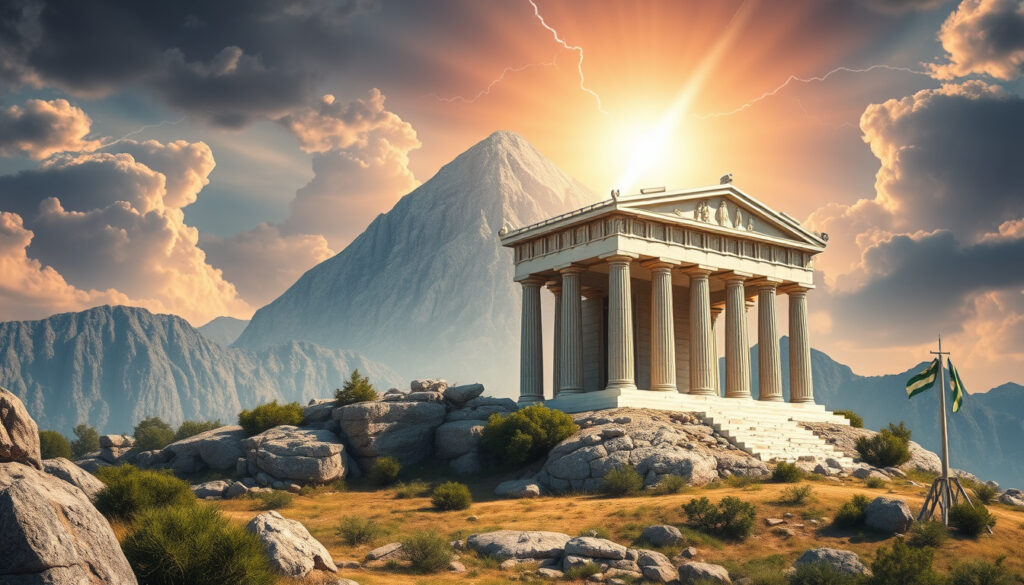
Greek Gods: From Olympians to Zeus – Pantheon Guide
When you hear “Greek god,” chances are Zeus, Athena, or maybe Hercules come to mind. That’s no accident — these figures from ancient Greece have shaped Western storytelling for thousands of years.
Olympian gods: 12 · Chief god: Zeus · Total deities in pantheon: over 50 · Most worshipped in ancient Greece: Zeus, Athena, Apollo
Quick snapshot
- Zeus is the king of the Greek gods (The Metropolitan Museum of Art – museum and scholarly resource)
- The 12 Olympians are the principal deities (British Museum – world‑renowned museum)
- Athena was born from Zeus’s head (The Metropolitan Museum of Art)
- Greek gods were worshipped from at least the Mycenaean period (Cleveland State University Pressbooks – academic source)
- Whether Hestia or Dionysus was the twelfth Olympian varied by city-state (British Museum)
- Exact composition of the 12 Olympians shifted (same source) (British Museum)
- Precise number of minor gods is unknown (Aongking – reference site)
- Regional popularity of specific gods is debated (Wikipedia – community encyclopedia)
- The Olympians defeated the Titans in the Titanomachy, after which they took control of the cosmos (Greek TravelTellers – travel and mythology guide)
- Greek gods continue to inspire modern media, literature, and scholarship, with new interpretations of their myths still emerging (The Metropolitan Museum of Art). For a comparison of how another ancient civilization structured its beliefs, see Ancient Egypt History: Facts, Symbols, and Language.
Five key facts, one pattern: the Greek pantheon is tiered — Olympians at the top, then Titans, then a vast array of lesser beings — yet the boundaries have always been fluid.
| Attribute | Value | Source |
|---|---|---|
| Chief god | Zeus | Met Museum – museum and scholarly resource |
| Number of Olympians | 12 | Met Museum |
| Home of the gods | Mount Olympus | British Museum – world‑renowned museum |
| Most ancient source | Hesiod’s Theogony (c. 700 BCE) | Greek TravelTellers – travel and mythology guide |
| Primary function | Control natural forces and human destiny | Cleveland State Pressbooks – academic source |
Who are the 12 main Greek gods?
The most familiar classification of Greek gods centers on the twelve Olympians who lived on Mount Olympus. According to the Metropolitan Museum of Art, the typical list includes Zeus, Hera, Poseidon, Demeter, Athena, Apollo, Artemis, Ares, Aphrodite, Hermes, Hephaestus, and Hestia — though some ancient sources replace Hestia with Dionysus.
The 12 Olympians
- Zeus – king of the gods, sky, and thunder
- Hera – queen of the gods, marriage
- Poseidon – sea, earthquakes
- Demeter – harvest, agriculture
- Athena – wisdom, war strategy
- Apollo – prophecy, music, arts
- Artemis – hunt, wilderness
- Ares – war
- Aphrodite – love, beauty
- Hermes – messenger, travel
- Hephaestus – metalworking, fire
- Hestia or Dionysus – hearth / wine and theater
Each of these deities had a distinct domain and cult following. As the British Museum notes, the twelve were not a rigid canon — different city-states featured different gods.
Additional Gods: The 15 and 50
If you count Hades, Hestia, and sometimes Demeter’s daughter Persephone, the number rises to 15. Beyond that, the Greek pantheon includes Titans (like Cronus and Rhea), primordial beings (Chaos, Gaia, Tartarus), and hundreds of lesser gods, nymphs, and personifications. Wikipedia lists over 50 named deities just in the main pantheon.
The Role of the Olympians
The Olympians governed natural forces and human life — a system that Cleveland State University Pressbooks describes as “polytheism where each god had a sphere of influence.” They were children of the Titans Cronus and Rhea, and they came to power after the Titanomachy.
The implication: the “12 Olympians” label is a useful shorthand, but the actual belief system was far more diverse — and more democratic in its local variations.
Who is called a Greek god?
A Greek god is a divine being worshipped in ancient Greece, distinguished from mortals by immortality, superhuman power, and a specific domain. The line between god, hero, and monster was surprisingly thin.
Definition of a Greek god
- Immortal by nature (though gods could be wounded or imprisoned)
- Possessed a defined timē (honor/domain) — e.g., Zeus ruled the sky, Athena wisdom
- Received cult worship — temples, sacrifices, festivals
- Could intervene in human affairs directly
As the Metropolitan Museum of Art explains, gods were not all-powerful in the modern sense — they had personalities, rivalries, and even children with mortals.
Who qualifies as a god in Greek mythology?
Demigods (like Heracles) were half‑human, half‑divine — powerful but not immortal. Heroes (like Odysseus) were mortal. Only beings who were born divine or achieved apotheosis (becoming a god) after death qualified as full gods. Greek TravelTellers notes that figures like Asclepius (a healer) were worshipped as gods in some places, blurring the line further.
The pattern: the Greeks used “god” broadly, but always tethered to cult practice — a god without worshippers was a god in name only.
Who is the #1 Greek god?
Without question, Zeus was the supreme deity — king of Olympus, father of gods and men, wielder of the thunderbolt. No other god challenged his authority in mainstream myth.
Zeus: King of the Gods
- Ruler of Mount Olympus and the sky
- Brother of Poseidon, Hades, Hera, Demeter, Hestia
- Father of Athena, Apollo, Artemis, Hermes, Persephone, and many others
- led the Olympians to victory over the Titans
Why Zeus is considered the most powerful
The Metropolitan Museum of Art states that Zeus is “the foremost deity and father of the gods.” His power lay not just in raw strength but in authority — he could override other gods, enforce oaths, and dispense justice. While Poseidon ruled the sea and Hades the underworld, Zeus held the sky and the ultimate veto.
The catch: Zeus’s supremacy didn’t mean he was universally loved. He was regularly tricked (by Prometheus, by his own wife Hera), and many myths show his authority being tested. Still, no god ever deposed him.
Who is Zeus’s favorite child?
Of all his many offspring, the goddess Athena held a special place — she was born directly from his head and became his most trusted advisor.
Athena: The Favorite Daughter
- Born fully armed from Zeus’s forehead after he swallowed her mother Metis
- Goddess of wisdom, strategic warfare, crafts, and civilization
- Zeus gave her his aegis (shield) and allowed her to use his thunderbolt
- In the Iliad, Zeus sends Athena to support mortals he favors
Other favored children of Zeus
Apollo and Artemis were also highly favored. Apollo received the gift of prophecy and became Zeus’s mouthpiece at Delphi. Hermes, the clever messenger, was given a golden staff and made herald of the gods. According to Greek TravelTellers, Zeus’s favor often depended on the child’s usefulness — Athena’s wisdom was simply indispensable.
Why this matters: the favorite child idea isn’t just gossip — it shows how Greek myth used family dynamics to explain why certain gods held higher status.
Who was pregnant with Athena?
The story of Athena’s birth is one of the most unusual in all Greek mythology — she was never actually born from a mother’s womb.
Myth of Athena’s Birth
- Metis, the Titaness of wisdom, was pregnant with Athena
- Zeus swallowed Metis on the advice of Gaia, fearing that her child would overthrow him
- Later, Athena emerged fully grown and armed from Zeus’s head
- Hephaestus (or Prometheus) split Zeus’s skull with an axe to deliver her
The Role of Metis and Zeus
The Metropolitan Museum of Art retells the episode as a clever merging of wisdom and power — by incorporating Metis into himself, Zeus literally became wiser. The birth symbolizes the transfer of wisdom from the old Titan order to the new Olympian order.
The trade-off: Metis never had a body or a cult of her own. She exists only as a swallowed voice — a reminder that even the most powerful god relied on a woman’s intelligence.
Confirmed facts vs. what’s unclear
Confirmed facts
- Zeus is the king of the Greek gods — attested in every ancient source
- The 12 Olympians are the principal deities
- Athena was born from Zeus’s head
- Greek gods were actively worshipped from the Mycenaean period onward
- The Titanomachy established Olympian rule
What’s unclear
- Whether Hestia or Dionysus officially held the twelfth seat
- The exact number of minor gods — different city‑states had different lists
- Which god was most popular in a given region
- How many gods were actually worshipped vs. merely mentioned in poetry
- The precise relationship between Greek gods and their Roman counterparts in worship practices
The pattern: the confirmed facts provide a sturdy backbone, but the uncertainties reveal a religion that was locally adaptive rather than doctrinaire.
Voices from antiquity
“Zeus, who drives the clouds, … the father of gods and men.”
— Hesiod, Theogony (c. 700 BCE), describing Zeus’s supremacy (Theoi – online reference)
“So spoke the goddess, grey‑eyed Athena, and the son of Cronus nodded assent.”
— Homer, Iliad, depicting Zeus’s deference to his daughter’s advice (Perseus Digital Library – academic archive)
“The gods of Olympus, they say, were twelve.”
— Apollodorus, Library (1st–2nd century CE), standard list (Theoi – online reference)
The ancient Greeks themselves didn’t agree on a single roster. For a modern reader, the real value isn’t memorizing a list — it’s seeing how each city‑state used myth to define its identity.
The evidence for Greek gods comes from texts like Hesiod’s Theogony, Homer’s epics, and archaeological remains of temples and votive offerings. For a look at how myth-making evolved in another era, see Leonardo da Vinci: The Genius, the Myths, the Reality.
For any student of mythology, the choice is clear: either treat the Olympians as a fixed group of twelve (the usual textbook approach) or embrace the messiness of regional variation. The latter may be harder to teach, but it’s closer to what ancient Greeks actually believed.
riordan.fandom.com, youtube.com, youtube.com, theoi.com, greekmythologytours.com, lpsonline.sas.upenn.edu
Frequently asked questions
Is Zeus the same as Jupiter?
Yes — the Romans identified Zeus with Jupiter, adapting most Greek myths. The attributes (thunderbolt, kingship) are identical (British Museum).
What is the difference between a Greek god and a demigod?
A god is immortal and worshipped; a demigod is the mortal (or partly mortal) offspring of a god and a human, like Heracles or Perseus. Demigods could become gods after death (Cleveland State Pressbooks).
Which Greek god is the god of war?
Ares is the god of war, though Athena also presided over the strategic and disciplined side of warfare. (Metropolitan Museum of Art)
What happened to the Greek gods after ancient times?
Worship gradually declined after the rise of Christianity in the 4th–6th centuries CE. However, the gods survived in literature and art, and remain central to Western cultural heritage. (British Museum)
Are there any surviving temples to Greek gods?
Yes — the Parthenon (Athena), the Temple of Olympian Zeus in Athens, the Temple of Apollo at Delphi, and many others. They are preserved as archaeological sites. (Metropolitan Museum of Art)
Who is the Greek god of the underworld?
Hades, brother of Zeus and Poseidon, rules the underworld. He is not one of the Olympians because he does not live on Mount Olympus. (Metropolitan Museum of Art)
What is the role of the Muses in Greek mythology?
The nine Muses were goddesses of the arts and sciences — daughters of Zeus and Mnemosyne. They inspired poets, musicians, and historians. (Greek TravelTellers)
Could mortals become Greek gods?
Rarely — Heracles was deified after his death, and Asclepius was later worshipped as a god of healing. But typical mortals remained mortals. (Cleveland State Pressbooks)
The final word: Greek gods were not a static pantheon but a living, locally adapted framework that gave ancient Greeks a way to explain the world — and still offers modern audiences a rich source of story and meaning.
More related posts
 Dom Dolla: Biography, Career, Age, Height & Net Worth
 Helen George 2026: Relationship, New Role & ADHD Diagnosis
 Phoebe Dynevor: No Daphne Recast; New Netflix Movies, Age
 Tom Holland Height: 5’8″ or 5’7″? Facts vs Myths
 AI Chat: Free Platforms, Privacy, and How They Work
 As Above So Below – Meaning Origin and Hermetic Principle
 Nick Vujicic: Biography, Family, and Career Overview
 Api Koroisau Suspension: Ban Length, Premierships & Career Stats
