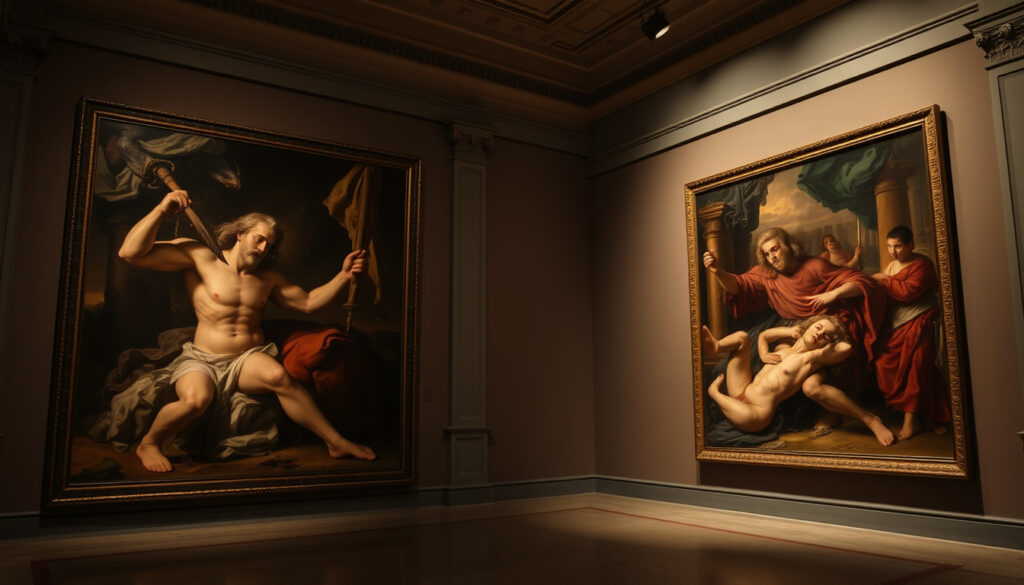
Saturn Devouring His Son: Myth, Rubens & Goya
Few images from the Western canon land with the same gut-punch as a god devouring his own child. Two of the most famous versions—by Peter Paul Rubens (c. 1636–1638) and Francisco Goya (c. 1820–1823)—sit in the Museo del Prado in Madrid, each offering a radically different take on the same ancient story.
Primary subject: Saturn (Roman god) devouring his son ·
Known versions: 2 major paintings (Rubens, Goya) ·
Museum location (Goya): Museo del Prado, Madrid ·
Mythological source: Greek myth of Cronus ·
Year of Goya’s painting: circa 1819–1823
Quick snapshot
- Rubens painted Saturn Devouring a Son in oil on canvas, dated 1636–1638 (Prado museum collection notes)
- Goya painted Saturn in mixed method on mural transferred to canvas, dated 1820–1823 (Prado museum collection notes)
- Goya’s painting has been on display at the Prado since 1889 (Prado museum)
- Exact year of Rubens’ painting is given as 1636–1638, but some art historians debate finer dating (Prado museum)
- Whether Rubens relied on a specific literary source for his iconography is undocumented (Prado museum)
- The precise number of children Saturn (Cronus) consumed varies across early mythological records (Prado museum)
- 8th–6th century BCE: Greek myth recorded in Hesiod’s Theogony (Prado museum)
- c. 1636: Rubens paints his version for Philip IV of Spain (Prado museum)
- 1820–1823: Goya paints his version as part of the Black Paintings (Prado museum)
- 1873: Goya’s Black Paintings transferred to canvas and later donated to the Prado (Prado museum)
- Both paintings remain on permanent display at the Museo del Prado, drawing ongoing scholarly analysis
- Future exhibitions may pair the works side-by-side for direct comparison
The Museo del Prado holds two Saturn paintings, one by Rubens and one by Goya. A closer look at their specs reveals the differences in medium, scale, and artistic approach.
| Attribute | Rubens’ Saturn Devouring a Son | Goya’s Saturn |
|---|---|---|
| Artist | Peter Paul Rubens | Francisco de Goya |
| Date | 1636–1638 (Prado museum) | 1820–1823 (Prado museum) |
| Medium | Oil on canvas | Mixed method on mural transferred to canvas |
| Dimensions | Not specified in museum record | 143.5 × 81.5 cm (Fundación Goya en Aragón) |
| Location | Museo del Prado, Madrid | Museo del Prado, Madrid |
| Style | Baroque | Romanticism / Black Paintings |
| Subject detail | Saturn biting his son’s arm | Saturn tearing into his child’s body |
Saturn Eating: Myth, Art, and the Two Masterpieces
What is the story behind Saturn eating his son?
The origin of Saturn (Cronus) in Greek and Roman mythology
- According to the Prado museum, the god Saturn (identified with the Greek Cronus) devoured his children to prevent a prophecy that he would be overthrown by one of them.
- The myth is recorded in Hesiod’s Theogony (8th–6th century BCE) and was later adopted by Roman culture.
The Saturn myth isn’t just a grisly story—it’s an origin myth for a dynasty of gods. Saturn’s fear of rebellion leads him to consume his own offspring, a cycle that mirrors the violent succession of divine power in Greek and Roman belief.
The myth explains the succession of gods
The prophecy said Cronus (Saturn) would be overthrown by his son, just as he had overthrown his own father Uranus. By eating his children, he tried to cheat fate—until his wife Rhea hid Zeus (Jupiter), who eventually forced Cronus to disgorge his siblings and claim the throne. This narrative structure appears in many Indo-European mythologies, but the Greek version remains the most influential.
The implication: the act of “eating” is not just cannibalism—it’s a symbol of power and fear, a temporary deferral of an inevitable fall.
Is Saturn eating his son a Greek myth?
Greek myth of Cronus
- The story is originally Greek: Cronus (Κρόνος) was a Titan who swallowed his children to prevent a prophecy of overthrow. This is documented in Hesiod’s Theogony, as referenced by the Prado’s collection notes.
Roman adoption of the myth
- The Romans identified the Greek Cronus with their agricultural god Saturn. The myth of Saturn devouring his children was imported alongside other Hellenistic stories during the 3rd–2nd centuries BCE. By the late Republic, the tale was well-known in Latin literature.
The catch: While the Romans borrowed the narrative, they often softened Saturn’s image into a more benevolent figure of the Golden Age. The consuming violence remained in mythology but was less emphasized in Roman civic religion.
What did Saturn eat?
The children of Saturn
- Saturn (Cronus) ate his own children—specifically, the Olympian gods in their infant form: Hestia, Demeter, Hera, Hades, and Poseidon (Prado museum).
Symbolic and literal interpretations
- Art historians note that Rubens’ depiction shows Saturn biting his son’s arm rather than swallowing whole—a detail that Goya adopted and made more visceral (Artnet art news article).
- The act is often interpreted as a metaphor for time (Chronos/Chronos confusion) devouring all things, but the original myth is about political succession, not abstract time.
What this means: The “eating” is both literal and symbolic. It serves as a warning about the lengths a ruler will go to preserve power, a theme that resonated with both Rubens’ patron Philip IV and Goya’s disillusioned view of authority.
Where is the painting of Saturn eating his son?
Location of Goya’s version at the Prado
- Goya’s Saturn is housed in the Museo del Prado in Madrid, where it has been on permanent display since 1889.
- The painting belongs to Goya’s series of “Black Paintings” from his later years, originally painted on the walls of his house, Quinta del Sordo.
Location of Rubens’ version
- Rubens’ Saturn Devouring a Son is also in the Prado. It was originally part of a cycle for the Torre de la Parada, a hunting lodge of Philip IV (Artnet).
The trade-off: Both paintings are in the same museum, but they are rarely displayed in the same room. Visitors can see both masterpieces, but the full contrast requires moving between galleries.
Why did Peter Paul Rubens make Saturn?
Rubens’ interest in mythological themes
- Rubens frequently painted mythological scenes for royal patrons. His Saturn was commissioned for the Torre de la Parada, a hunting lodge of Philip IV of Spain, around 1636 (Artnet).
- The series featured Ovidian myths, and Saturn’s story likely served as an allegory for the dangers of unchecked power.
Political and allegorical context
- Baroque art often used mythological subjects to comment on contemporary politics. Saturn’s fear of usurpation may have reflected Philip IV’s own anxieties about succession and rebellion.
- Rubens’ style—dynamic, muscular, and richly colored—makes the scene dramatic but still decorous for a royal setting.
Rubens’ Baroque Saturn looks almost theatrical—a staged horror. Goya’s version, by contrast, feels like a raw confession. The same myth, two centuries apart, becomes a mirror for the artist’s own time and psyche.
Is the painting ‘Saturn Devouring His Son’ by Rubens?
Attribution to Rubens
- Yes, Peter Paul Rubens painted a version titled Saturn Devouring a Son, dated 1636–1638, held at the Museo del Prado (Prado museum).
- The painting was part of a series for the Torre de la Parada, Philip IV’s hunting lodge.
Confusion with Goya’s version
- Because Goya painted the same subject about two centuries later, some viewers confuse the two. Both are in the Prado, but their styles are markedly different.
The implication: Both paintings share a subject but diverge in era, intent, and emotional register.
Timeline
The story of Saturn eating his son spans millennia, from ancient oral tradition to two of the most disturbing paintings in Western art. Here’s the chronology.
- : Greek myth of Cronus recorded in Hesiod’s Theogony
- : Romans adopt Cronus as Saturn, integrating the myth into Latin literature
- : Rubens paints his version for Philip IV’s hunting lodge (Artnet)
- : Goya paints his version as part of the Black Paintings (Prado museum)
- : Goya’s Black Paintings transferred to canvas and later donated to the Prado
The pattern: The myth predates both paintings by over two thousand years. Rubens and Goya each chose to depict the same moment—the devouring—but their treatments reflect the Baroque fascination with allegory and the Romantic obsession with the interior self.
Clarity: confirmed facts vs. what remains unclear
Confirmed facts
- Rubens and Goya both painted versions of Saturn devouring his son (Prado museum; Prado museum)
- The myth originates from Greek tradition (Cronus) and was adopted by Romans as Saturn
- Goya’s painting measures 143.5 × 81.5 cm and was done in mixed method (Fundación Goya en Aragón)
- Rubens’ version is oil on canvas, dated 1636–1638
- Goya’s painting has been on view at the Prado since 1889
What’s unclear
- The exact year of Rubens’ painting within the 1636–1638 window
- Whether Rubens used a single literary source or compiled multiple Ovidian references
- The precise number of children Saturn ate in the earliest oral versions of the myth
- Whether the 1873 transfer of Goya’s Black Paintings altered the original mural surface
Quotes from experts and critics
“The image is of a god devouring his child—a subject that Rubens and Goya both treated, but with very different emotional effects.”
Museo del Prado easy-read guide
“Goya adopts the biting detail from Rubens but transforms the scene into something much more gut-wrenching.”
Artnet art news article
For art lovers visiting Madrid, the choice is clear: stand before both paintings in the Prado’s collection and witness two centuries of artistic obsession with the same terrifying myth. Rubens’ baroque version is a courtly allegory; Goya’s Black Painting registers as a mind unraveling. The contrast is the lesson.
Related reading: Saturn devouring his son in the Prado: Rubens vs. Goya
museodelprado.es, en.wikipedia.org, thehistoryofart.org, en.wikipedia.org, museodelprado.es, en.wikipedia.org, en.wikipedia.org, worldmuseumguide.org
Frequently asked questions
What does Saturn devouring his son symbolize?
The act symbolizes the fear of being overthrown, a cycle of power and consumption that is central to Greek and Roman succession myths. It also has later interpretations as an allegory for time (Chronos) devouring all things.
How big is Goya’s Saturn painting?
According to the Fundación Goya en Aragón, it measures 143.5 × 81.5 cm.
Is Saturn Devouring His Son by Goya the same as Rubens’ version?
No. Both depict the same mythological subject, but they are different paintings from different periods (Rubens: c. 1636; Goya: 1820–1823) with distinct styles and emotional tones.
Who commissioned Rubens’ Saturn painting?
It was commissioned for the Torre de la Parada, a hunting lodge of Philip IV of Spain, around 1636 (Artnet).
Can I see Saturn Devouring His Son in the Prado?
Yes, both the Rubens and Goya versions are in the collection of the Museo del Prado in Madrid. Goya’s has been on display since 1889 (Prado museum).
Why is Saturn eating his son considered a masterpiece?
Both paintings are considered masterpieces for their powerful depiction of a dark myth. Goya’s version, in particular, is celebrated for its raw psychological intensity and is a key work of the Romantic and Black Painting movements.
What art movement does Goya’s painting belong to?
Goya’s painting is part of his Black Paintings series, often associated with Romanticism and the artist’s later, more personal and dark style.
More related posts
 Michelle Bridges: Age, Career, Partner, Net Worth & 12WBT
 Craigie Leisure Centre – Facilities, Classes and Contact Guide
 Sarah Jones: Actress Career Facts and Common Misconceptions
 Albert Finney: Biography, Career, and Knighthood Refusal
 iPhone SE 3rd Generation – Specs, Performance and 2025 Value
 Lori Loughlin’s College Scandal: Sentence, Apology, and Return
 Shoes Insoles: Benefits, Risks, and What Podiatrists Recommend
 We Liars Twist Explained: The Shocking Ending of We Were Liars
