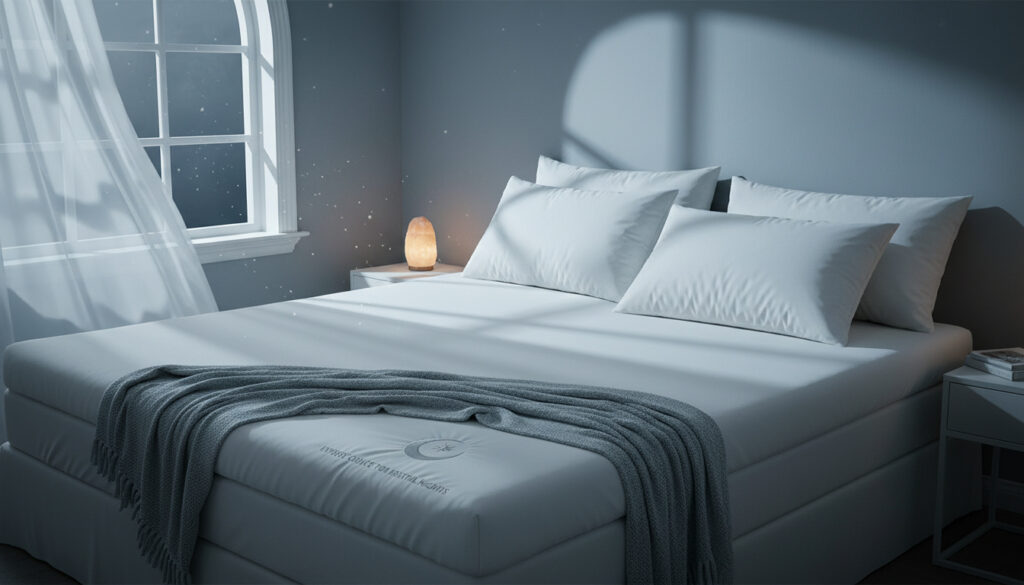
Mattress Topper Queen – Expert Picks for Better Sleep
Queen mattress toppers measure 60 by 80 inches to match standard bed dimensions. These layers rest atop existing mattresses to modify firmness, improve cooling, or relieve pressure points without replacing the entire sleep surface.
Prices for quality queen toppers range from $235 to $532 depending on materials and certifications. High-density memory foam and organic latex command premium prices but offer longer lifespans and better support according to independent testing.
Selection depends on sleep position, temperature preferences, and whether the underlying mattress suffers from sagging or simply feels too firm. Consumer Reports ranks models by support and ease of use following 12+ laboratory tests.
What Is the Best Mattress Topper for a Queen Bed?
Independent tests identify distinct leaders across specific categories. The Silk & Snow Organic Mattress Topper ranks as the best overall choice, utilizing Dunlop latex with a ventilated core and breathable cotton cover priced at $270. Sleep Foundation testing indicates this model avoids deep sinkage while maintaining spinal alignment.
Silk & Snow Organic
Dunlop latex
$270 | Medium/Firm
Helix GlacioTex Premium
Microcoil hybrid
Plush profile
ViscoSoft Select High Density
Memory foam
$235 | 2-4″
Tempur-Pedic TEMPUR-Adapt
Contour foam
Medium (5)
For cooling performance, the Helix GlacioTex Premium uses a GlacioTex cover combined with adaptive foam and microcoils to dissipate heat. Sleepopolis evaluations highlight this construction for hot sleepers seeking pressure relief.
The ViscoSoft Select High Density delivers contouring support at $235, utilizing 2-4 inch high-density foam profiles that isolate motion for couples. National Council on Aging reviews note its stability straps suit adjustable bases.
- Latex resists impressions longer than standard polyurethane foam
- High-density memory foam exceeds 4 pounds per cubic foot for durability
- Cooling technologies vary: graphite infusion versus ventilated cores versus phase-change fabrics
- Queen dimensions remain standardized at 60 by 80 inches across manufacturers
- GOLS certification indicates organic latex standards
- Side sleepers require 3-4 inch profiles for shoulder and hip cushioning
- Corner straps prevent shifting on articulated bed frames
| Fact | Details |
|---|---|
| Standard Queen Size | 60 x 80 inches |
| Common Thickness Range | 2-4 inches |
| Average Lifespan | 3-5 years |
| Price Range | $235–$532 |
| Overall Top Pick | Silk & Snow Organic (Dunlop Latex) |
| Cooling Leader | Helix GlacioTex Premium |
| Value Selection | ViscoSoft Select High Density ($235) |
| Back Pain Specialist | Tempur-Pedic TEMPUR-Adapt |
| High-Density Foam Spec | >4 lbs per cubic foot |
| Cooling Technologies | Graphite, gel, ventilation |
How Do I Choose the Right Mattress Topper for a Queen Size Bed?
Selection requires matching material properties to specific sleep complaints. Latex offers responsive support without the sinking sensation of memory foam, while gel-infused and graphite-infused foams address heat retention.
How Thick Should a Mattress Topper Be?
Thickness determines support level and pressure relief capability. Two to three inches suffice for minor firmness adjustments or stomach sleepers needing minimal cushioning. Three to four inches provide substantial pressure relief for side sleepers and those attempting to soften sagging mattress sections.
Thicker profiles alter the bed’s feel more dramatically, sometimes approaching the sensation of a new mattress. Sleep Foundation guidance indicates that 4-inch options like the ViscoSoft model excel for shoulder and hip pressure relief.
Stomach sleepers and those seeking slight firming should select 2-inch profiles. Side sleepers and individuals with shoulder pain require 3-4 inches to maintain spinal alignment while cushioning pressure points.
Which Side of a Mattress Topper Goes Up?
Most queen toppers function symmetrically without designated top or bottom surfaces. The ViscoSoft Select features a removable washable cover without orientation requirements. Latex models benefit from ventilation regardless of placement.
Do You Sleep Directly on a Mattress Topper?
Users place bedding directly atop the topper, which itself rests on the mattress. The topper becomes the immediate sleep surface beneath sheets, fundamentally altering the bed’s comfort layer without replacing the foundation.
Can You Use a Mattress Topper on an Adjustable Bed?
Compatibility depends on construction density and securing mechanisms. High-density foams and microcoil hybrids maintain structural integrity during articulation. Models equipped with corner straps, such as the ViscoSoft Select, prevent shifting when the base elevates head or foot sections. Sleep Doctor evaluations confirm that dense materials perform reliably on adjustable frames.
Measuring carefully ensures proper fit, much like selecting appropriate gear dimensions as detailed in the Trek Marlin 5 – Specs, Price, Sizes & Beginner Guide.
Do Mattress Toppers Really Make a Difference?
Toppers provide measurable pressure relief and motion isolation but cannot salvage severely compromised mattresses. They excel at temperature regulation when utilizing graphite, gel, or ventilated latex constructions.
Which Mattress Topper Is Best for Back Pain on a Queen Bed?
The Tempur-Pedic TEMPUR-Adapt provides medium contouring suitable for side and back sleepers up to 230 pounds, adding plushness to overly firm mattresses. The Saatva Graphite Memory Foam Topper cradles the lower back effectively using slow-response graphite-infused foam that contours around hips and shoulders. Sleepopolis testing confirms these models outperform thin pads for lumbar support.
Toppers address minor sagging and firmness complaints but cannot repair deep indentations exceeding 1.5 inches or broken internal mattress components.
Most manufacturers offer 30-90 night trial periods. Consumers should verify return policies before purchase, as comfort preferences vary significantly by body weight and sleep position.
How Long Does a Mattress Topper Last?
Lifespan varies by material density and usage patterns. High-density memory foam and natural latex resist compression longer than low-density alternatives.
-
:
Initial 30-90 night trial period allows comfort assessment. Sleep Foundation notes that proper break-in requires 2-3 weeks.
-
:
Inspect for impressions exceeding 0.5 inches. Rotate if dual-firmness design allows.
-
:
High-density foam and latex models typically maintain support; standard foam may show degradation.
-
:
Industry standard suggests replacement when compression affects spinal alignment or comfort.
High-density memory foam exceeding 4 pounds per cubic foot and Dunlop latex demonstrate above-average durability. Sleep Doctor longevity tests indicate these materials resist permanent impressions.
What Do We Know for Certain About Queen Toppers?
Scientific testing and consumer reports establish clear boundaries between verified capabilities and marketing claims.
| Established Evidence | Remaining Uncertainties |
|---|---|
| Pressure relief for side sleepers using 3-4 inch foam profiles | Exact lifespan for individuals over 230 pounds |
| Motion isolation superior to thin mattress pads | Universal firmness preferences across body types |
| Graphite and gel infusion reduces heat retention versus standard foam | Effectiveness on mattresses with severe structural sagging |
| Queen dimensions standardized at 60×80 inches | Long-term performance in humid environments |
| Latex provides responsive support without deep sinkage | Individual chemical sensitivity to specific foams |
The Evolution of Queen-Size Sleep Accessories
The queen mattress topper market reflects broader trends in personalized sleep technology. Manufacturers have shifted from one-size-fits-all foam slabs to zoned constructions targeting specific pressure points. The integration of phase-change materials and ventilated latex responds to consumer demand for temperature neutrality.
Material science developments parallel precision manufacturing in other consumer categories, demanding accurate measurement and specification similar to mechanical devices such as the Etch A Sketch – How the Classic Toy Works and Its History.
Current emphasis on certifications like GOLS for organic latex and density ratings for memory foam indicates maturing consumer literacy regarding durability and chemical composition.
Expert Sources and Testing Methodology
Evaluations derive from standardized pressure mapping, thermal imaging, and longevity compression tests conducted by independent laboratories.
Consumer Reports ranks mattress toppers by support and ease of use following 12+ laboratory tests, favoring balanced models that maintain structural integrity across repeated use cycles.
— Consumer Reports Product Testing, 2025
High-density memory foam above 4 pounds per cubic foot demonstrates superior durability and motion isolation compared to standard polyurethane alternatives.
— National Council on Aging Product Resources
Final Selection Guidance
Queen mattress toppers offer cost-effective solutions for adjusting sleep surface comfort without replacing entire mattresses. Latex models suit those seeking responsive support and cooling, while high-density memory foam excels at pressure relief and motion isolation. Verify thickness requirements based on sleep position, confirm adjustable base compatibility if applicable, and prioritize trial periods exceeding 30 nights to ensure suitability.
Frequently Asked Questions
What is the difference between a mattress topper and a mattress pad?
Toppers measure 2-4 inches thick, adding significant support, contouring, and firmness modifications. Pads remain thin, providing minimal cushioning and protection without altering mattress feel substantially.
Do mattress toppers work on queen beds with box springs?
Yes, toppers rest between the mattress and fitted sheets regardless of foundation type, including box springs, platform beds, or adjustable bases.
What are the best cooling mattress toppers for queen beds?
The Helix GlacioTex Premium utilizes phase-change fabric and microcoils, while the Saatva Graphite employs graphite-infused foam. Both excel at heat dissipation according to laboratory thermal testing.
Do mattress toppers come with sleep trials?
Most manufacturers offer 30-90 night trial periods allowing comfort assessment. Policies vary regarding return shipping costs and condition requirements.
Which material is best for hot sleepers?
Ventilated Dunlop latex and graphite-infused memory foam demonstrate superior breathability compared to standard polyurethane foam, effectively reducing heat retention.
Can a queen topper fix a sagging mattress?
Toppers alleviate minor sagging up to 1.5 inches deep but cannot restore structural integrity to severely compromised mattresses requiring replacement.
More related posts
 Nextdc Share Price – Live Data, Charts and Analysis
 Alexis Knapp Biography: Pitch Perfect Role and Life Now
 Henry VIII: Wives, Children, Death, and Key Facts
 Miles Heizer: Filmography, Career Timeline & Next Moves
 GoDaddy Australia: Hosting Costs, Reviews & Contact Info
 Ashley Graham: Plus-Size Icon and Body Positivity Advocate
 Megan Katseye: Age, Nationality, Health, and Hiatus Facts
 BIG W Parabanks: Address, Hours, Phone Number & More
