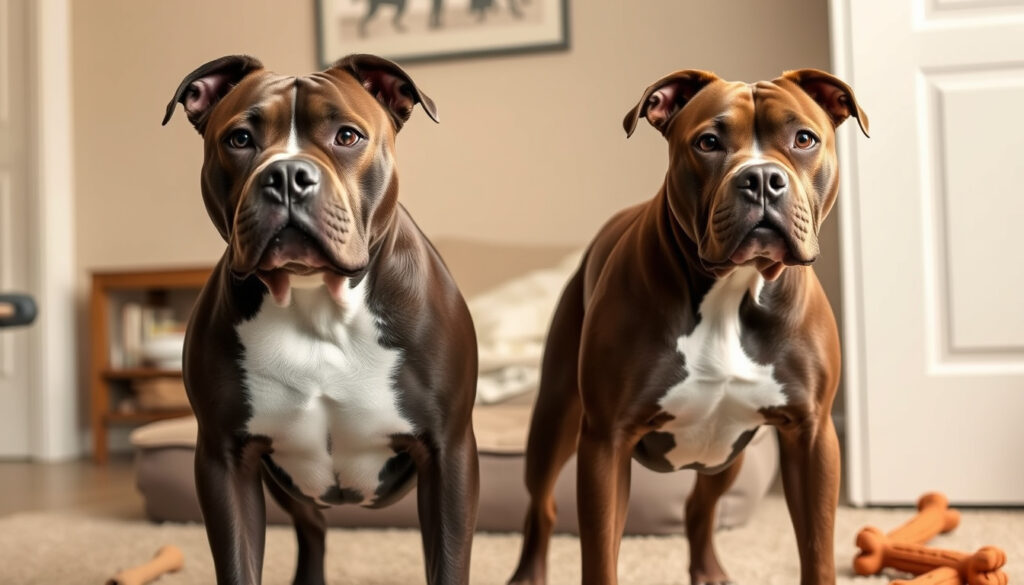
American Staffy vs Pit Bull: Temperament & Care Guide
Few dog breeds spark as much confusion—and unfair judgment—as the American Staffy; walk into any park with one and you are likely to get the same question: “Is that a Pit Bull?” The answer matters more than most people realise, especially if you live in the UK where a dog’s legal status can hinge on how its head looks rather than what the registration papers say.
AKC Recognition Year: 1936 ·
Height: 43–48 cm (17–19 in) ·
Weight: 25–30 kg (55–70 lb) ·
Life Expectancy: 12–16 years ·
Coat Colors: All solid colors, parti-colors, and patterns; white not exceeding 80% ·
Temperament: Confident, good-natured, courageous
Quick snapshot
- AmStaff is a separate breed from APBT (PetMD veterinary resource)
- UK law bans Pit Bull types, not AmStaff by name (Reef Brief legal analysis)
- AmStaffs are not inherently aggressive (NAHF breed summary)
- Whether a specific dog will be classified as a Pit Bull type in the UK
- The exact prevalence of dog aggression in AmStaffs
- Long-term effects of leaving a Staffy alone for 8 hours regularly
- 19th century: Developed from Bulldog and terrier ancestors for dog fighting and farm work. (AKC breed history)
- 1936: Recognized by the AKC as the American Staffordshire Terrier. (AKC official standard)
- 1970s–present: Gained popularity as a family companion and show dog. (AKC breed information)
- UK XL Bully ban may tighten identification of Pit Bull types
- DNA testing becomes more common for breed identification
- Better owner education on socialization and training
Four key facts, one pattern: the American Staffy lives in a gap between how it is classified and how it is perceived. Understanding that gap is the first step toward responsible ownership.
The table below distills the essential breed information.
| Fact | Detail |
|---|---|
| Original Breed Name | American Staffordshire Terrier |
| Common Nickname | AmStaff |
| Group | Terrier (AKC) |
| Country of Origin | United States |
Is American Staffy a Pit Bull?
What is the difference between an American Staffy and a Pit Bull?
- The American Staffordshire Terrier and the American Pit Bull Terrier (APBT) are separate breeds with different breed standards. The AKC recognises the AmStaff; the UKC recognises the APBT (PetMD veterinary resource).
- AmStaffs are generally heavier and more muscular than APBTs, with a broader head and a more square body.
- Both share common ancestry from the Staffordshire Bull Terrier, bred originally in 19th-century England for dog fighting and ratting.
Are American Staffies considered a type of Pit Bull?
- In everyday language, “Pit Bull” is not a single breed but a type that includes the APBT, the AmStaff, and sometimes the Staffordshire Bull Terrier.
- The AKC and UKC draw a sharp line: an AmStaff is not an APBT. But most shelters, insurance companies, and breed-specific laws treat them as the same thing.
- The trade-off: your dog may be legally “not a Pit Bull” on paper but physically indistinguishable from one to an animal control officer.
A dog that is 100% AmStaff by DNA can be classed as a Pit Bull type by law, while a dog with no APBT ancestry can be labelled a Pit Bull by a shelter. The label tells you less than the individual dog does.
The implication: the breed name protects you only as far as the person making the judgment uses AKC definitions. For UK owners, that gap matters a great deal.
Here is a direct comparison of the two breeds side by side.
| Feature | American Staffy (AmStaff) | American Pit Bull Terrier (APBT) |
|---|---|---|
| Weight | 25–30 kg (55–70 lb) | 14–27 kg (30–60 lb) |
| Height | 43–48 cm (17–19 in) | 43–53 cm (17–21 in) |
| Head shape | Broad, square | Moderate, distinct stop |
| Temperament | Confident, good-natured | Determined, energetic |
| Kennel Club recognition | AKC (Terrier group) | UKC (Terrier group) |
How aggressive are American Staffordshire Terriers?
Is American staffy aggressive?
- Aggression levels depend on training, socialisation, and individual temperament — not breed alone. AmStaffs are not inherently aggressive; they are known for courage and protectiveness (NAHF breed summary).
- The AKC describes the breed standard as “confident, good-natured, courageous,” with aggression toward humans being a serious fault (PetMD veterinary resource).
- Early socialisation and obedience training are essential — this dog is strong, tenacious, and can be dog-reactive if not well-handled (Artero UK breed guide).
“The American Staffordshire Terrier is confident, good-natured, and courageous. Aggression toward humans is a serious fault.”
Are American Staffies as aggressive as Pit Bulls?
- There is no reliable study showing AmStaffs are more or less aggressive than APBTs. Both breeds share similar ancestry and similar owner profiles.
- Breed-specific legislation (BSL) often lumps them together, but the science on which dog is “more dangerous” is thin — bite statistics rarely distinguish between the two breeds (Reef Brief legal analysis).
- The real risk factor: owner commitment. A well-trained AmStaff is safer than an untrained Labrador.
You are not choosing between a safe breed and a dangerous one. You are choosing a dog that will reflect whatever training and environment you provide — and that truth applies to every terrier type.
The pattern: breed-based aggression claims collapse under scrutiny. The meaningful question is not “how aggressive” but “how trainable,” and by that measure AmStaffs score well — provided you know what you are getting into.
Is an American Staffy a good family dog?
What are the disadvantages of a Staffy?
- AmStaffs can be affectionate and loyal family companions, forming deep bonds with their owners (Espree breed profile).
- Disadvantages include potential dog aggression, high energy, and a need for firm training — this is not a dog you can own casually.
- They may not be suitable for first-time owners without guidance; the breed requires someone who can provide consistent leadership (Artero UK breed guide).
Do American Staffies get along with children?
- They are generally good with children when properly socialised from puppyhood. AmStaffs are often called “nanny dogs” in historical contexts because of their tolerance with kids.
- Supervision is still essential — the same tenacity that makes them good protectors can manifest as rough play if not guided.
- The catch: a well-socialised AmStaff is a great family dog; an unsocialised one can be a liability. The difference is entirely in the owner’s hands.
“American Staffordshire Terriers are loyal, protective of their family, and friendly when properly socialized.”
The trade-off: you get a dog that will adore your children, but you must also manage a dog that may not adore strange dogs. That is the reality of owning a terrier type bred for gameness.
Are American Staffy legal in the UK?
What breeds are banned under the UK Dangerous Dogs Act?
- The UK Dangerous Dogs Act 1991 bans four types: the Pit Bull Terrier, the Japanese Tosa, the Dogo Argentino, and the Fila Brasileiro.
- American Staffordshire Terriers are not explicitly banned in the UK, but dogs of a “Pit Bull type” are illegal — and the law focuses on conformation and behaviour, not breed name (Reef Brief legal analysis).
- Many AmStaffs may meet the physical criteria for a Pit Bull type: a broad head, muscular build, and certain proportional measurements.
How can I determine if my dog is considered a Pit Bull type?
- The UK Home Office uses a set of physical characteristics, including head shape, ear set, and body proportions, to determine if a dog is a prohibited type.
- Owners should check with local authorities and consider DNA testing — though even DNA results are not definitive in court.
- The XL Bully ban (effective 2024) adds another layer: a dog that matches XL Bully type may also be subject to restrictions, even if it is technically an AmStaff (Reef Brief legal analysis).
If you own an AmStaff in the UK, you are in a legal grey zone. Your dog might be perfectly legal today — but a new neighbour’s complaint or a stricter enforcement policy could change that with no warning.
The consequence for UK owners: you cannot rely on the breed name alone. You need documentation, responsible ownership, and ideally a solicitor who understands dog law.
Is it better to get a boy or girl Staffy?
What are the personality differences between male and female Staffies?
- Males are typically larger, more dominant, and may be more territorial. They can be more challenging with other male dogs.
- Females are often more independent and slightly easier to handle, but can be moody during heat cycles if not spayed.
- Both genders can be loving and require consistent training; neither is objectively “better” — it depends on your household.
Which gender is easier to train?
- Females may be somewhat more focused during training sessions, while males can be more easily distracted by scent and social cues.
- Neutering/spaying reduces certain behavioural differences — a neutered male is often calmer than an intact one, and a spayed female avoids heat-related mood shifts.
- The pattern: for most first-time owners, a neutered male or spayed female of reputable breeding is the safest choice.
The implication: gender matters less than individual temperament and the quality of the breeder. Meet the parents, see how the puppies behave, and choose the one that matches your energy level.
Can staffies be left alone for 8 hours?
How to prevent separation anxiety in Staffies?
- Staffies are social dogs and may suffer from separation anxiety if left alone too long. Eight hours is generally too long without a break (Rubyloo family guide).
- Crate training and a dog walker can help. Provide enrichment toys such as puzzle feeders and safe chews to occupy the dog during your absence.
- Adult dogs can be left for 4-6 hours with proper preparation — but an 8-hour workday without a break is pushing it for any terrier type.
What is the maximum time an American Staffy can be left alone?
- Puppies: 1-2 hours maximum. The breed’s high energy means an under-stimulated puppy will find destructive outlets.
- Adults (1 year+): 4-6 hours, provided they have had a good walk, a toilet break, and mental stimulation before you leave.
- 8 hours: not recommended without a dog walker or doggy daycare. Destructive behaviour, barking, and anxiety are common results.
The trade-off: if you work long hours, a Staffy is not the dog for you unless you have a plan. This is a people-oriented breed that wants to be part of your daily life — and it will let you know if it feels neglected.
Care and ownership overview
Exercise needs
- The American Staffordshire Terrier requires at least 60 minutes of exercise daily (PetMD veterinary resource).
- This dog thrives with a job: agility, obedience, weight pull, or even a daily run. Without sufficient exercise, the energy turns into digging, chewing, or barking.
- Mental stimulation is as important as physical — puzzle toys and training sessions keep the breed engaged.
Grooming
- The short coat needs weekly brushing and baths every 4–6 weeks (PetMD veterinary resource).
- Use a rubber mitt or brush to remove excess hair and reduce shedding at home (Artero USA grooming guide).
- Pay extra attention to the elbows — the skin there can dry and crack (Artero UK breed guide).
- The breed should not be clipped; the coat renews itself naturally (Artero UK breed guide).
Training and socialisation
- The breed is intelligent and trainable, but it needs firm leadership and early socialisation with other dogs (Artero UK breed guide).
- Positive reinforcement works well, but consistency is key. An AmStaff that learns one day that growling gets it out of a situation will repeat that behaviour.
- Class attendance is highly recommended — a well-behaved Staffy opens doors; a poorly behaved one reinforces stereotypes.
The upshot for prospective owners: the AmStaff is not a high-maintenance dog in terms of grooming, but it is high-maintenance in terms of time and attention. If you have the time, you will get a loyal, trainable companion. If you do not, the breed will expose your schedule gaps.
Upsides
- Loyal and affectionate with family
- Intelligent and trainable with consistent leadership
- Low-maintenance coat — easy to groom
- Excellent for active owners who enjoy training
Downsides
- Potential dog aggression if not socialised well
- High energy — needs daily exercise of 60+ minutes
- May be classified as Pit Bull type in UK law
- Not ideal for first-time owners without guidance
Summary
Dog aggression is real in this breed — but human aggression is a fault by breed standard. The American Staffy does not have a temperament problem; it has an owner-education problem. If you commit to training, socialisation, and legal awareness, you get a confident, good-natured dog that consistently ranks among the most loyal family breeds. For UK owners, the choice is clear: either you learn the law and manage the risk, or you risk having a decision made for you by a neighbour’s complaint and a council officer’s tape measure. Do your homework, meet the parents, and never rely on the name alone.
Related reading: American Staffy Breed Guide · American Staffy Dog Family Guide
dogdatahub.com, artero.com, pawportal.com, eachpaw.com, dearpooch.com, petmd.com, amstafflove.com
Frequently asked questions
Do American Staffies shed a lot?
They shed moderately year-round. Weekly brushing with a rubber mitt helps control loose hair — it is manageable for most owners.
Are American Staffies good with other dogs?
It depends on socialisation. Early and consistent exposure to other dogs at a young age improves chances. Some AmStaffs are dog-aggressive, especially with same-sex dogs.
How much exercise does an American Staffy need?
At least 60 minutes of daily exercise is recommended. This dog thrives with structured activities like walks, runs, or training sessions.
What is the average cost of an American Staffy puppy?
Prices range from £1,000 to £2,500 in the UK, depending on breeder reputation, pedigree lines, and geographic location. Always check the breeder’s health testing records.
How long do American Staffies live?
Life expectancy is 12-16 years with proper care, nutrition, and regular veterinary checkups.
Are American Staffies easy to train?
Yes, they are intelligent and eager to please, but they require firm, consistent leadership. Positive reinforcement works well, and formal obedience classes are recommended.
What health problems are common in American Staffies?
Common issues include hip dysplasia, skin allergies, and hypothyroidism. Responsible breeders screen for these conditions. Regular vet visits and a good diet reduce risk.
Related reading: American Staffy Breed Guide · American Staffy Dog Family Guide
More related posts
 Matt Berry: Career, Family, Net Worth, Voice & Albums (2025)
 Ahn Hyo-Seop: English, Citizenship, Relationship & Career Facts
 Qin Shi Huang: First Emperor of China and His Legacy
 Oscar Piastri Age: F1 Driver DOB, Height & Girlfriend
 AUD to Nepali Rupees Exchange Rate: Live Comparison
 Microsoft Flight Simulator 2024: Platforms, Price, Specs
 Michael Jai White: Martial Arts, Black Belts & Fight Record
 Harmanpreet Kaur: Age, Married Status, Career Stats & Net Worth
