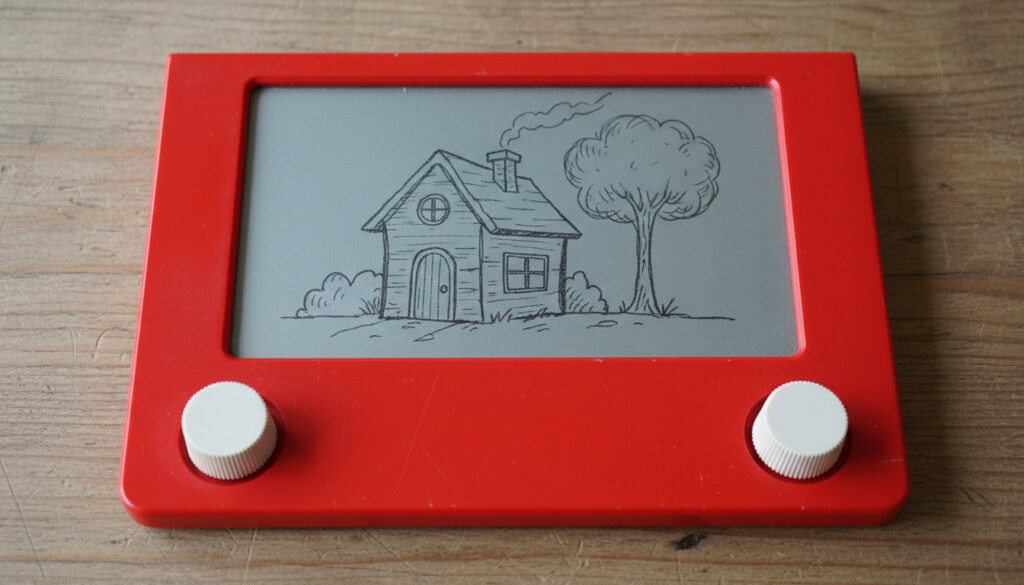
Etch A Sketch – How the Classic Toy Works and Its History
The Etch A Sketch stands as one of the most recognizable mechanical toys of the 20th century, requiring no batteries yet producing intricate line drawings through a seemingly magical process. Invented by a French electrician in the late 1950s, this red-framed drawing tablet has sold over 100 million units worldwide and persists in production today.
Unlike modern digital tablets, the device operates purely through mechanical ingenuity and static electricity. Its enduring popularity spans from Baby Boomer childhoods to cameo appearances in blockbuster films, cementing its status as a cultural touchstone.
The red-framed drawing tablet relies on aluminum powder suspended by static charge, a mechanism discovered accidentally by André Cassagnes while working as an electrician in France.
How Does Etch A Sketch Work?
- Invented accidentally by a French electrician observing decal peel marks.
- Utilizes static electricity to suspend aluminum powder against glass.
- Operates entirely without electrical power or digital components.
- Reached 100 million units sold by 1998.
- Survived corporate bankruptcy through film licensing deals.
- Inducted into the National Toy Hall of Fame in 1998.
- Requires simultaneous dual-knob coordination for curved lines.
| Fact | Details |
|---|---|
| Invented | 1960 by André Cassagnes |
| Launched | July 12, 1960 by Ohio Art |
| Original Price | $2.99 (equivalent to $33 in 2025) |
| Current Owner | Spin Master |
| Core Materials | Glass screen, aluminum powder, plastic beads |
| Power Source | None (mechanical/static) |
| Sales Milestone | 600,000 units (1960); 100+ million (1998) |
| Recognition | National Toy Hall of Fame (1998) |
| Origin | Vitry-sur-Seine, France |
| Original Name | L’Écran Magique (The Magic Screen) |
The device relies on a thick gray screen coated internally with aluminum powder mixed with microscopic plastic beads. According to technical documentation, static charge holds this powder to a clear plastic backing until displaced.
Two white knobs positioned on the lower corners control orthogonal steel rods. The left knob manages horizontal movement, while the right knob governs vertical positioning. At their intersection sits a wire stylus that scrapes away the aluminum powder when knobs rotate, creating visible dark lines against the gray background.
Who Invented Etch A Sketch and Its History?
The Accidental Discovery
André Cassagnes, born in 1926 in France, worked as an electrician for Lincrusta in Vitry-sur-Seine. Records indicate that around 1955 or 1956, Cassagnes peeled a translucent decal from a light switch plate and observed pencil marks transferring through the translucent material. This observation sparked the concept of using aluminum powder and static electricity to create a drawing device.
He constructed a prototype named L’Écran Magique (“The Magic Screen”) and presented it at the 1959 Nuremberg Toy Fair. Most manufacturers dismissed the invention due to Cassagnes’s steep licensing fee demands.
From France to Ohio
The Ohio Art Company, headquartered in Bryan, Ohio, initially passed on the toy before reconsidering. Historical accounts note that executives acquired the rights for $25,000—a record sum equivalent to approximately $272,000 today. They renamed the device Etch A Sketch and launched it on July 12, 1960, priced at $2.99.
Production demanded extensive trial and error. Early manufacturing generated numerous defective units that required destruction as the company refined the mechanism.
Ohio Art produced units continuously through Christmas Eve noon in 1960 to meet demand, selling 600,000 units during that inaugural season alone, according to the Strong National Museum of Play.
Corporate Survival and Modern Ownership
By 1998, sales exceeded 100 million units worldwide, prompting induction into the National Toy Hall of Fame. However, Ohio Art faced bankruptcy in subsequent decades, receiving a crucial 20% sales boost from appearances in Toy Story (1995) and Toy Story 2 (1999).
Following Ohio Art’s financial decline, Spin Master acquired the brand. Current documentation confirms the toy remains in production today with minimal design changes.
How Do You Use an Etch A Sketch?
Basic Controls
Users grip the two white lower knobs using thumbs and index fingers for maximum precision. The left knob controls horizontal stylus movement, while the right knob manages vertical displacement. Rotating both knobs simultaneously at equal speeds produces diagonal lines.
Mastering curves requires varying the relative speeds of each knob gradually. The learning curve proves steep; practitioners describe the skill as “simple but not easy.”
Drawing Techniques
Novices should begin with straight lines to develop muscle memory before attempting complex curves. Unlike following a Chocolate Chip Cookie Recipe, where precise measurements yield predictable results, Etch A Sketch drawing requires constant adjustment and accepts no standardized formula for success.
Experienced artists can create detailed lineographic images through expert coordination, though the mechanism inherently favors straight-line compositions.
Erasing and Starting Over
To clear the screen, users turn the toy upside down and shake vigorously. This motion redistributes the aluminum powder evenly across the screen’s interior, coating the glass anew and erasing previous lines. The process requires no batteries or electrical input.
How to Fix or Maintain Etch A Sketch?
Common Issues
Operational problems typically stem from uneven powder distribution or mechanical misalignment. Persistent dark spots often indicate areas where powder has clumped or the stylus has lost contact with the screen surface.
Sources provide no verified procedures for replacing the internal stylus or repairing the glass screen. Attempting to open the sealed unit risks permanent damage and dispersal of the aluminum powder mixture.
When to Seek Professional Help
For issues involving dried powder or detached internal rods, professional service remains the only documented solution. Modern units maintain sealed construction designed to prevent user servicing.
Regular vigorous shaking after use ensures even powder coating and prevents sticking. Store the unit flat to avoid internal shifting of the aluminum powder and plastic bead mixture.
What Is the Etch A Sketch Timeline?
- : André Cassagnes discovers the concept while peeling a decal from a light switch plate in France.
- : Cassagnes debuts L’Écran Magique at the Nuremberg Toy Fair.
- : Ohio Art Company launches Etch A Sketch in the United States.
- : Ohio Art sells 600,000 units despite production challenges, stopping only at noon on Christmas Eve.
- : Release of the Etch A Sketch Animator featuring a 40×30 dot matrix display.
- : Introduction of a color version utilizing markers on paper rather than aluminum powder.
- : Feature appearances in Toy Story and Toy Story 2 boost sales by 20 percent.
- : Product reaches 100 million units sold and enters the National Toy Hall of Fame.
- : André Cassagnes dies at age 86.
- : Spin Master acquires the brand from struggling Ohio Art Company.
Teachers College Columbia University libraries maintain verified records of the 1998 Hall of Fame induction and subsequent sales milestones.
What Is Known and Unknown About Etch A Sketch?
| Established Information | Remaining Uncertainties |
|---|---|
| Mechanical operation using aluminum powder and static electricity | Exact proprietary formula of the aluminum powder and plastic bead mixture |
| No batteries or electrical power required | Precise manufacturing specifications for the internal stylus tension |
| Invention by André Cassagnes in 1960 | Detailed repair protocols for screen or stylus replacement |
| Current ownership by Spin Master | Specific age recommendations beyond general marketing guidelines |
| Sales figures exceeding 100 million units by 1998 | Exact modern production numbers and factory locations |
Why Did Etch A Sketch Become a Cultural Icon?
The toy emerged during the Baby Boom era as a symbol of analog creativity, offering tangible resistance to the growing digitalization of entertainment. Its appearances in Pixar’s Toy Story franchise served as both plot device and nostalgic anchor, introducing the mechanism to new generations while reinforcing its status as a timeless play object.
Educators value the device for developing fine motor skills and bilateral coordination, as users must synchronize both hands to create images. Parents determining whether their child has reached appropriate developmental milestones for such toys might reference a How Old Am I Calculator, though the product itself carries no strict age requirements beyond general safety guidelines.
The bright red frame and distinctive white knobs became visual shorthand for mid-century industrial design, appearing in countless films and television programs as period-appropriate set dressing.
What Do Primary Sources Say About Etch A Sketch?
Documentation from the Strong National Museum of Play establishes the technical specifications of the original 1960 model, including the aluminum powder mechanism and static adhesion principles. Smithsonian Magazine provides verified accounts of the toy’s acquisition by Ohio Art and its cultural trajectory through American households.
Tech Times archives preserve the details of Cassagnes’s accidental discovery and his death in 2013. Teachers College Columbia University libraries maintain records of the 1998 Hall of Fame induction and sales milestones.
What Should You Know About Etch A Sketch Today?
More than six decades after its debut, the Etch A Sketch remains a purely mechanical drawing tool requiring no batteries, utilizing aluminum powder and dual-knob precision to create temporary art. Now produced by Spin Master after rescuing the brand from Ohio Art’s financial troubles, the toy continues selling worldwide as both educational tool and nostalgic collectible, proving that simple physical mechanisms can outlast digital trends. Those seeking to recapture childhood creativity or introduce children to pre-digital play patterns will find the classic red frame unchanged from its 1960 design, though mastering its subtle controls remains a challenging pursuit requiring patience and practice rather than electrical power.
Frequently Asked Questions
Is Etch A Sketch still made?
Yes. Spin Master currently manufactures the toy with minimal changes to the original 1960 design and mechanism.
What age is appropriate for Etch A Sketch?
Marketing targets children ages three and up, though mastering the dual-knob coordination typically challenges older children and adults.
Does Etch A Sketch need batteries?
No. The toy operates purely through mechanical pulleys and static electricity holding aluminum powder to the screen.
Can you replace the stylus on Etch A Sketch?
No documented procedures exist for consumer-level stylus replacement. Professional service is required for internal repairs.
What materials are inside an Etch A Sketch?
The sealed unit contains aluminum powder mixed with microscopic plastic beads, held against glass by static charge, plus steel rods and a wire stylus.
More related posts
 Dining Tables Guide: Sizes, Materials & Irish Retailers
 Seth Green: From Child Actor to Voiceover Icon
 Julianne Moore: Actress, Author, Alzheimer’s Advocate
 Everton Park Library – Hours, Accessibility, Meeting Rooms
 Nancy Guthrie Disappearance: Latest FBI Evidence & Update
 Iga Swiatek: Relationships, Career, Rankings & FAQs
 Matt Berry: Career, Family, Net Worth, Voice & Albums (2025)
 Breaking News Perth Today – Latest Updates and News
