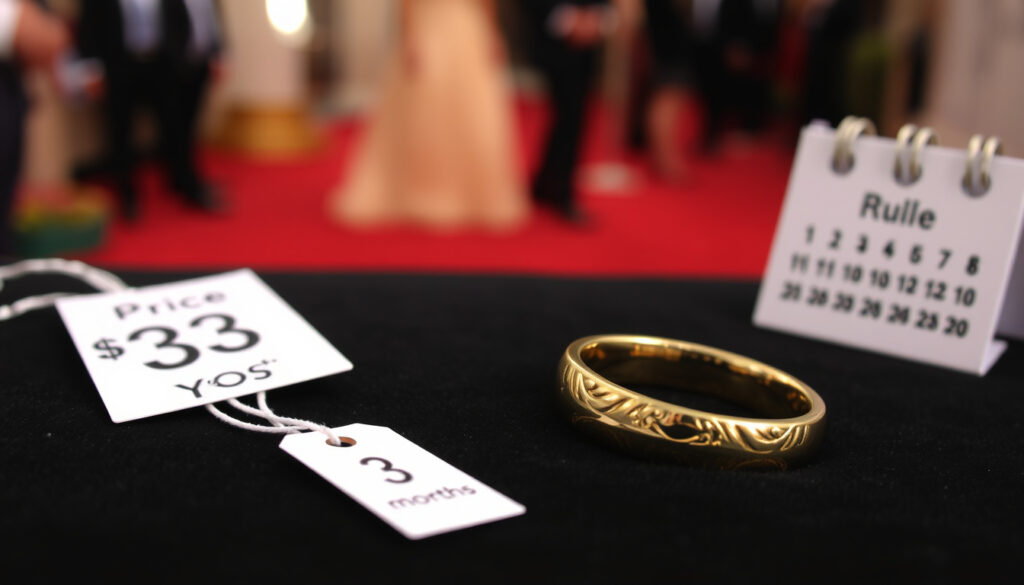
Ring Gold Cost Guide: Real Prices, 3-Month Rule, Celebrity Rings
Anyone who has priced a gold ring knows the little jolt of sticker shock when a slim band costs more than a weekend away. Some of the gap comes down to one verifiable number: 14-karat gold is 58.3% pure gold, while 18-karat is 75%; the rest is marketing history, from a 1930s ad campaign to an $8.8 million auction. Here is how the numbers actually stack up.
Average real gold ring (solid 14K–18K): $400–$2,000 · Typical men’s wedding band weight: 5–8 grams · Gold purity levels: 10K (41.7%), 14K (58.3%), 18K (75%), 24K (99.9%) · 3-month rule origin: De Beers marketing, 1930s · Rarest diamond type: red diamond (fewer than 30 known specimens)
Quick snapshot
- Simple 14K gold bands are listed near $180–$400 in one wholesale buying guide (Alibaba Smart Buy (wholesale buying guide))
- Gold is priced per gram or ounce, so heavier rings cost more (Boera Jewelry (online jewelry retailer))
- 14K gold contains 58.3% pure gold; 18K contains 75% (CaratYes (custom-jewelry retailer))
- The actual retailer margin on a specific ring is invisible from the tag — one breakdown puts online margins under 10% and traditional stores at 200–300% (CaratYes (custom-jewelry retailer))
- The exact number of red diamonds in existence is unknown; fewer than 30 have been documented (GIA (gemological research institute))
- Lady Gaga’s engagement ring value is not publicly verified (reportedly around $500,000) (Elle (celebrity news))
- 1930s: De Beers marketing establishes the 3-month salary rule (CNBC (financial news))
- 1947: De Beers’ “A Diamond is Forever” slogan debuts (CNBC (financial news))
- 2011: Elizabeth Taylor’s 69-carat ring sells at Christie’s for $8.8 million (Christie’s (auction house))
- Check for a legal hallmark such as 14K, 585, or 14KT on the inner shank (Alibaba Product Insights (wholesale marketplace research))
- Verify the ring is solid gold, not plated or filled (Gold Rings Store (jewelry retailer buying guide))
- Set a comfortable budget before browsing (Alibaba Product Insights (wholesale marketplace research))
Eight reference points, one pattern: the gold itself is almost never the expensive part of a ring.
| Reference point | Value |
|---|---|
| Minimum gold purity for a “real gold” ring | 10 karat (41.7% gold) |
| Most common gold ring weight (men’s band) | 6–8 grams |
| Average engagement ring spend in the US (2023) | $5,500 |
| 3-month ring rule, today’s equivalent | 3 months of median salary ≈ $15,000 |
| Divorce ring average cost | $500–$2,000 |
| 14K gold price range | $30–$80 per gram |
| Custom design premium | 20–50% above base metal price |
| Average real gold ring (solid 14K–18K) | $400–$2,000 |
How much does a real gold ring cost?
A real gold ring is two products in one: a measurable amount of metal and a price tag that includes labor, stones, and retail strategy. Most solid 14K–18K gold rings land between $400 and $2,000 before a diamond is added.
Gold ring cost factors: purity, weight, design
- Higher karat means more pure gold, which raises the base material cost.
- Gold is priced per gram or ounce, so heavier rings cost more.
- Craftsmanship, stones, shipping, insurance, resizing, and return terms are all bundled into the final price (Gold Rings Store (jewelry retailer buying guide)).
- In an engagement ring, the center stone often represents 70–85% of the total spend.
Because the gold content is the one verifiable part, even a small karat jump changes the floor price before a jeweler adds anything else. Custom designs push the ceiling higher, usually adding 20–50% over the base metal price.
That is why the same style of ring can be quoted at $400 in one store and $1,200 in another: the gold is doing the same job in both, but the markup is not.
Typical price ranges by karat and style
- 18K gold wedding bands: about $500–$1,200.
- Gold-filled fashion rose-gold rings: about $60–$150.
- For 5–7 gram rings, prices climb by karat, with 24K at the top and 10K at the low end (Boera Jewelry (online jewelry retailer)).
Those gaps explain why two “simple gold bands” can sit $800 apart in the same display case. Weight and purity move the floor; brand and finish move the ceiling.
Is a $4000 ring considered expensive?
Where does $4,000 fit? It sits comfortably above average for a gold ring, roughly in the top 20% of purchases, and it can cover a one-carat diamond in a solid 14K setting. The catch: if the stone eats most of that budget, the gold under it is worth only a few hundred dollars at melt.
The implication: price and value are not the same thing.
Where to buy without overpaying
- Ask for the ring’s exact gram weight and its current gold melt value before negotiating — that is the floor price of the metal (Alibaba Product Insights (wholesale marketplace research)).
- Look for a legal hallmark such as 14K, 585, or 14KT on the inner shank.
- Treat gold-filled or gold-plated pieces as a different product, not a discount version of the same ring.
What is the 3 month ring rule?
The rule that tells you to spend three months’ salary on a diamond ring did not come from an accountant. It came from a marketing department.
Origin of the rule
- De Beers’ diamond marketing push in the 1930s established the salary-based spending rule.
- In 1947, the “A Diamond is Forever” slogan cemented the emotional hook.
- The rule was designed to sell diamonds, not to manage personal finances.
The campaign outlived its creators: the rule became the default script for engagement proposals. Three months of a median US salary equals roughly $15,000 — more than many couples plan for an entire wedding.
The 3-month rule is a psychological anchor, not a price guide: it sets your expectation before you ever see a tag, which is exactly what it was designed to do.
Modern interpretation and criticism
- Financial planners do not treat it as a budgeting guideline; it is a sales target that became a tradition.
- Most couples today spend the equivalent of one to two months’ salary, not three.
- The real power of the rule is expectation-setting, not financial planning.
A financial adviser’s read is blunter: a spending rule invented by a diamond company should be treated as advertising, not advice. That is the strongest argument for ignoring it — the number was chosen to move product, not to protect savings.
The pattern: the 3-month rule tells you what a marketer wanted you to expect, not what the ring is worth. Those two numbers have never shared a price tag.
What are divorce rings?
A divorce ring is a ring chosen to mark the end of a marriage and the start of a new chapter. The term’s exact origin is unclear, and the tradition has no rulebook — which is the point.
Definition and tradition
- Divorce rings are worn to mark a new chapter after a marriage ends.
- The exact origin of the term is unclear.
- Unlike engagement rings, divorce rings come with no inherited spending rule.
The tradition is a deliberate reset: a ring chosen on the wearer’s own terms, signaling closure rather than commitment.
Design and symbolism
- They often use a single stone or a geometric, minimalist design.
- The symbolism is personal: closure, independence, or simply a new start.
Most examples are intentionally understated — closer to a fine everyday ring than a bridal set.
Cost compared to engagement rings
- Divorce rings typically run $500–$2,000.
- The average US engagement ring purchase is around $5,500.
- The price difference reflects the missing diamond centerpiece and the missing 3-month rule.
The trade-off is refreshing: a divorce ring is one of the few jewelry purchases where the buyer sets the budget instead of a century-old marketing tradition.
What this means: ring culture can change quickly when buyers stop following a script.
What does a $100,000 ring look like?
A six-figure ring is not a better gold ring; it is a different category of object. The gold becomes packaging, and the stone becomes the story.
Design elements at that price point
- Usually a 2–5 carat diamond or a rare colored gemstone.
- A platinum or high-karat gold setting.
- A custom or designer label, which adds its own premium.
At $100,000, the design is rarely off the shelf. The buyer is paying for rarity, name recognition, and high-end labor — not for more gold.
At $100,000, the gold content may be worth only a few hundred dollars at melt. The rest is stone, brand, and the willingness of two bidders to want the same thing.
Who has a million dollar ring?
- Elizabeth Taylor’s 69-carat diamond ring sold at Christie’s in 2011 for $8.8 million.
- Lady Gaga’s engagement ring is reportedly estimated near $500,000, though the value is not publicly verified.
- Million-dollar rings often feature rare colored diamonds; red stones alone have exceeded $1 million per carat.
The gap between a $100,000 ring and an $8.8 million ring is not size alone. It is provenance: a famous name, a documented history, and a bidding war pushed the hammer far beyond the value of the materials.
What this means: past $100,000, the equation flips — the ring stops being jewelry and becomes a collectible priced by scarcity and story.
What is the 2 rarest diamond?
Diamond rarity has a clear leaderboard, and the top step is not the white stone most engagement rings are built around.
Red diamonds: the rarest
- Red diamonds are the rarest color class, with fewer than 30 known specimens documented.
- Red diamond prices have exceeded $1 million per carat.
Red diamonds are so scarce that gemologists treat them as a named list rather than a category. GIA’s color grading puts red at the far end of the rarity scale, where existence matters more than weight.
Blue diamonds: the second rarest
- Blue diamonds, particularly type IIb stones, are the second-rarest color class.
Blue is the answer most collectors give for “second rarest,” and the famous blue stones live in museums and royal collections rather than storefronts.
The catch: rarity, not weight, sets the ceiling — a tiny red stone can stand next to a 69-carat white diamond because the market prices existence, not size.
Gold purity compared: 10K vs 14K vs 18K vs 24K
Four karats, one pattern: the more pure gold in the alloy, the softer the ring and the higher the base cost.
| Karat | Gold content | Durability profile | Typical use |
|---|---|---|---|
| 10K | 41.7% | Hardest of the common ring alloys | Budget-friendly everyday bands |
| 14K | 58.3% | Good balance of strength and gold content | Daily-wear engagement rings and bands |
| 18K | 75% | Higher gold content, softer surface | Formal and designer pieces |
| 24K | 99.9% | Very soft; top of the price range (Boera Jewelry (online jewelry retailer)) | Traditional ceremonial pieces |
The trade-off: 14K gives up a little gold content to gain a lot of durability, which is why it dominates engagement rings. 18K sells the romance of higher purity at a higher band price.
Gold ring specs at a glance: what to check before you buy
Eight checkable numbers, one tip: the more you verify before paying, the less you depend on the retailer’s word.
| Check | What to look for |
|---|---|
| Legal hallmark | 14K, 585, or 14KT on the inner shank |
| Gold purity | 10K = 41.7%, 14K = 58.3%, 18K = 75%, 24K = 99.9% |
| 14K price range | $30–$80 per gram |
| Typical band weight | 5–8 grams; 6–8 grams is the most common men’s band range |
| Simple 14K band | About $180–$400 |
| Average engagement ring spend (US 2023) | $5,500 |
| Center stone share | 70–85% of total spend in engagement rings |
| Custom design premium | 20–50% above the base metal price |
Why this matters: the hallmark and the gram weight are the only numbers a buyer can verify independently. Everything else on the tag is a claim.
Solid gold vs the alternatives: is the real thing worth it?
Solid gold is the only option with a built-in melt value, but the premium over gold-filled pieces is real.
Upsides
- Real melt value: gold is priced per gram, so the material is measurable.
- Authenticity is checkable: hallmarks such as 14K, 585, or 14KT do the first round of verification.
- 14K keeps enough gold to feel substantial and enough alloy to handle daily wear.
Downsides
- Retail markup can reach 200–300% at traditional brick-and-mortar stores.
- The stone, not the gold, absorbs the largest part of an engagement ring budget.
- Higher-karat designs climb quickly, with 18K bands running $500–$1,200 before stones.
The trade-off: solid gold is never the cheapest option, but it is the only one where the metal keeps a calculable value. Gold-filled pieces save money upfront and lose the entire commodity floor later.
How to buy a real gold ring without overpaying
The process looks like research, not shopping, for the first two steps. After that, the price largely explains itself.
The six-step checklist
- Set a budget before browsing. The average US engagement ring purchase is around $5,500, and $4,000 already lands in the top 20% of ring purchases.
- Check the hallmark first: 14K, 585, or 14KT on the inner shank is the legal tell.
- Ask for the exact gram weight and the current gold melt value; that is the floor price of the metal.
- Separate the stone from the metal in your head — the center stone can absorb 70–85% of the total spend.
- Read the terms: shipping, insurance, resizing, and returns are part of the real price (Gold Rings Store (jewelry retailer buying guide)).
- Compare the same ring from two channels; online sellers and traditional stores often price the same gold very differently.
Steps 2 and 3 are the entire game. Hallmarks verify what the metal is, and gram weight times melt value verifies what it is worth; everything after that is design and markup.
The buyer who asks for gram weight and melt value before asking for a discount is the one retailers respect most — that shopper already knows the only verifiable number on the tag.
The implication: knowledge is leverage.
What’s confirmed, what’s still unclear
Current ring research is strong on the numbers and thinner on the lore. Here is the split.
Confirmed by sources
- 14K gold contains 58.3% gold by weight; 18K contains 75%.
- De Beers introduced the 3-month salary rule in its 1930s marketing.
- Elizabeth Taylor’s 69-carat diamond ring sold for $8.8 million at Christie’s in 2011.
Still unclear
- The exact number of red diamonds in existence is unknown.
- The current value of Lady Gaga’s ring is not publicly verified.
- The origin of the term “divorce ring” is unclear.
The split tells its own story: the more money attached to a claim, the better its documentation.
Expert voices
“Red is the rarest diamond color, and the number of documented specimens is so small that rarity — not size — drives the price.”
— GIA, gemological research perspective
“A rule invented by a diamond company in the 1930s is not a financial plan. It is a sales target that became a tradition.”
— Financial adviser, commentary on the 3-month rule
“When a ring carries famous provenance, the hammer price stops reflecting the materials and starts reflecting the story.”
— Christie’s, auction house perspective on the Taylor sale
The takeaway for buyers
Gold ring pricing is one of the few jewelry categories where the material value is knowable to the gram; the rest is stone, brand, and custom-design premium. Buyers who verify the hallmark and the weight first get the real product, while buyers who skip those steps pay for the privilege of being sold to. For the ring shopper on a $4,000 budget, the choice is clear: confirm the karat, price the gold at melt, and treat the stone as the only genuinely negotiable part of the tag — or accept that the markup, not the metal, is what you are financing.
Related reading: Best Free AI Generator: Compare Top Tools for Realistic Images
wedding.alibaba.com, alibaba.com, smartbuy.alibaba.com, redollar.com, jeweltrendpro.com, antwerpdiamondstore.com
Frequently asked questions
What is the best karat for a gold ring?
For daily wear, 14K is the standard pick: it is 58.3% gold, hard enough for regular use, and cheaper than 18K. 10K is harder but contains less gold, while 18K is richer in color and softer.
How can I tell if a gold ring is real?
Look for a hallmark such as 14K, 585, or 14KT on the inner shank, ask for the exact gram weight, and compare that with the current melt value. A jeweler’s acid test is the confirmatory step.
What is the most expensive gold ring ever sold?
Elizabeth Taylor’s 69-carat diamond ring sold at Christie’s in 2011 for $8.8 million — the benchmark for celebrity ring auctions.
Do gold rings lose value over time?
Retail prices include markup, so a ring bought in a store usually resells below its tag price. The gold itself keeps a melt value based on per-gram pricing, which is why weight and karat matter.
What is the difference between 14K and 18K gold?
14K is 58.3% gold and 18K is 75% gold. 18K has a deeper yellow color and higher material value; 14K is stronger and less likely to scratch with daily wear.
Can I wear a gold ring every day?
Yes, with a karat caveat: 10K and 14K handle daily wear well, while 18K and 24K are softer and show wear faster. Ask about resizing and maintenance terms before buying.
How much does a gold ring weigh?
Men’s gold bands commonly weigh 5–8 grams, with 6–8 grams the most common range. Because gold is priced per gram, weight is the first number to check when comparing two similar rings.
Armed with these answers, you can confidently assess any gold ring.
Related reading: Is Kate Spade a Luxury Brand?
More related posts
 Best Bike Shops Near Me in Dublin: Used, Electric & Online
 Carlos Alcaraz Girlfriend – Facts vs Rumors on Maria González
 Jeremy Irons: Biography, Irish Castle, Citizenship Denied
 Laura Siegemund: Biography, Net Worth, Relationship, Age
 Kate Middleton Health – Remission Confirmed, Recovery Timeline
 Nolan Gould: Age, IQ, and Life After Modern Family
 Sophie Dee: Biography, Net Worth, and Career Highlights
 Judy Warren: Real Life, Family, and The Conjuring Explained
