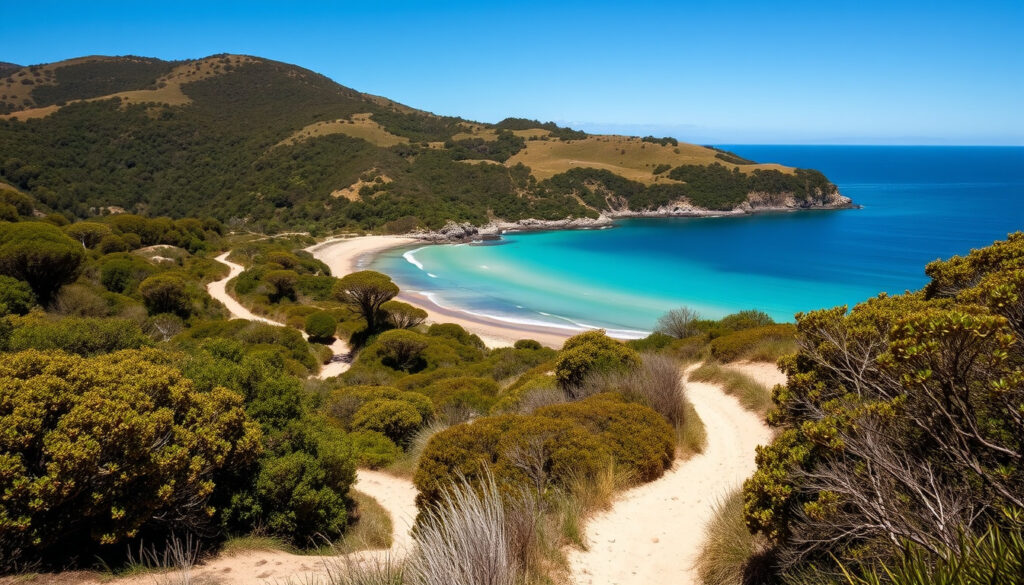
Abel Tasman: Explorer, National Park, Hiking Guide
When you hear the name Abel Tasman, you might picture golden beaches and a famous coastal track — but the story behind that name begins four centuries ago with a Dutch explorer who redrew the map of the South Pacific. Tasman’s 1642 voyage became the first European sighting of New Zealand, and today the park that bears his name is one of the country’s most-loved hiking destinations.
Year of first voyage: 1642 ·
Park size (Abel Tasman National Park): 225 km² ·
Track length (Abel Tasman Coast Track): 60 km ·
Average hiking duration: 3–5 days ·
Number of visitors annually (approx.): 200,000
Quick snapshot
- Tasman commanded two VOC expeditions (Encyclopaedia Britannica)
- He sighted New Zealand on 13 December 1642 (NZ History (govt.nz))
- The Abel Tasman Coast Track is 60 km one way (Department of Conservation (DOC))
- Park opened in 1942 on 300th anniversary of his voyage (DOC – official site)
- 1603 – Born in Lutjegast, Netherlands (Wikipedia)
- 1642 – First voyage: discovers Tasmania and New Zealand (NZ History)
- 1942 – Abel Tasman National Park established (DOC)
- Summer peak season — book huts months ahead (DOC advice) (Project Janszoon)
- Project Janszoon restoration efforts continue along the coast (Project Janszoon)
Here’s a quick reference for Tasman’s life and the park that bears his name.
| Born | 1603, Lutjegast, Netherlands (Wikipedia) |
|---|---|
| Died | 1659, Batavia (Jakarta) (Britannica) |
| First European to sight | Tasmania, New Zealand, Tonga, Fiji (NZ History) |
| New Zealand name | Staten Landt (later Nieuw Zeeland) (Te Ara – Encyclopedia of New Zealand) |
| National park size | 225 km² (DOC) |
| Track length | 60 km (Coast Track) (DOC) |
What is Abel Tasman famous for?
Who was Abel Tasman?
- A Dutch explorer employed by the Dutch East India Company (VOC) (Encyclopaedia Britannica)
- He led the first European expedition to reach New Zealand in 1642 (NZ History (govt.nz))
- He also sighted Tasmania, Tonga, and Fiji (Wikipedia)
The Abel Tasman National Park — one of New Zealand’s smallest but most visited parks — is named after him, preserving the coastline he first charted. The park was officially opened in 1942, marking the 300th anniversary of Tasman’s voyage, according to the Department of Conservation (DOC).
Tasman never set foot on the park’s golden beaches — he anchored off Wainui in Mohua on 18 December 1642, had a violent encounter with Māori, and sailed on. Yet that single visit is why the park carries his name and why thousands hike its coast every year.
Why is Abel Tasman important in New Zealand history?
- His voyage proved New Zealand was not part of a southern continent (Te Ara)
- He mapped parts of the coast, opening the way for later European settlement (NZ History)
The implication: Tasman’s maps were used by James Cook 127 years later. Without Tasman, Cook’s landing might have looked very different.
What did Abel Tasman name New Zealand?
What did Abel Tasman call New Zealand?
Tasman named the land Staten Landt, believing it was connected to a landmass near South America (Te Ara). Later, Dutch cartographers renamed it Nieuw Zeeland after the Dutch province of Zeeland (Wikipedia). That name stuck.
Why did he choose that name?
- He thought Staten Landt might join the “Staten” island off South America (Britannica)
- His charts were based on incomplete geographic knowledge (Te Ara)
The catch: Tasman never knew his “Staten Landt” would become half a country’s identity.
Did Abel Tasman meet Aboriginals?
What was Tasman’s first contact in Australia?
Tasman landed in Tasmania — not mainland Australia — in November 1642 (NZ History). His crew saw smoke and found trees with notched bark, but had no recorded direct meeting with Aboriginal Australians (Wikipedia).
Did Tasman encounter Indigenous people?
- In New Zealand, he had a violent encounter with Māori at Golden Bay (then Murderers’ Bay) — four of his crew were killed (NZ History)
- No such contact occurred in Australia (Britannica)
The pattern: contact with Indigenous peoples shaped the early European exploration narrative.
What problems did Abel Tasman have?
Challenges faced by Tasman during his voyage
- First voyage: hostile reception from Māori in Golden Bay; four crew killed (NZ History)
- Second voyage (1644): failed to find trade routes or wealth — VOC was disappointed (Britannica)
Why did his second voyage fail?
Tasman’s second expedition into the Gulf of Carpentaria and along the Australian coast yielded no spices, gold, or new trading partners. According to Encyclopaedia Britannica, the VOC considered the voyage a failure and did not send him again.
What this means: Tasman ended his career in relative obscurity, dying in Batavia in 1659 without the fame later historians gave him.
For modern hikers, Tasman’s “failures” are the reason the Abel Tasman coast remained undeveloped for centuries — preserving the very landscapes that draw 200,000 visitors each year.
The implication: Tasman’s perceived failures inadvertently preserved the coastline for future generations.
How long does it take to hike Abel Tasman?
What is the Abel Tasman Coast Track?
The Abel Tasman Coast Track is a 60 km one-way walk along the park’s coastline, hugging beaches and forest rather than climbing alpine terrain (DOC). It is one of New Zealand’s Great Walks and is widely described as the most accessible (Never Ending Voyage (travel guide)).
How many days for the full walk?
- Typically 3 to 5 days (DOC track notes)
- Day walks are possible — for example, Mārahau to Anchorage Hut is 12.4 km and takes 3–4 hours (Abel Tasman Tourism (official site))
Can you do day walks?
Yes. The track has multiple entry/exit points via water taxi. Walkers can choose short sections or the full 60 km (Southern Scope (hiking guide)).
The trade-off: a full 3–5 day walk lets you experience the full coastline, but day walks with water taxi pickups cost extra — budget accordingly.
How much does it cost to do the Abel Tasman walk?
What are the fees for the Abel Tasman Track?
Here’s a breakdown of costs for independent and guided hiking.
| Item | Cost (2025) | Source |
|---|---|---|
| Hut fees (Great Walks season, per night) | NZ$32–$65 per person | DOC |
| Campsite fees (Great Walks season) | NZ$18–$25 per person per night | DOC |
| Water taxi (one-way, Mārahau–Totaranui) | Approx. NZ$50–$70 | Abel Tasman Tourism |
| Guided 3-day walk | From NZ$1,650 | Abel Tasman Official Booking Site |
| Premium guided itinerary | Up to NZ$2,650 | Abel Tasman Official Booking Site |
Cost of huts, transport, and guided walks
Independent walkers should budget roughly NZ$150–$300 per person for huts or campsites plus transport. Guided walkers pay a premium for accommodation, meals, and luggage transfers. The catch: independent trekking requires booking months ahead in summer, while guided packages often have more availability — but at 5–10× the cost.
Is Abel Tasman worth it?
Pros and cons of visiting
Upsides
- Stunning golden sand beaches and clear turquoise water (DOC)
- Easy access — track is well-maintained and mostly flat (Never Ending Voyage)
- Great for beginners and families (Abel Tasman Tourism)
- Marine reserve offers kayaking and wildlife viewing (DOC)
Downsides
- Can be very busy in summer (Dec–Feb) — book months ahead (DOC)
- Small park — if you want wilderness seclusion, try the Heaphy or Routeburn (Never Ending Voyage)
- No car access — you must walk or kayak (We12Travel (hiking blog))
- Costs add up — transport, huts, and food can exceed NZ$200 per day for independent walkers
Best time to visit
- Summer (Dec–Feb): warmest weather, busiest trails (DOC)
- Autumn (Mar–May): cooler, fewer crowds, still pleasant (Abel Tasman Tourism)
- Winter (Jun–Aug): huts open but cold; fewer services (DOC)
What this means: timing your visit can significantly affect your experience and budget.
Timeline of Abel Tasman
- 1603 – Abel Tasman born in Lutjegast, Netherlands (Wikipedia)
- 1642 – First voyage: discovers Tasmania and New Zealand; violent encounter with Māori in Golden Bay (NZ History)
- 1644 – Second voyage to southern lands; maps parts of Australia but no trading success (Britannica)
- 1659 – Dies in Batavia (Jakarta), Dutch East Indies (Britannica)
- 1942 – Abel Tasman National Park established (300th anniversary of his voyage) (DOC)
The pattern: Tasman’s timeline spans his life and the park’s establishment.
Clarity: what we know vs what we don’t
Confirmed facts
- Tasman commanded two VOC expeditions (Britannica)
- He sighted New Zealand on 13 December 1642 (NZ History)
- He named it Staten Landt (Te Ara)
- Today’s national park and the Tasman Sea are named after him (Wikipedia)
What’s unclear
- Exact details of his early life are sparse (Britannica)
- No surviving portrait made during his lifetime – all are later depictions (Wikipedia)
- Whether Tasman ever set foot on the Australian mainland is debated (Wikipedia)
- The exact date of his birth is unknown (Wikipedia)
The implication: while many facts are established, gaps remain in Tasman’s personal history.
Quotes from experts and official sources
The park’s golden sand beaches and coastal forests make it one of New Zealand’s most accessible Great Walks.
— Department of Conservation (DOC) — official park description
Abel Tasman was the first European to visit Aotearoa-New Zealand.
— DOC — historical overview
He gave New Zealand its first European name, Staten Landt, and proved it was not part of a southern continent.
— Encyclopaedia Britannica — biography
Māori have had a long association with the park dating back more than 600 years.
— Project Janszoon — conservation partner
These quotes reinforce the significance of Tasman’s legacy.
Summary
For anyone planning a New Zealand hiking trip, the choice is clear: Abel Tasman National Park offers the most accessible coastal experience in the country, with a history that reaches back to early European exploration. But the crowds and costs mean you need to plan ahead — book huts in summer, consider shoulder-season visits, and decide whether the convenience of a guided walk is worth the premium. For independent hikers on a budget, day walks with water taxi pickups are the smartest way to sample the coastline without committing to a full multi-day tramp.
abeltasman.com, en.wikipedia.org, doc.govt.nz, awaywithmaja.com
Frequently asked questions
What is the best time to visit Abel Tasman National Park?
Summer (December–February) offers the warmest weather but also the biggest crowds. Autumn (March–May) is a sweet spot with fewer walkers and still pleasant temperatures, according to DOC.
Can you swim in Abel Tasman National Park?
Yes — the park’s golden beaches and clear water are popular for swimming, especially at sheltered bays like Anchorage and Kaiteriteri (Abel Tasman Tourism).
Are there guided walks on the Abel Tasman Track?
Yes. Several operators offer guided multi-day walks, with prices starting from NZ$1,650 for a 3-day trip (Abel Tasman Official Booking Site).
Do you need to book huts in advance?
Yes — hut and campsite bookings are essential during Great Walks season (October to April) and often sell out weeks ahead (DOC).
What wildlife can you see in the park?
Native birds like tui, kererū, and weka are common. The adjacent marine reserve hosts fur seals, dolphins, and sometimes orcas (DOC).
How do you get to the start of the track?
The most common starting point is Mārahau, about 1 hour’s drive from Nelson. Water taxis and shuttles run daily; there is no car access to the track itself (Abel Tasman Tourism).
More related posts
 Jessica Matten: Biography, Height, Tribe, Movies & TV
 Olympiacos vs Real Madrid – Preview, Stats and Live Updates
 Lori Loughlin’s College Scandal: Sentence, Apology, and Return
 Chocolate Chip Cookie Recipe – Original Toll House Formula
 Sawyer Sweeten Suicide: What Happened to the Child Star
 Niko Omilana: Age, Height, Net Worth, Mayor Campaign
 Naomie Harris: Ethnicity, Children, Husband, and Pirates Role
 Caoilfhionn Dunne: Pronunciation, Age, and Relationship Status
