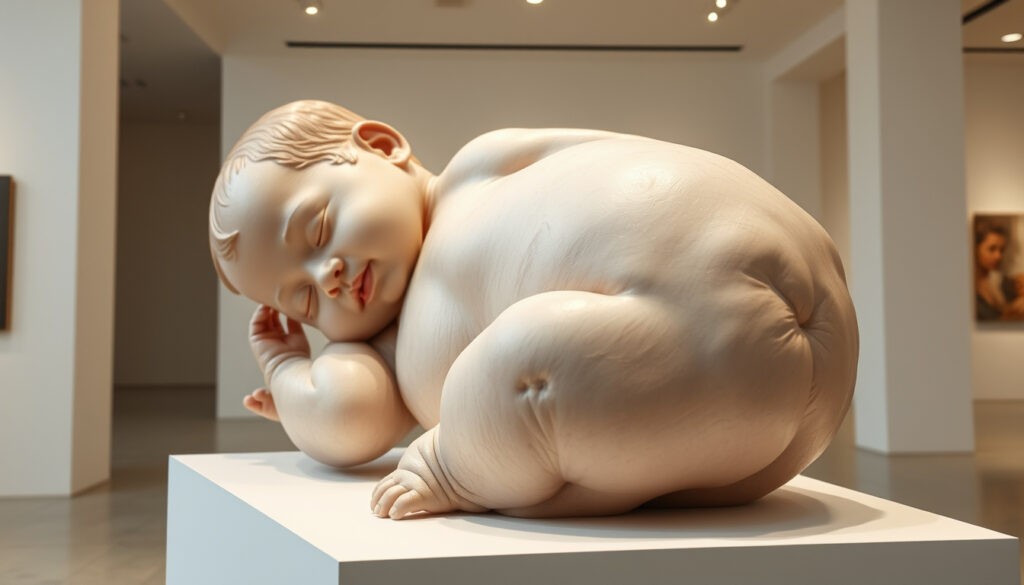
Ron Mueck: Hyperrealistic Sculptures and Famous Works
Most sculptors spend years carving away at stone or clay, but Ron Mueck started his career with a very different kind of material: Muppets. After building puppets for Jim Henson’s Creature Shop, Mueck shifted to fine art and created hyperrealistic human figures that stop viewers in their tracks. This guide explores how a former puppet maker became one of the most talked-about sculptors alive, from the tiny corpse of Dead Dad to the towering skulls of Mass.
Born: 1958, Australia · Known for: Hyperrealistic human figure sculptures · Notable scale: From minute to monumental · Major exhibition: Ron Mueck at Mori Art Museum, 2026 · Instagram followers: 87,000+ · Medium: Silicone, fiberglass, resin, bronze
Quick snapshot
- Born 1958 in Melbourne, Australia (The Broad)
- Started as a puppet maker for Sesame Street and Jim Henson (Museum Voorlinden)
- Moved to UK in 1990 (Museum Voorlinden)
- Transitioned to hyperrealist sculpture after working with Paula Rego (Fondation Cartier)
- Uses silicone, fiberglass, resin, and bronze (Mori Art Museum)
- Works slowly, creating extreme detail and scale manipulation (Thaddaeus Ropac)
- Dead Dad (1996–97) (Thaddaeus Ropac)
- Mass (2017) (Mori Art Museum)
- Big Baby, In Bed (2005) (Museum Voorlinden)
The pattern: Mueck’s life and career are anchored in a single country—the UK—but his roots and recognition are global.
| Detail | Value |
|---|---|
| Full name | Hans Ronald Mueck |
| Birth date | 9 May 1958 |
| Nationality | Australian |
| Residence | United Kingdom |
| Art movement | Hyperrealism |
| Notable exhibition | Ron Mueck at Mori Art Museum, 2026 |
| Spouse | Paula Rego (painter) |
What is Ron Mueck famous for?
What makes his sculptures hyperrealistic?
- Mueck’s figures are cast from life using silicone and fiberglass, capturing every pore and wrinkle (The Broad).
- He manipulates scale to create psychological impact: a tiny figure feels fragile, a giant newborn feels overwhelming (Thaddaeus Ropac).
Mueck doesn’t just replicate the human body; he chooses a scale that forces a specific emotional response. The Mori Art Museum notes that his work evokes “loneliness, vulnerability, anxiety, and resilience” through these careful choices (Mori Art Museum).
Despite his ultra-realistic technique, Mueck never aims for a 1:1 replica. The scale tweak is what makes his work art rather than taxidermy.
How does scale define his work?
- His figures are often smaller or larger than life-size, never exactly 1:1 (Thaddaeus Ropac).
- Dead Dad is reduced to about two-thirds scale, making the viewer feel like a child looking at a parent (Thaddaeus Ropac).
Why this matters: Scale is Mueck’s primary storytelling tool. By making a sculpture slightly smaller than life, he turns a clinical cast into an intimate, uncomfortable encounter. The Broad describes the impact as “humanistic and empathetic” (The Broad).
The implication: Mueck’s hyperrealism isn’t about fooling the eye—it’s about using scale to tap into emotions we usually keep hidden. For viewers, the trade-off is clear: you can’t walk away neutral.
What are some of Ron Mueck’s most famous pieces?
Dead Dad
- Sculpture of his father’s body, reduced scale, created 1996–97 (Thaddaeus Ropac).
- First shown at the 1997 Sensation exhibition at the Royal Academy of Arts (Thaddaeus Ropac).
“I want the viewer to feel the weight of the scale.” – Ron Mueck
The Broad notes that Dead Dad brought Mueck “great acclaim and press attention.”
Mass
- Monumental installation of 100 human skulls made from fiberglass (Mori Art Museum).
- Each skull is a unique, hand-finished piece, creating an overwhelming sense of mortality (Mori Art Museum).
Big Baby
- Oversized sculpture of a newborn (about 5m length) (Museum Voorlinden).
- Playing with scale, the giant infant becomes both adorable and unsettling.
In Bed
- Large-scale sculpture of a woman lying under a blanket, exhibited in 2005 (Museum Voorlinden).
- Captures vulnerability and isolation.
What this means: Each piece uses scale to amplify a single human experience—grief in Dead Dad, mortality in Mass, new life in Big Baby, solitude in In Bed. Mueck’s entire oeuvre can be read as a study of human extremes.
How many sculptures has Ron Mueck made?
How many sculptures does Ron Mueck produce per year?
- Mueck has produced fewer than 50 major pieces in his career (Mori Art Museum).
- Each piece takes months to years to complete, so his output is a sculpture every 1–2 years on average (The Broad).
Mueck’s scarcity is by design: each sculpture is a year-long project. For collectors, that means supply will never meet demand, driving prices higher.
Why is his output relatively small?
- The painstaking process of molding, casting, and finishing each figure in silicone and fiberglass is extremely time-consuming (Fondation Cartier).
- Mueck works alone, without a studio team (Thaddaeus Ropac).
The catch: Mueck’s scarcity is part of his mystique. With so few works in circulation, each new sculpture becomes a major event—and the market follows accordingly.
What is the value of a Ron Mueck sculpture?
How are Ron Mueck’s sculptures priced?
- Mueck’s works fetch high auction prices, often in the hundreds of thousands to millions of dollars (Thaddaeus Ropac).
- Because he works primarily in silicone and fiberglass (not bronze), the market for his pieces is distinct from traditional sculpture (Mori Art Museum).
Are bronze sculptures worth anything?
- Bronze has a long-established market, but Mueck rarely uses it (Fondation Cartier).
- His resin and silicone works command comparable prices due to their rarity and art-world demand.
Is vintage bronze worth anything?
- Vintage bronze can be valuable, but Mueck’s sculptures are not primarily bronze; his medium choice is silicone, fiberglass, and resin (Museum Voorlinden).
- Collectors should be aware that Mueck’s market is driven by his hyperrealistic style and limited output, not by material.
Why this matters for investors: A Mueck sculpture is a bet on contemporary hyperrealism and the artist’s scarcity. While bronze has an established resale history, Mueck’s works follow a different calculus—one where the brand and the art movement matter more than the metal.
Where does Ron Mueck live?
Does Ron Mueck live in the UK or Australia?
- Mueck is based in the United Kingdom, though originally from Melbourne, Australia (Museum Voorlinden).
- He has lived in London for many years.
Why did he move to the UK?
- He moved to the UK in 1990, partly to work with Jim Henson’s Creature Shop (Fondation Cartier).
- The shift allowed him to transition from puppetry into fine art, culminating in his collaboration with Paula Rego (Museum Voorlinden).
The pattern: Mueck’s move to the UK was the catalyst for his artistic identity. Without the exposure to the British art scene—and Rego’s mentorship—the puppet maker might never have become the sculptor the world knows.
Is Ron Mueck married?
- Ron Mueck is married to the British painter Paula Rego (Museum Voorlinden).
- Rego commissioned a sculpture of Pinocchio from Mueck in 1996, which launched his fine-art career (Fondation Cartier).
What to watch: The personal and professional partnership with Rego is often cited as a key influence on Mueck’s trajectory. Their marriage is not just biographical trivia—it’s part of his origin story.
Timeline signal
- 1958 – Born in Melbourne, Australia (The Broad)
- 1980s – Worked as model maker and puppeteer for Sesame Street and Jim Henson (Museum Voorlinden)
- 1996–1997 – Created Dead Dad, breakthrough piece (Thaddaeus Ropac)
- 2005 – In Bed exhibited (Museum Voorlinden)
- 2017 – Mass unveiled (Mori Art Museum)
- 2026 – Major retrospective at Mori Art Museum, Tokyo (Mori Art Museum)
The timeline signal: Each new work comes years apart, but each one resets the conversation around figurative sculpture. The 2026 retrospective in Tokyo will likely draw global attention.
Confirmed facts
- Birth date: 9 May 1958 (The Broad)
- Residence: UK (Museum Voorlinden)
- Spouse: Paula Rego (Museum Voorlinden)
- Notable works: Dead Dad, Mass, Big Baby (multiple sources)
What’s unclear
- Exact number of sculptures – estimates range but no official count (Mori Art Museum)
- Current market valuation of private sales – auction records are sparse
- Details of future exhibitions beyond 2026 – only the Mori show is confirmed
“I want the viewer to feel the weight of the scale.” – Ron Mueck
“His work can evoke loneliness, vulnerability, anxiety, and resilience.” – Mori Art Museum (Mori Art Museum)
For collectors, the opportunity to acquire a Mueck sculpture is rare—fewer than 50 exist. The 2026 retrospective will likely drive renewed interest, but with prices already in the millions, the window for entry is narrow. For art enthusiasts, the best move is simple: book a trip to Tokyo and see Mass in person while you can.
ropac.net, artblart.com, themodern.org, echostains.wordpress.com, facebook.com, art.catholic.org.au, en.wikipedia.org
For a deeper look into how he achieves such lifelike results, explore Ron Muecks sculpting techniques and materials.
Frequently asked questions
Where can I see Ron Mueck’s sculptures?
Mueck’s works are held in major collections including Tate Modern, Fondation Cartier, and Hirshhorn Museum (Museum Voorlinden). His 2026 retrospective at the Mori Art Museum in Tokyo will gather many pieces in one place (Mori Art Museum).
How does Ron Mueck create his hyperrealistic sculptures?
He uses silicone, fiberglass, and resin to cast from life models, then meticulously paints every detail. This labor-intensive process can take months to years per piece (The Broad).
What is the meaning behind Ron Mueck’s Dead Dad?
The sculpture is a reduced-scale likeness of his deceased father. The smaller-than-life size makes the viewer feel like a child looking at a parent, evoking vulnerability and grief (Thaddaeus Ropac).
How long does it take Ron Mueck to make one sculpture?
Each piece takes anywhere from several months to over a year. His output is therefore very low—less than 50 works in his entire career (Mori Art Museum).
Are Ron Mueck’s sculptures made of bronze?
Rarely. Most of his works use silicone, fiberglass, and resin. Bronze is not his primary material (Fondation Cartier).
What is Ron Mueck’s most expensive sculpture?
Exact prices vary, but his works have fetched hundreds of thousands to millions of dollars at auction. Dead Dad and Mass are among the most talked-about and likely the highest-valued (Thaddaeus Ropac).
How did Ron Mueck start his art career?
He began as a model maker for film and television, including Jim Henson’s Creature Shop. His fine-art breakthrough came in 1996 when he made a Pinocchio sculpture for Paula Rego (Fondation Cartier).
What will the Ron Mueck exhibition 2026 feature?
Announced by the Mori Art Museum, the retrospective will showcase his major works, likely including Dead Dad, Mass, Big Baby, and In Bed (Mori Art Museum).
More related posts
 Damien Martyn: Truth Behind the Coma Rumor and His Life Now
 Jane Turner: Biography, Career, Kath & Kim, and Stage Roles
 Lisa Kudrow: Net Worth, Kids, Husband, and Friendship Secrets
 Marlon Williams: Māori Identity, Home, Relationship, Dark Child
 Stuart Broad: Retirement, Net Worth, and Yuvraj Incident
 Peach PRC: Real Name, Age, PRC Meaning, and Rise to Fame
 Kristin Cavallari: Divorce, Kids, Net Worth, Relationship
 Wilmer Valderrama: Ethnicity, Career, Wife, and Net Worth
