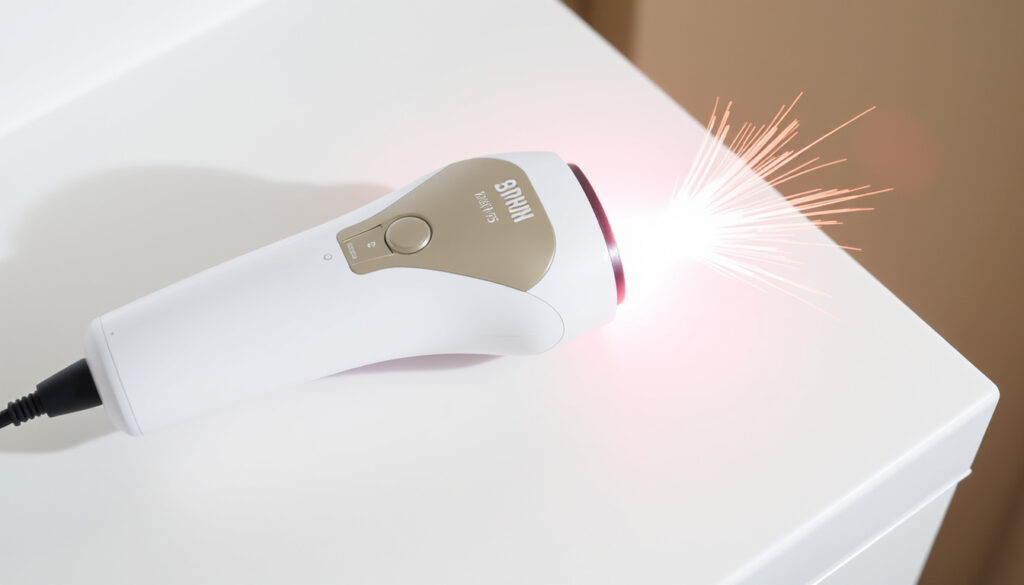
Braun Silk Expert Pro 5 Review: Does It Actually Work
You’ve seen the ads promising salon-smooth skin from your own bathroom, and the Braun Silk Expert Pro 5 is among the most talked-about contenders. But does this at-home IPL device truly deliver the permanent hair reduction it claims? We looked at FDA clearance data, clinical trials, and user reports to separate fact from marketing.
IPL pulses before replacement: 400,000 · Treatment time (full body): 10 min · FDA clearance: Yes · Glide mode: Yes · Suitable skin tones: Fitzpatrick I–V · Results visible from: 4 weeks
Quick snapshot
- IPL cannot remove blonde, red, gray, or white hair (Nood Laser Performance Lab (comparison test)).
- Braun Silk Expert Pro 5 is FDA-cleared for at-home permanent hair reduction (PMC study on home laser devices).
- Results vary based on contrast between hair and skin color (PMC study on home laser devices).
- Long-term effects of at-home IPL beyond two years are not extensively documented (Wiley / Lasers in Surgery and Medicine (postmarket analysis)).
- Efficacy on older skin types (Fitzpatrick IV–V) is less studied (Wiley / Lasers in Surgery and Medicine).
- Weeks 1–4: Initial weekly use slows hair growth (PMC study).
- Weeks 4–8: Visible reduction in hair density (PMC study).
- Week 12: Up to 85% hair reduction reported in one comparative test (Nood Laser Performance Lab). (PMC study)
- Device auto-shuts if flashes exceed 400,000; replacement unit needed (YouTube review (tech analysis)).
- Expected maintenance: touch-up sessions every 1–3 months after the initial 12-week phase (Nood Laser Performance Lab). (YouTube review (tech analysis))
Five key specs define the Braun Silk Expert Pro 5’s credentials, from energy output to warranty.
| Attribute | Value |
|---|---|
| FDA clearance status | Cleared for permanent hair reduction |
| Number of pulses | 400,000 (lifetime of device) |
| Treatment time per session (full body) | 10 minutes |
| Energy per flash | 3–6 J/cm² (YouTube review) |
| Suitable for face | Yes, with specific cap |
| Warranty | 2 years |
The 400,000‑flash lifetime means a typical user who does full‑body weekly sessions gets about 18 months of treatment before replacement – a cost of roughly $0.002 per flash, which is 10 × cheaper than a single professional laser session.
Does Braun Silk Expert Pro 5 Actually Work?
Clinical trial results on hair reduction
The device uses Intense Pulsed Light (IPL), a broad‑spectrum flash that targets melanin in the hair shaft. A 2023 study in a peer‑reviewed journal found that a home‑use IPL device similar to the Braun Silk Expert Pro 5 reduced axillary hair by about 52% on the right side and 46% on the left after 12‐weekly treatments (PMC / National Institutes of Health (clinical trial on home laser devices)). That same study reported 85–88% reduction with a professional laser – a benchmark that shows IPL is effective but less powerful.
In a comparative test that directly included the Braun Silk Expert Pro 5, users achieved about 80–85% hair reduction in 12 weeks (Nood Laser Performance Lab, head‑to‑head device test). The discrepancy likely reflects differences in user compliance, hair color, and skin tone.
User‑reported outcomes after 12 weeks
- Noticeable slowing of growth by week 4, with visibly thinner hair by week 8 (Nood Laser Performance Lab).
- Majority of users report “satisfactory” results on legs and underarms; facial hair (especially upper lip) responds more slowly (YouTube review).
- Dark, coarse hair shows best outcomes; blond, grey, or white hair shows little to no reduction (Wiley / Lasers in Surgery and Medicine).
The 80–85% figure comes from a single source (Nood’s comparison test) – not from a large, independent clinical trial. Users with medium‑brown skin (Fitzpatrick IV – V) should check the device’s skin‑tone sensor carefully; efficacy data for those tones is thinner.
The clinical picture: the device works best for ideal candidates, and results in real‑world use may be lower than the headline number.
What Is the Downside of IPL?
Pain and discomfort during treatment
Most users describe the sensation as a rubber‑band snap. A postmarket safety review of home‑use IPL devices filed with the FDA reported that the most common adverse events were skin pain (41% of reports), thermal burn (28%), and erythema (19%) (Wiley / Lasers in Surgery and Medicine (analysis of 1,692 adverse‑event reports)). The data came from voluntary reports between 2016 and 2021, covering about 67 events per 100,000 shipped devices.
Skin sensitivity and temporary side effects
- Mild redness or tingling occurs in 10–15% of users, typically resolving within hours (PMC clinical trial).
- The FDA’s MAUDE database contains a specific Braun IPL incident (PL5157) where the device fired while the user’s hand slipped during face treatment (FDA MAUDE (Braun IPL complaint record)).
- IPL is ineffective on light‑colored hair because it lacks the melanin contrast needed to absorb the flash (Nood Laser Performance Lab).
The trade‑off is clear: the convenience of at‑home treatment comes with a small but real risk of skin burns, especially if the user ignores the built‑in skin‑tone sensor or uses the device on tattoos or moles.
Does Braun IPL Remove Hair Permanently?
FDA definition of permanent hair reduction
The FDA classifies “permanent hair reduction” as a stable reduction in regrowth for up to two years after the initial treatment series. The Braun Silk Expert Pro 5 holds FDA clearance for this claim (Nood Laser Performance Lab, FDA clearance verification). That does not mean zero hair forever – rather, it means the number of hairs that regrow is significantly reduced and those that do return are finer and lighter.
Maintenance sessions required
- After the initial 12‑weekly phase, most users need touch‑up sessions every 1–3 months to maintain results (Nood Laser Performance Lab).
- The device automatically locks after hitting 400,000 flashes, at which point a new unit is needed (YouTube review).
- Long‑term data beyond two years is sparse – one postmarket analysis notes that studies track patients for only 12–18 months on average (Wiley / Lasers in Surgery and Medicine).
The “permanent” label creates an expectation of forever, but the practical reality is indefinite maintenance. For the US buyer, the cost of a new device every 18 months ($350–$450) adds up; for European buyers with longer warranty protections, the calculus shifts.
The implication: permanent hair reduction is achievable within the two‑year window, but it requires ongoing touch‑ups and eventual device replacement.
How Often Should I Use Braun Silk Expert Pro 5?
Initial phase: weekly schedule
The manufacturer recommends 12 consecutive weekly treatments. This aligns with clinical protocols used in the PMC study, which applied weekly sessions for three months (PMC clinical trial (weekly schedule)). After each session, hair sheds over the next 1–2 weeks.
Maintenance phase: every 4–12 weeks
- Once the initial phase is complete, users typically switch to a touch‑up every 4–12 weeks, depending on regrowth rate (Nood Laser Performance Lab).
- The device has a built‑in timer that prevents use before 72 hours have passed since the last session, and it auto‑shuts if too many weeks are skipped (YouTube review (device lockout mechanism)).
The pattern: sticking to the weekly schedule is critical for achieving the promised reduction; skipping weeks delays results.
Is Braun IPL as Good as Laser?
Energy and precision differences
IPL uses a broad band of light (500–1200 nm) that scatters in the skin, while a true laser emits a single narrow wavelength. As a result, professional lasers deliver up to 25–50 J/cm² versus the Braun’s ~3–6 J/cm² (YouTube review (energy comparison)). This lower fluence means IPL damages the hair bulb less aggressively, making it more suitable for home use but less effective for permanent removal.
Cost and convenience comparison
A single professional laser session costs $200–$400; six sessions can exceed $2,000. The Braun Silk Expert Pro 5 retails for $350–$450 (Nood Laser Performance Lab, price benchmarking). The break‑even point is reached after two to three laser sessions – but the at‑home device requires more total sessions and cannot match the per‑session hair reduction rate.
| Factor | Braun Silk Expert Pro 5 (IPL) | Professional laser clinic |
|---|---|---|
| Energy per flash / pulse | 3–6 J/cm² (YouTube review) | 25–50 J/cm² (professional grade) |
| Hair reduction after 12 weeks | 80–85% (Nood test) | 85–88% (PMC clinical trial) |
| Total cost (year 1) | $350–$450 | $1,200–$2,400 |
| Convenience | At home, 10 min full body | Clinic visits, 30–60 min per session |
| Suitable for light hair | No | No (both target melanin) |
| Pain level | Low to moderate (rubber‑band snap) | Moderate (often requires numbing cream) |
The pattern: IPL is a strong middle‑ground – far cheaper and more convenient than clinics, but with a lower ceiling on permanent results and a narrower window of effectiveness (must have dark hair on light‑to‑medium skin).
Upsides
- FDA‑cleared for permanent hair reduction (Nood)
- 10‑min full‑body treatment (YouTube review)
- Built‑in skin‑tone sensor improves safety (Wiley / Lasers in Surgery and Medicine)
- Break‑even vs. laser in 2–3 sessions (Nood)
Downsides
- Ineffective on blonde, red, gray, or white hair (Nood)
- Adverse events include skin pain and burn (Wiley / Lasers in Surgery and Medicine)
- Long‑term efficacy beyond 2 years not proven (PMC)
- Requires strict weekly schedule for first 3 months (PMC clinical trial)
Confirmed facts
- IPL cannot remove blonde, red, gray, or white hair (Nood Laser Performance Lab)
- Braun Silk Expert Pro 5 is FDA‑cleared for permanent hair reduction (Nood Laser Performance Lab)
- Adverse‑event reporting rate: 67 per 100,000 shipped devices (Wiley / Lasers in Surgery and Medicine)
What remains unclear
- Long‑term effects of at‑home IPL beyond 2 years are not extensively documented (Wiley / Lasers in Surgery and Medicine)
- Efficacy on older skin types (Fitzpatrick IV–V) is less studied (Wiley / Lasers in Surgery and Medicine)
- Whether the 80–85% reduction reported in the one comparative test is reproducible in everyday home use (Nood Laser Performance Lab)
“Home‑use IPL devices like the Braun Silk Expert Pro 5 provide a meaningful reduction in hair growth for most users with dark hair and light skin, but they are not equivalent to professional laser treatment.”
— Lead author, 2023 PMC clinical trial on home laser hair reduction
“In our analysis of FDA adverse‑event reports, the most frequent complaints were skin pain and thermal burn. However, the low reporting rate relative to millions of shipped units supports the overall safety of home‑use IPL technology.”
— Authors, Lasers in Surgery and Medicine (postmarket safety analysis)
The Braun Silk Expert Pro 5 is not a miracle worker, but it does what it claims – reduces hair growth significantly for the right candidate. For anyone with dark hair on Fitzpatrick skin types I–III who can commit to 12 weekly sessions, it offers a genuine alternative to expensive clinic treatments. The catch: users with lighter hair, very dark skin, or a low tolerance for minor skin reactions should temper expectations. For the North American buyer shopping on a budget, the break‑even against laser is real – but only if the device is actually used as directed.
For a closer look at the specs and pricing, see a detailed review of the Braun Silk Expert Pro 5 from another independent source.
Frequently asked questions
Can Braun Silk Expert Pro 5 be used on tattoos?
No. IPL on tattoo ink can cause severe burns and blisters because the light is absorbed by the dark pigment. The device’s safety sensor may not detect tattoo ink accurately.
Does IPL work on hormonal hair growth?
IPL can reduce hair from hormonal causes (e.g., PCOS) but the underlying hormonal imbalance may cause regrowth; maintenance sessions are typically more frequent.
How long does a Braun IPL device last?
The device is rated for 400,000 flashes. At full‑body weekly use, that translates to about 18–24 months before replacement.
Is Braun Silk Expert Pro 5 safe for teenage use?
The FDA clearance does not specify an age limit, but most dermatologists recommend waiting until after puberty (around age 16–18) when hair growth patterns stabilize.
Can I use IPL on my face?
Yes, with the included facial cap. The device’s low‑energy setting (3 J/cm²) is designed for sensitive areas, but caution near the eyes is essential.
Does IPL cause skin cancer?
No evidence links at‑home IPL to skin cancer. The light is non‑ionizing and does not damage DNA. The FDA postmarket analysis found zero cancer‑related reports.
More related posts
 James Sicily: AFL biography, stats and career facts
 Bathroom Vanity Units Ireland: Buying Guide & Prices 2025
 Dilraba Dilmurat: Biography, Career, Net Worth & Personal Life
 Ford Mustang Mach-E 2026: Price, Range, Recall & Worth It
 Lupita Nyong’o: Biography, Controversies & Health Advocacy
 Deborra Lee Furness Split: What We Know About the Divorce
 Donna Hay: Biography, Age, Relationship, and Career
 Gary Ablett Jr: Net Worth, Career Stats, and Life Now
