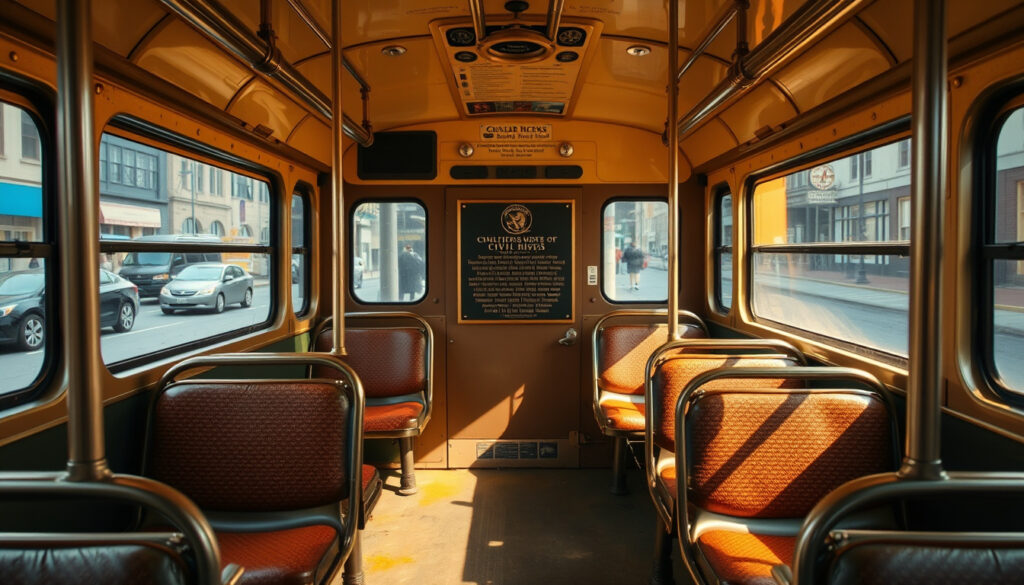
Rosa Parks: The Bus Incident, Life, and Enduring Impact
Few moments in American history pivot on a single decision the way the story of Rosa Parks does. On a Thursday evening in December 1955, her refusal to give up a bus seat in Montgomery, Alabama, ignited a boycott that reshaped the civil rights movement — this article separates the woman from the myth, examining the facts of her life, the deliberate act of resistance, and the legal and social machinery that turned one arrest into a national campaign.
Born: February 4, 1913, Tuskegee, Alabama ·
Key Date: December 1, 1955 (bus incident) ·
Known for: Montgomery Bus Boycott, Civil Rights Activism
Quick snapshot
- Parks was arrested on December 1, 1955, for refusing to give up her seat (U.S. National Park Service).
- The resulting Montgomery Bus Boycott began December 5, 1955 (Rosa Parks Institute).
- The boycott ended after the U.S. Supreme Court ruled bus segregation unconstitutional (Britannica).
- Parks was known as the “Mother of the Civil Rights Movement” (U.S. National Park Service).
- Whether Parks’s arrest was consciously planned as a test case or a spontaneous act of defiance remains a matter of debate among historians (Britannica).
- December 1, 1955: Arrest on Montgomery bus (U.S. National Park Service).
- December 5, 1955: Boycott begins (Rosa Parks Institute).
- November 13, 1956: Supreme Court rules against segregation (Britannica).
- October 24, 2005: Parks dies in Detroit (U.S. National Park Service).
- The Rosa Parks Museum in Montgomery preserves the story and the bus (Britannica).
Six key facts, one throughline: Parks was a trained organizer whose personal stand was the spark for a planned, community-driven movement, not a random event.
| Label | Value |
|---|---|
| Full Name | Rosa Louise McCauley Parks |
| Born | February 4, 1913, Tuskegee, Alabama |
| Died | October 24, 2005, Detroit, Michigan |
| Spouse | Raymond Parks (married 1932) |
| Occupation | Seamstress, civil rights activist |
| Notable Award | Presidential Medal of Freedom (1996) |
What is Rosa Parks famous for?
Rosa Parks is famous for her central role in the Montgomery Bus Boycott and as a catalyst for the civil rights movement. On December 1, 1955, her refusal to vacate her seat on a segregated bus in Montgomery, Alabama, became the flashpoint for a 381-day boycott that challenged racial segregation in public transit.
Parks’s act was not an isolated moment; it was a deliberate and strategic act of civil disobedience. Her arrest and the subsequent boycott demonstrated the power of collective action and nonviolent protest in the fight for racial equality.
Her stand was the match that lit a fire, but the movement was already organized and ready for it.
The implication: The boycott’s success depended not on a single act but on a prepared community ready to act.
The Montgomery Bus Boycott
- The boycott began on December 5, 1955, and lasted for 381 days.
- It was organized by local Black leaders, including Martin Luther King Jr., who rose to prominence during the protest.
- The boycott ended on December 20, 1956, after the U.S. Supreme Court ruled bus segregation unconstitutional.
The boycott’s success marked a turning point in the civil rights movement, demonstrating the effectiveness of nonviolent resistance and economic pressure. It also launched Martin Luther King Jr. into the national spotlight, making him a leading figure in the fight for civil rights.
The implication: Parks’s act was a catalyst, but the boycott’s success was a collective achievement that required the discipline and coordination of an entire community.
What happened to Rosa Parks on the bus?
Rosa Parks was arrested on December 1, 1955, in Montgomery, Alabama, for refusing to give up her bus seat to a white passenger. The bus driver, James F. Blake, ordered Parks and three other Black passengers to vacate their row so a white passenger could sit. When Parks refused, Blake called the police, and she was arrested.
Her arrest on was a direct violation of Montgomery’s segregation ordinance, which required Black passengers to sit in the back of the bus and give up their seats to white passengers if the front was full. Parks’s refusal was not just an act of personal defiance; it was a deliberate challenge to a system of racial segregation that had been enforced for decades.
Parks’s quiet strength masked a deep-seated resolve to challenge an unjust system, even at the risk of personal harm.
What this means: Her composure was not passivity; it was discipline born from years of organizing experience.
The exchange with the bus driver
The encounter between Parks and bus driver James F. Blake has become a defining moment in civil rights history. When Blake ordered Parks to move, she reportedly said, “I don’t think I should have to stand up.” Her quiet refusal was met with Blake’s threat to call the police, to which Parks allegedly replied, “You may do that.”
“I don’t think I should have to stand up.” — Rosa Parks
“You may do that, but I’ll have you arrested.” — James F. Blake
Her arrest was documented in official police records, now preserved by the U.S. National Archives, and her booking photo and fingerprints became symbols of the civil rights movement (U.S. National Archives).
What did the bus driver say to Rosa Parks?
The bus driver, James F. Blake, ordered Parks and other Black passengers to move from their seats so a white passenger could sit. When Parks refused, Blake reportedly said, “You may do that, but I’ll have you arrested.” Parks replied, “You may do that.”
Blake’s threat was not an idle one; under Montgomery’s segregation laws, Black passengers were required to comply with the driver’s orders to maintain racial separation on buses (U.S. National Park Service). Parks’s arrest was the direct result of Blake’s decision to call the police.
The bus driver’s order was intended to reinforce segregation, but it ultimately became the trigger for the boycott that dismantled it.
The pattern: A routine enforcement of Jim Crow law became the turning point that exposed the system’s fragility.
The arrest and aftermath
- Parks was arrested on and taken to the Montgomery city jail.
- She was charged with violating the city’s segregation ordinance and fined $10 plus $4 in court costs.
- Her arrest sparked a 381-day boycott of the Montgomery bus system, beginning .
The boycott was a remarkable display of community solidarity, with Black residents walking for miles or carpooling to avoid public transit. It lasted until , when the U.S. Supreme Court ruled that bus segregation violated the 14th Amendment.
The pattern: Parks’s arrest was the necessary spark, but the boycott’s success depended on the organizational infrastructure of Montgomery’s Black community, including churches, colleges, and civic groups.
How did Rosa Parks die?
Rosa Parks died on , in Detroit, Michigan, at the age of 92. Her death was attributed to natural causes, and she was survived by her husband, Raymond Parks, and their only child, a son named Sidney.
Parks’s death was met with an outpouring of national mourning, and her body lay in state at the U.S. Capitol Rotunda — a rare honor usually reserved for presidents and distinguished leaders. She was also remembered with a state funeral in Montgomery, Alabama, where she had lived for much of her life (Britannica).
Parks’s death marked the end of an era, but her legacy continues to inspire new generations of activists fighting for racial justice.
The implication: Her passing did not close the story; it opened a new chapter in how the nation remembers the cost of civil rights.
Final years and legacy
- Parks received the Presidential Medal of Freedom in from President Bill Clinton.
- She also received the Congressional Gold Medal in 1999, the highest honor Congress can bestow on an individual.
- Her autobiography, “Rosa Parks: My Story,” was published in , providing a first-hand account of her life and activism.
Parks’s legacy goes beyond her famous arrest. She was a lifelong advocate for civil rights, and her work has been recognized by institutions worldwide. The Rosa Parks Museum in Montgomery, Alabama, tells the story of her life and the boycott, while her former home in Detroit is now a national historic landmark.
What this means: Parks’s death was not the end of her impact; it was the beginning of a national reckoning with her legacy.
Did Rosa Parks know Martin Luther King?
Yes, Rosa Parks knew Martin Luther King Jr., and their relationship was central to the Montgomery Bus Boycott. Parks was a member of the NAACP, where she served as a secretary and investigator. King, who was a young pastor at Montgomery’s Dexter Avenue Baptist Church, became the boycott’s most visible leader after being elected president of the Montgomery Improvement Association.
The boycott transformed King into a national figure, and he credited Parks with sparking the movement. In his memoir “Stride Toward Freedom,” King wrote that Parks’s arrest was a “catalytic” event that galvanized Montgomery’s Black community.
Parks and King represented two sides of the same movement: Parks the grassroots organizer and King the charismatic leader. Their partnership helped fuse direct action with strategic planning.
The catch: While Parks and King are often remembered together, their roles were distinct. Parks was the spark; King was the strategist. Their combined efforts were essential to the movement’s success.
Their connection in the civil rights movement
- Parks was a member of the NAACP, where King was an active leader.
- King led the Montgomery Bus Boycott, which Parks’s arrest had inspired.
- The two worked together in the movement, though their roles differed: Parks focused on local organizing, while King focused on national strategy.
The relationship between Parks and King was mutual. Parks often said that she was proud of King’s leadership, while King credited Parks with having the courage to act. Their partnership demonstrated the power of collaboration in the civil rights movement.
The catch: While Parks and King are often remembered together, their roles were distinct. Parks was the spark; King was the strategist. Their combined efforts were essential to the movement’s success.
Rosa Parks achievements and education
Rosa Parks’s education and achievements were rooted in her early life in Alabama. She attended the Industrial School for Girls in Montgomery, where she learned tailoring and other vocational skills. Her education was interrupted by the death of her mother, but she later returned to school and earned a high school diploma.
Parks’s career as a seamstress was not her only role. She was a dedicated civil rights activist who worked with the NAACP for decades. Her achievements include receiving the Presidential Medal of Freedom in and the Congressional Gold Medal in 1999.
Parks’s education gave her the tools to be an effective organizer, but her activism was rooted in lived experience and a deep commitment to justice.
The trade-off: Parks’s education opened doors, but it was her moral courage and strategic thinking that made her a transformative figure in American history.
Early life, education, and awards
- Born Rosa Louise McCauley on in Tuskegee, Alabama.
- Attended the Industrial School for Girls in Montgomery and later received a diploma from Montgomery Industrial School.
- Received the Presidential Medal of Freedom in 1996 and the Congressional Gold Medal in 1999.
Parks’s education was not just formal. She was deeply influenced by her experiences growing up in the segregated South, and she used her knowledge to challenge injustice. Her autobiography, “Rosa Parks: My Story,” was published in 1992, and she received an honorary doctorate from Alabama State University.
The trade-off: Parks’s education opened doors, but it was her moral courage and strategic thinking that made her a transformative figure in American history.
Rosa Parks’s life and legacy offer a powerful example of how one person’s courage can spark a movement. Her refusal to give up her seat on a Montgomery bus was not just a personal act of defiance; it was a deliberate challenge to an unjust system that had oppressed Black Americans for generations. The Montgomery Bus Boycott, which her arrest inspired, was a turning point in the civil rights movement, demonstrating the power of nonviolent resistance and collective action.
Her legacy is celebrated not only through monuments and honors but through the continued fight for racial justice. Parks’s story is a reminder that change is possible when ordinary people come together to demand it. The lesson for modern activists is clear: one person’s stand, combined with strategic planning and community support, can overturn entrenched systems of oppression.
womenshistory.org, history.com, naacp.org, en.wikipedia.org, nps.gov, britannica.com, nationalgeographic.com
Frequently asked questions
Why is Rosa Parks known as the “Mother of the Civil Rights Movement”?
Rosa Parks is famous for her role in the Montgomery Bus Boycott and as a catalyst for the civil rights movement. Her refusal to give up her bus seat on December 1, 1955, sparked a 381-day boycott against racial segregation in public transit.
What were the specific events on the bus that led to her arrest?
On December 1, 1955, Rosa Parks was arrested for refusing to give up her seat to a white passenger. The bus driver, James F. Blake, ordered her to move, but she refused, leading to her arrest and the launch of the Montgomery Bus Boycott.
How did the bus driver respond when Rosa Parks refused to move?
The bus driver, James F. Blake, ordered Parks to give up her seat. When she refused, he threatened to call the police, to which Parks reportedly replied, “You may do that.”
How were Rosa Parks and Martin Luther King Jr. connected?
Yes, Rosa Parks knew Martin Luther King Jr. She was a member of the NAACP, and King led the Montgomery Bus Boycott, which was inspired by Parks’s arrest. Their partnership was central to the civil rights movement.
What was Rosa Parks’s education?
Rosa Parks attended the Industrial School for Girls in Montgomery, Alabama, where she learned vocational skills. She later earned a high school diploma and received an honorary doctorate from Alabama State University.
What honors did Rosa Parks receive after her death?
Rosa Parks died on October 24, 2005, in Detroit, Michigan, at the age of 92. Her death was attributed to natural causes, and she received national honors, including lying in state at the U.S. Capitol Rotunda.
What were Rosa Parks’s achievements?
Rosa Parks received the Presidential Medal of Freedom in 1996 and the Congressional Gold Medal in 1999. She was also known as the “Mother of the Civil Rights Movement” for her role in the Montgomery Bus Boycott.
Related: Most Famous People World Rankings · Virginia Woolf: Facts, Fiction, and Frequently Asked Questions
More related posts
 Booboo Stewart Biography: Age, Movies, and Personal Life
 Fidel Castro: Biography, Legacy, and Cause of Death
 Jordan Mailata: Biography, Contract, Wife, and Background
 Josh Groban Engaged 2025: Katy Perry, Health, Songs
 Kmart Storage Containers: Best Tubs, Boxes & Bags for Home
 Jane Turner: Biography, Career, Kath & Kim, and Stage Roles
 Adam Hyde: Biography, Age, and Relationship with Abbie Chatfield
 Bryan Johnson: Wealth, Diet, and Biological Age
