Vasco da Gama: Biography, Route to India, and Legacy
Vasco da Gama’s voyages did more than open a sea route to India; they reshaped global trade and set the stage for colonial empires. His legacy, however, is also marked by violence and the human cost of expansion.
Born: c. 1460 in Sines, Portugal Died: December 24, 1524 in Cochin, India First India voyage: 1497–1499 Rounded Cape of Good Hope: November 22, 1497 Voyages to India: Three (1497–99, 1502–03, 1524)
Who was Vasco da Gama?
- Portuguese explorer and nobleman – Britannica biography
- Born around 1460 in Sines, Portugal – Britannica
- Credited with establishing the sea route to India – BBC History
What did he achieve?
- First European to sail directly from Europe to India – The Mariners’ Museum
- Voyages opened up the spice trade – BBC History
- Later served as governor and viceroy in India – Britannica summary
Why is he significant?
- Ushered in the Age of Discovery – History.com
- Laid foundation for Portuguese colonial empire – EBSCO Research Starters
- Changed global maritime navigation – World History Encyclopedia
Fast Facts
- Full name: Vasco da Gama – Biography.com
- Born: c. 1460, Sines, Portugal – Britannica
- Died: December 24, 1524, Cochin, India – Britannica summary
- Number of voyages to India: 3 – Britannica
The following key facts provide a quick reference to da Gama’s life and achievements.
| Label | Value | Source |
|---|---|---|
| Full name | Vasco da Gama | Britannica |
| Born | c. 1460, Sines, Portugal | Britannica |
| Died | December 24, 1524, Cochin, India | Britannica summary |
| Occupation | Explorer, navigator, nobleman | Britannica |
| Known for | First maritime route from Europe to India | BBC History |
| Number of voyages to India | 3 | Britannica |
| Title | 1st Count of Vidigueira, Governor and Viceroy of Portuguese India | Britannica summary |
What is Vasco da Gama famous for?
Discovery of the first maritime route to India
Vasco da Gama is best known as the first European to sail from Europe to India by rounding Africa’s Cape of Good Hope. This achievement, completed between 1497 and 1499, opened a sea-based trade route that bypassed overland paths controlled by Arab and Venetian merchants. According to BBC History, the voyage broke the monopoly of Arab and Venetian spice traders. The route took advantage of prevailing winds by sailing far into the Atlantic before swinging back toward southern Africa, a technique still used by sailing vessels today (BBC History).
His voyages and contributions to the Age of Discovery
Da Gama made three voyages to India, each reinforcing Portuguese presence in the Indian Ocean. His expeditions were commissioned by King Manuel I of Portugal to find a maritime route to the East and to tap into the lucrative spice trade. The Mariners’ Museum describes him as the first European to sail to India by going around Africa, a feat that shifted the center of European trade from the Mediterranean to the Atlantic. The EBSCO Research Starters note that his arrival in India in 1498 marked a turning point for European naval dominance in Asian waters.
“He was the first European to sail to India by going around Africa.”— The Mariners’ Museum, Ages of Exploration
When did Vasco da Gama discover India?
Timeline of his first voyage (1497–1499)
Da Gama’s first expedition set sail from Lisbon in July 1497 with four vessels (History.com). The fleet rounded the Cape of Good Hope in late November 1497 and reached Calicut (now Kozhikode) on India’s southwest coast on May 20, 1498. The voyage included stops at Mozambique, Mombasa, and Malindi on the East African coast (History.com). He returned to Portugal in 1499, having established the first direct sea route between Europe and India (World History Encyclopedia).
The exact date of reaching Calicut
Most sources agree that da Gama arrived in Calicut on May 20, 1498. The Britannica entry places the landing in 1498, while BBC History confirms the date as May 20. The EBSCO entry specifies that he rounded the Cape of Good Hope on November 22, 1497, giving a precise marker for the journey’s midpoint.
- c. 1460 – Vasco da Gama is born in Sines, Portugal. Britannica
- 1497–1499 – First voyage to India, discovering the sea route. Britannica
- May 20, 1498 – Arrives in Calicut, India. History.com
- 1502–1503 – Second voyage to India, leading a fleet to enforce Portuguese interests. Britannica
- 1524 – Appointed viceroy; sails to India for the third time. Britannica summary
- December 24, 1524 – Dies in Cochin, India. Britannica summary
What happened to Vasco da Gama?
His later voyages and governorship
Da Gama returned to India twice more. In 1502–1503, he led a heavily armed fleet aimed at intimidating local rulers and disrupting Arab shipping. He was later appointed Portuguese viceroy in India in 1524, a role that required him to oversee colonial administration. However, his tenure was cut short by illness soon after arriving in Goa (Britannica summary).
Death and legacy
Vasco da Gama died on December 24, 1524, in Cochin, India. His body was later returned to Portugal and buried in the Jerónimos Monastery in Lisbon. His legacy is double-edged: celebrated for opening the sea route to India and condemned for the brutality he employed in establishing Portuguese dominance. The BBC History notes that the voyage broke the monopoly of Arab and Venetian spice traders, but also set a pattern of colonial exploitation.
“Da Gama’s voyages opened sea trade routes between Europe and Asia, but they also brought conflict and colonial subjugation.”— Britannica biography
What is the real name of Vasco?
Full name and title
His full name is simply Vasco da Gama. “Vasco” is a given name; “da Gama” is a family name. He was later granted the title 1st Count of Vidigueira. Variant spellings in historical documents include “Vasco da Gama” with occasional diacritics; no alternative “real name” exists.
Common variations in spelling
In Portuguese, the name is written “Vasco da Gama” without accent marks. Modern English references use the same form. There are no known aliases or pseudonyms.
Are there descendants of Vasco da Gama still alive today?
Genealogy and lineage
Vasco da Gama had seven children with his wife, Catarina de Ataíde. His descendants inherited the title Count of Vidigueira, which continued for centuries. Several noble families in Portugal claim descent from him.
Current status of descendants
Documented descendants of Vasco da Gama are alive today. The title of Count of Vidigueira eventually became extinct in the 20th century, but the genetic lineage continues through collateral branches. Genealogical records are maintained by Portuguese historical societies.
Who landed in India first?
European explorers before da Gama
Vasco da Gama is widely recognized as the first European to reach India by sea, but earlier travelers like Marco Polo (13th century) and other medieval missionaries had reached India overland. The overland route was long and dangerous, and no European had succeeded in sailing there.
Other claims to reaching India by sea
Some historians note that earlier exploratory voyages by the Portuguese, such as those of Diogo Cão and Bartolomeu Dias, laid the groundwork by charting the African coast. However, da Gama’s 1498 arrival in Calicut is the accepted first sea voyage from Europe to India. The Britannica explicitly credits him with being the first.
Who came first, British or Dutch?
Portuguese arrival
The Portuguese, led by Vasco da Gama, arrived in India in 1498, establishing the Estado da Índia.
Dutch arrival
The Dutch East India Company (VOC) entered Indian waters in the early 17th century (first voyage 1595–1597). They established trading posts but never achieved the same territorial control as the Portuguese.
British arrival
The English East India Company was founded in 1600 and established its first factory in Surat in 1613. Both the Dutch and British arrived more than a century after the Portuguese.
Be aware: many accounts of da Gama’s first voyage downplay the violence he authorized against local populations, including attacks on Muslim ships and the massacre of pilgrims. These actions set a grim precedent for European colonization.
Editorial judgment: The human cost of da Gama’s voyages is often omitted from simplified narratives. Including it provides a more balanced understanding of the Age of Discovery.
Confirmed facts
- Vasco da Gama was the first European to reach India by sea (1498). Britannica
- He made three voyages to India. Britannica
- He died in Cochin, India, in 1524. Britannica summary
What remains unclear
- Exact birth date is uncertain; it is often given as c. 1460. Britannica
- Details of his early life are not fully documented. Britannica
- The exact date of his departure from Lisbon is sometimes listed as July 8, 1497, though some sources vary. History.com
Frequently Asked Questions
What was Vasco da Gama’s route?
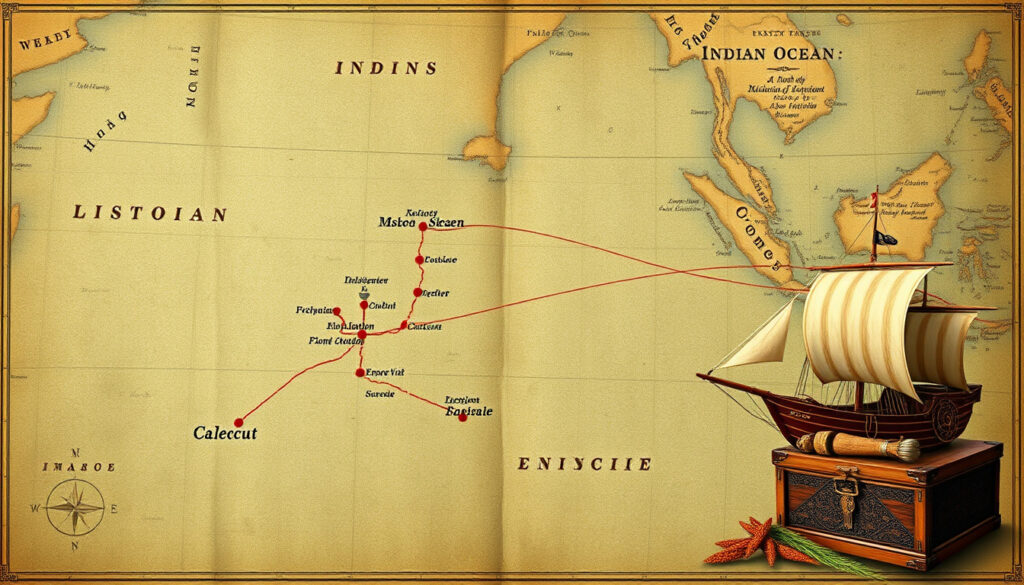
Da Gama sailed from Lisbon down the west African coast, then swung far out into the Atlantic to use the westerly winds before rounding the Cape of Good Hope. He then followed the East African coast, stopping at Mozambique, Mombasa, and Malindi, before crossing the Indian Ocean to Calicut.
How many voyages did Vasco da Gama make to India?
He made three voyages: 1497–1499, 1502–1503, and 1524 (during which he died).
Who accompanied Vasco da Gama on his first voyage?
The fleet of four ships included his brother Paulo da Gama, the pilot Pero de Alenquer, and a crew of about 170 men. He also took padrões (stone pillars) to claim lands for Portugal.
Where did Vasco da Gama die?
He died in Cochin, India, on December 24, 1524.
What was the impact of Vasco da Gama’s voyages?
They opened the sea route to India, broke the Arab-Venetian spice monopoly, and initiated Portuguese colonial rule in Asia. The voyages also set a precedent for European maritime expansion and the exploitation of Asian resources.
Was Vasco da Gama the first European to reach India by sea?
Yes, he is credited as the first European to sail directly from Europe to India, arriving in Calicut in 1498.
Why is Vasco da Gama considered important in history?
He dramatically altered global trade routes, enabled the Portuguese Empire’s growth, and his voyages marked the beginning of a new era of naval exploration and colonization.
Vasco da Gama’s actions permanently rerouted world commerce from the Mediterranean to the Atlantic, a shift that ultimately benefited northern European powers and marginalized the overland trade networks of the Middle East.
More related posts
 Jonathan Brown Brain Surgery: Tumor, Concussions, and CTE
 Tiffany Salmond: Age, Location & NRL Presenter Controversy
 Samantha Lewes: Life, Death & Legacy of Tom Hanks’ First Wife
 $100 Million Winner – Sydney Father Claims Powerball Jackpot
 Aimee Garcia Biography: Age, Ethnicity, and Movies
 Ryan Seacrest: Relationship, Weight Loss, Net Worth
 Karl Pilkington: What Happened, Current Life, and Future Plans
 Qin Shi Huang: First Emperor of China and His Legacy
