1 Cup in mL – US Metric Imperial Conversions
The question of what 1 cup equals in milliliters seems straightforward, yet the answer varies depending on which measurement system a recipe follows. This guide examines official standards from NIST and the USDA, alongside regional differences that affect baking and cooking measurements worldwide.
Understanding cup measurements matters because using the wrong volume can throw off recipes, particularly in baking where precision counts. The distinction between a US customary cup and a metric cup represents more than a 10 mL gap—it reflects different historical standards and culinary traditions.
How Many mL Are in 1 Cup?
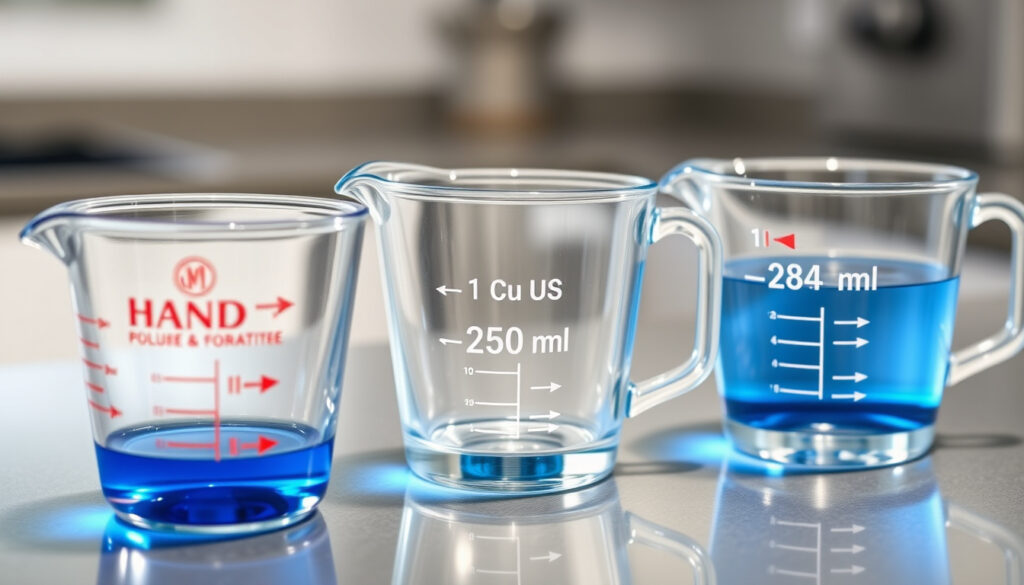
The most commonly cited value in American kitchens is 240 mL, though official sources vary slightly. The National Institute of Standards and Technology defines 1 cup as 240 mL for metric conversions. The USDA’s Food Buying Guide lists 8 fluid ounces as 236.59 mL, with 1 fluid ounce equaling approximately 29.57 mL.
For practical purposes, most American recipes treat 1 cup as 240 mL. The difference between this rounded figure and the USDA’s precise 236.59 mL rarely affects recipe outcomes when measuring liquids.
Quick Reference Overview
236.6–240 mL
250 mL
~284 mL
240 mL
Key Conversion Facts
- A US customary cup equals 236.59 mL (USDA) or 240 mL (NIST rounded value)
- A metric cup (UK, Australia, Canada) measures exactly 250 mL
- The difference between US and metric cups is 10 mL—about 4%
- Water density is 1 g/mL, so 1 cup of water weighs approximately 240 grams
- Historical UK imperial cups measured around 284 mL before metrication
- Baking recipes benefit from weight measurements over volume for consistency
Volume Conversion Standards
| Cup Type | Milliliters | Fluid Ounces | Common Use |
|---|---|---|---|
| US Customary | 236.6–240 mL | 8 fl oz | United States recipes |
| Metric Cup | 250 mL | 8.45 fl oz | UK, Australia, Canada |
| Imperial (historical) | ~284 mL | 10 fl oz | Pre-metric UK recipes |
| US Legal Cup | 240 mL | 8.12 fl oz | FDA labeling |
The USDA defines 8 fluid ounces as exactly 236.59 mL, while NIST rounds to 240 mL for kitchen conversions. Most recipe developers use the rounded value for simplicity, but precision matters in commercial food production.
US Cup vs. Metric Cup: Key Differences
The distinction between US and metric cups represents fundamentally different measurement philosophies. The US customary system evolved from colonial-era British imperial units, while metric cups were adopted during the 20th century metrication waves in Commonwealth countries.
Metric Cup (250 mL)
The metric cup, standardized at 250 mL, is used throughout the United Kingdom, Australia, Canada, and many other countries that have adopted the metric system. This measurement aligns with the International System of Units and makes calculations straightforward since it represents a quarter of a liter.
Australia and New Zealand use the 250 mL cup exclusively in modern recipes. The United Kingdom similarly standardized on this value after metrication, though historical British recipes may reference the older imperial cup of approximately 284 mL.
Imperial Cup Variations
Before metrication, the British imperial cup measured roughly 10 fluid ounces, or about 284 mL. This historical measurement appears in older cookbooks and traditional recipes from before the 1970s. Converting these legacy recipes requires awareness of the larger volume to avoid adding too much of an ingredient.
Canada presents an interesting case. While geographically aligned with the United States, Canadian recipes typically use the 250 mL metric cup in baking contexts. Food packaging in Canada often displays both measurements, reflecting the country’s dual heritage.
When following recipes from different countries, note that a British or Australian recipe using 1 cup likely means 250 mL, while an American recipe using 1 cup means 236-240 mL. This 10-14 mL difference compounds in recipes with multiple cups of ingredients.
1 Cup in mL for Baking and Cooking
Applying cup measurements in the kitchen requires understanding how different ingredients behave. Liquids and dry goods behave differently in measuring cups, and the density of ingredients affects weight-to-volume relationships.
Dry Ingredients: Flour and Other Staples
Flour presents particular challenges for volume measurement because its density varies based on how it is packed into the cup. King Arthur Baking, a respected American baking authority, specifies 120 grams of all-purpose flour per cup. Cotswold Flour lists 120 grams unsifted or 110 grams sifted flour per US cup measurement.
Different measurement techniques yield different results. Scooping flour directly from a bag compacts it, yielding approximately 130-140 grams per cup. The spoon-and-level method, which involves sprinkling flour into the cup and leveling it with a straight edge, produces approximately 120-130 grams depending on the source.
| Source | Unsifted Flour (g) | Sifted Flour (g) |
|---|---|---|
| King Arthur Baking | 120 g | — |
| Cotswold Flour | 120 g | 110 g |
| Cook Like Czechs (spooned) | 130 g | — |
Liquid Measurements
Liquids offer more consistent conversions because water-based fluids have predictable densities. One US cup of water equals exactly 240 grams, or 240 mL, at standard room temperature. Milk, juice, and other water-based liquids convert similarly, though oils and denser liquids may vary slightly.
For liquid measurements, using a clear measuring cup with volume markings ensures accuracy. The meniscus—the curved surface of the liquid—should be read at eye level, with the measurement taken from the lowest point of the curve.
No official standard exists for flour volume-to-weight conversion. NIST and USDA provide volume measurements only. Baking authorities recommend weighing flour for consistent results, as the difference between 120 g and 130 g per cup affects dough hydration and final texture.
Cup Sizes in Different Countries
Cup sizes vary significantly across international measurement systems, creating potential confusion for home cooks following recipes from different regions. Understanding these variations helps ensure recipe success regardless of the cookbook’s origin.
United States
The US customary cup of 236.6-240 mL remains standard in American kitchens. This measurement is legally defined for food labeling purposes and appears on most American measuring cups sold in hardware stores and kitchen supply retailers.
United Kingdom and Commonwealth Nations
Following metrication, the United Kingdom adopted the 250 mL cup as standard. Australia, New Zealand, and Canada similarly use this metric cup in contemporary recipes. The shift simplified international recipe adaptation since all metric-using countries share the same cup volume. For more information on conversions, check out Kalorienbedarf zum Abnehmen berechnen.
For those following British recipes from before metrication, the imperial cup of approximately 284 mL may appear. These older recipes require adjustment when converting to modern US measuring equipment.
| Country | Cup Volume | Notes |
|---|---|---|
| United States | 236.6–240 mL | Standard US measuring cup |
| United Kingdom | 250 mL | Post-metrication standard |
| Australia | 250 mL | Metric cup since 1970s |
| Canada | 250 mL | Common in baking; dual labeling |
| Japan | 200 mL | Traditional cup measurement |
| South America | 200–250 mL | Varies by country |
Official Standards and Historical Context
The standardization of cup measurements traces back to the Mendenhall Order of 1893, which established the US customary system based on English units and metric equivalents. This historical decision shaped American measurement conventions that persist in modern kitchens.
The National Institute of Standards and Technology maintains the official definitions used in federal contexts, while the Food and Drug Administration applies these standards for nutrition labeling. Commercial food production typically adheres to the precise USDA values for consistency.
Baking authorities like King Arthur emphasize weight measurement over volume for professional results. Their ingredient weight guides reflect research into how different flours and ingredients perform when measured precisely. This approach eliminates the variability introduced by packing density and measurement technique.
Sources and Official References
The National Institute of Standards and Technology provides the authoritative US customary definitions for kitchen measurement conversions.
USDA food buying guides use 8 fluid ounces equaling 236.59 mL for institutional and commercial food preparation calculations.
Summary
The conversion of 1 cup to milliliters depends on the measurement system in use. American recipes typically follow the US customary standard of 236.6-240 mL per cup, while recipes from metric-using countries call for 250 mL. Historical imperial cups measured approximately 284 mL and appear in older British recipes.
For baking specifically, flour weight varies by measurement method, ranging from 110-130 grams per US cup depending on sifting and packing. Professional bakers recommend weighing ingredients when precision matters, though household cooks can achieve good results with consistent technique.
Frequently Asked Questions
Is 1 cup exactly 250 mL?
No. A US customary cup equals approximately 236.6-240 mL. Only metric cups (used in UK, Australia, Canada) measure exactly 250 mL. The common 250 mL approximation comes from rounding for simplicity.
How many mL in 1 cup of water?
One US cup of water equals 240 mL or 240 grams, since water has a density of 1 g/mL. The USDA defines this as 236.59 mL for precise calculations.
What is the difference between US and metric cups?
The US cup measures 236.6-240 mL, while the metric cup measures exactly 250 mL. This 10-14 mL difference affects recipe proportions, particularly in multiple-cup measurements.
How many mL is an imperial cup?
A historical imperial cup (pre-metric UK) measured approximately 284 mL or 10 fluid ounces. Modern UK recipes use the 250 mL metric cup instead.
Why do different sources give different cup measurements?
Different sources reflect different measurement systems and rounding conventions. NIST rounds to 240 mL, while USDA uses the precise 236.59 mL. Metric countries use 250 mL. No single value satisfies all standards.
How much flour is in 1 cup?
Flour weight varies by measurement method: approximately 120 g per cup using the spoon-and-level method (King Arthur, Cotswold), 110 g if sifted, and up to 130-140 g if scooped directly from a bag.
More related posts
 Vivienne Jolie-Pitt: Biography, Family, and 2026 News
 Voting Near Me: Find Your Polling Station in Ireland
 ASX:BHP – Share Price, Performance and FY2025 Results
 Our Generation Dolls: Sizes, Reviews & Ireland Guide
 Chance Combs: An Inside Look at Diddy’s Daughter
 Sophie Dee: Biography, Net Worth, and Career Highlights
 Julie Andrews in 2024: Life, Health, Family, and New Projects
 Aimee Garcia Biography: Age, Ethnicity, and Movies
