Saturn Devouring Goya: Goya’s Saturn Painting Explained
There is a reason Goya’s Saturn Devouring His Son stops people mid-step in Madrid: it was never meant to be seen. Painted directly onto the plaster wall of his villa, the Quinta del Sordo, around 1819–1823, it stayed in that private house until restorers moved it to canvas in the 1870s (Wikipedia (reference aggregator)).
Location: Museo del Prado, Madrid · Date: c. 1819–1823 · Medium: Oil on canvas transferred from wall plaster · Dimensions: 143 × 81 cm · Series: One of Goya’s 14 Black Paintings
Quick snapshot
- Goya painted it on the plaster wall of his home, Quinta del Sordo; the Prado now holds it (Wikipedia (reference aggregator)) (Artnet News (art market publication))
- It is one of the 14 murals known as the Black Paintings (Artnet News (art market publication))
- The exact painting date is not documented; estimates center on c. 1819–1823 (Wikipedia (reference aggregator)) (Simon Fraser University (university art history resource))
- The link to the Cronus myth is an interpretation, not a title Goya authenticated (Simon Fraser University (university art history resource))
- 1819: Goya moves into the Quinta del Sordo (Artnet News (art market publication))
- 1873–1876: restorers transfer the murals to canvas; 1881: the Prado acquires them (Wikipedia (reference aggregator))
- See the painting today at the Museo del Prado, Madrid (Wikipedia (reference aggregator))
- Art historians still debate whether the giant represents Saturn, Cronus, or Time itself (Simon Fraser University (university art history resource))
Seven catalogue fields, one pattern: the object is stable, while its meaning and original title are not.
| Field | Detail |
|---|---|
| Full title | Saturn Devouring His Son, also called Saturn Devouring One of His Sons |
| Artist | Francisco de Goya y Lucientes |
| Date | c. 1819–1823 |
| Medium | Oil on canvas transferred from plaster |
| Dimensions | 143 × 81 cm (56 × 32 in) |
| Location | Museo del Prado, Madrid |
| Series | Black Paintings |
| Source basis | Catalogue data aggregated by Wikipedia (reference aggregator) |
What is the meaning behind Francisco Goya’s painting ‘Saturn Devouring His Son’?
No one knows what Goya thought he was painting. He produced the image on a wall in his own house, and he left no note, letter, or title that explains it (Wikipedia (reference aggregator)).
Goya’s Black Paintings and the work’s place in them
- The Black Paintings: 14 murals Goya made at the Quinta del Sordo in his late years (Artnet News (art market publication))
- Painted directly over the plaster of the room, not on a conventional canvas (Wikipedia (reference aggregator))
- Goya never supplied original titles or notes for the group (Wikipedia (reference aggregator))
Because the house was a home, not a gallery, the earliest audience for Saturn was private. This is art with no commissioner and no public, which helps explain why it is so blunt.
Main interpretations: age, fear, and political violence
- Myth: the Titan Cronus, called Saturn in Rome, ate his children because a prophecy said one would overthrow him (Artnet News (art market publication))
- Politics: some modern interpretations read the giant as power that consumes its own young — a resonant image for Spain under Ferdinand VII (Artnet News (art market publication))
- Aging: some readings see the desperate giant as a figure of time and mortality consuming the future (Simon Fraser University (university art history resource))
None of these readings has a documentary smoking gun. The myth identification came to the painting from outside, from viewers who recognized the story (Simon Fraser University (university art history resource)).
The painting is famous as an explanation of a myth, yet its real subject may be the absence of explanation. Visitors see a father eating a child; no source tells us whether Goya meant the father to be himself, the state, or Time.
Reading the painting’s composition
- Unlike Rubens’s earlier Saturn, who bites a small infant, Goya’s victim is adult-sized (Simon Fraser University (university art history resource))
- Goya had already drawn a similar Saturn scene in red chalk around 1796–1797 (Simon Fraser University (university art history resource))
- The scene has no setting: no throne, no sky, no room — only darkness
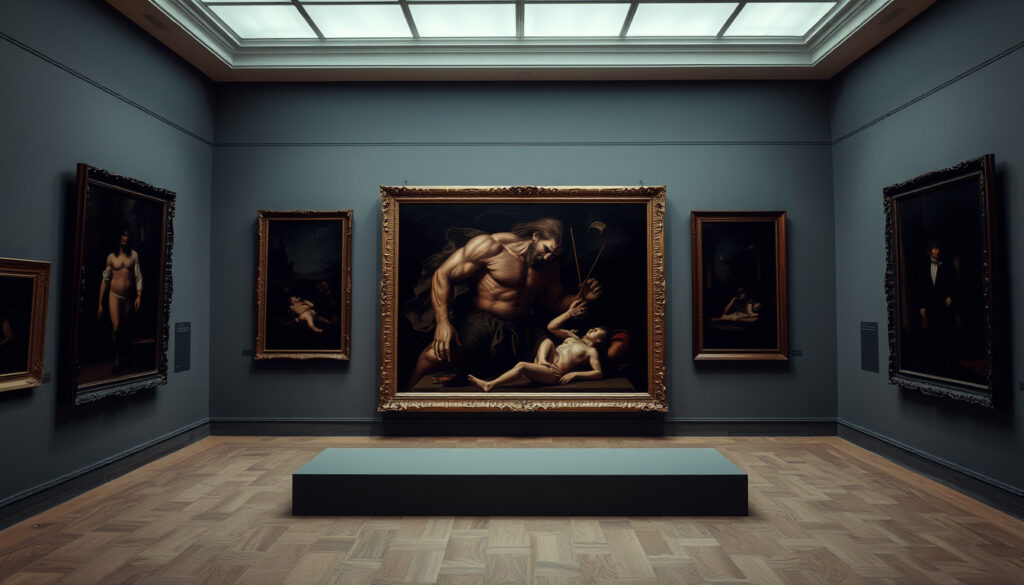
Read the composition and you see a compression: the whole myth is reduced to one open mouth. That is what makes the image feel modern rather than mythological.
Where is Goya’s Saturn displayed?
The short answer is one museum: the Prado, in Madrid.
Museo del Prado, Madrid
- Current home: Museo del Prado, Madrid, which holds the painting in its Goya collection (Wikipedia (reference aggregator))
- The Black Paintings arrived at the museum as a group after the 19th-century transfer (Wikipedia (reference aggregator))
For most of its public life, Saturn has been part of the Prado’s collection.
Provenance from the Quinta del Sordo
- Goya moved into the Quinta del Sordo in 1819, according to later accounts (Artnet News (art market publication))
- The mural was painted directly on the villa’s plaster and stayed there for roughly fifty years (Wikipedia (reference aggregator))
A private house is a strange birthplace for one of the most reproduced images in Western art. But that may be why it survived: no patron demanded polish, and no critic defined its meaning for Goya.
Transfer and conservation
- In 1873–1876, restorers cut the murals from the plaster and transferred them to canvas (Artnet News (art market publication))
- The work entered the Prado’s collection in 1881 (Wikipedia (reference aggregator))
- The wall no longer exists as a support; what survives is the paint layer on canvas
The transfer saved the paintings, but it also changed them. A mural meant for a dark private room became a flat, portable museum object.
Conservators rescued the Black Paintings by removing them from the walls — yet that rescue erased the original architecture. The villa Goya painted on is gone, and no visitor can ever stand in that room.
The catch: the painting’s home is a museum, but its true context was a private wall. Visitors see a masterpiece; Goya’s own world would have seen a strange and frightening decoration.
What are the dimensions of Goya’s ‘Saturn Devouring His Son’?
The number that surprises people: the canvas is 143 × 81 cm, about the size of a tall door (Wikipedia (reference aggregator)).
Dimensions and medium
- The current medium is oil on canvas, after beginning life as oil on plaster (Wikipedia (reference aggregator))
For a myth of this scale, the object is compact. The narrow vertical format pushes the giant hard against the edges of the frame.
Scale in context
- Saturn is one of the smaller compositions among the Black Paintings (Artnet News (art market publication))
- Some of the other murals in the set were designed for much larger wall surfaces (Wikipedia (reference aggregator))
Scale changes the viewing experience. A wall-sized fresco invites you to stand back; a narrow canvas invites you to lean in — and leaning into this painting is deliberately uncomfortable.
What changed during transfer
- The support changed from wall plaster to canvas in the 1870s (Artnet News (art market publication))
- The dimensions you see quoted today describe the canvas, not the original plaster surface
Conservation is the quiet third author of this work. The flat, framed image that you have seen in books is a 19th-century intervention, not Goya’s original presentation.
Small scale means close viewing, and close viewing makes the violence feel immediate. That is why the painting works in reproduction and still stops visitors cold in the Prado.
What this means: the painting that hangs in Madrid is a transported, re-supported survivor. Every reproduction you have seen is one step further from the plaster Goya actually touched.
Is Saturn Devouring His Son actually Saturn?
The figure is named after Saturn, the Roman god identified with the Greek Titan Cronus — and, yes, the painting is sometimes searched as “Saturn Devouring Goya,” which accidentally swaps the god for the artist (Wikipedia (reference aggregator)).
Roman Saturn and Greek Cronus
- Saturn (Roman) and Cronus (Greek) are the same Titan, who swallowed his children after hearing a prophecy (Artnet News (art market publication))
- Cronus had himself overthrown his father, Uranus, and suspected his own offspring would do the same (Artnet News (art market publication))
- Rhea saved Zeus by giving Cronus a stone wrapped in cloth instead of the newborn (Artnet News (art market publication))
Goya’s painting is called Saturn because of the Roman name, but the story is Greek. Which name you use usually tells you which tradition you are reading.
What the myth describes
- The myth is a story about power and succession: a father destroys his heirs to protect his throne (Artnet News (art market publication))
- Zeus escaped, fulfilled the prophecy, and eventually defeated and imprisoned Cronus (All That’s Interesting (history magazine))
The painting shows only the eating — no prophecy, no rescue, no downfall. Goya cuts the story to a single frame.
How Goya transforms the god
- The figure is not a calm classical god: he is wild-eyed, gaunt, and monstrous
- In Rubens’s version the victim is an infant; in Goya’s the body is adult-sized, which complicates the literal myth reading (Simon Fraser University (university art history resource))
- There are no divine attributes — no crown, no scepter — only hunger
Goya painted the myth without its mythology: a god reduced to appetite. That transformation is why “Saturn Devouring His Son” belongs to him as much as to the ancient story.
Why was Goya so dark?
The short answer involves illness, war, and the political wreckage of Spain. The longer answer starts in 1792.
What are the dark paintings of Francisco de Goya known for?
- Known for their dark palette, disturbing subjects, and private origin (Artnet News (art market publication))
- They were painted on the walls of Goya’s house, not for exhibition (Wikipedia (reference aggregator))
The label “Black Paintings” comes partly from the colors — blacks, browns, ashy grays — and partly from the subjects: violence, loneliness, and fear.
What did Francisco Goya suffer from?
- In 1792 Goya suffered a severe illness that left him permanently deaf; the exact diagnosis is still uncertain (Artnet News (art market publication))
- He described the illness and isolation in letters to Martín Zapater (Artnet News (art market publication))
No one knows what the illness was, and the exact diagnosis is uncertain. The consequence is clear: Goya emerged deaf, and his art changed.
What is Francisco Goya’s most famous painting?
- Two works usually compete for the title: The Third of May 1808 and Saturn Devouring His Son (Wikipedia (reference aggregator))
- Both centre on violence, and both refuse to offer a heroic exit
There is no single consensus on Goya’s most famous painting. But Saturn is the one people describe first when they talk about his darkness.
Where does ‘Saturn’ fit in Goya’s late work?
- Saturn belongs to Goya’s late, private style, often tied to the violence and instability of early 19th-century Spain (Tripimprover (arts and travel commentary))
- The Black Paintings came after the Peninsular War and the restoration of Ferdinand VII (Tripimprover (arts and travel commentary))
- Goya’s motives are not recorded; interpretations rely on historical context, biography, and the paintings themselves (Simon Fraser University (university art history resource))
Saturn is the doorway into that late world. Once you know it was painted on a wall in Goya’s own house, the court portraits from earlier in his career read very differently.
Technical profile: Saturn Devouring His Son
Ten specification rows, one pattern: the painting that hangs in Madrid is a transported, re-supported survivor — not a wall mural that stayed in place.
| Specification | Detail |
|---|---|
| Artist | Francisco de Goya y Lucientes |
| Date | c. 1819–1823; exact date not documented (Wikipedia (reference aggregator)) |
| Original support | Plaster wall, Quinta del Sordo |
| Current support | Canvas, transferred 1873–1876 (Artnet News (art market publication)) |
| Original medium | Oil on plaster |
| Current medium | Oil on canvas |
| Dimensions | 143 × 81 cm (56 × 32 in) |
| Location | Museo del Prado, Madrid (Wikipedia (reference aggregator)) |
| Series | Black Paintings — 14 murals from the Quinta del Sordo (Artnet News (art market publication)) |
| Title | Saturn Devouring His Son, assigned after Goya’s death; original title unknown (Simon Fraser University (university art history resource)) |
| Earliest audience | Private — Goya’s home, not a public exhibition |
The pattern: the physical history of the painting is now more documented than its meaning.
Timeline: from Quinta del Sordo to the Prado
The painting has crossed four moments that changed its physical form.
- 1819–1823: Goya paints the Black Paintings on the walls of the Quinta del Sordo, including Saturn Devouring His Son (Wikipedia (reference aggregator))
- 1824: Goya leaves Spain for Bordeaux (Wikipedia (reference aggregator))
- 1873–1876: restorers transfer the murals from plaster to canvas (Artnet News (art market publication))
- 1881: the Black Paintings enter the Museo del Prado (Wikipedia (reference aggregator))
What this means: the painting has existed in three physical states — Goya’s plaster, a restorer’s canvas, and the museum object we see today.
What’s documented — and what’s still argued
Confirmed facts
- Attributed to Francisco de Goya (Artnet News (art market publication))
- Painted on the wall of Goya’s home, Quinta del Sordo (Wikipedia (reference aggregator))
- Part of the group known as the Black Paintings (Wikipedia (reference aggregator))
- Held by the Museo del Prado, Madrid (Wikipedia (reference aggregator))
- Transferred from plaster to canvas in the 19th century (Artnet News (art market publication))
What’s unclear
- The exact painting date and the intended meaning are not documented (Wikipedia (reference aggregator))
- Goya never titled the painting; the current name was assigned after his death (Wikipedia (reference aggregator))
- Whether the figure is Saturn, Cronus, or Time is interpretation, not documented fact (Simon Fraser University (university art history resource))
- The illness behind Goya’s 1792 deafness is uncertain (Artnet News (art market publication))
- Political readings are modern interpretations, not documented intent (Artnet News (art market publication))
- Goya’s motives for the Black Paintings are not recorded; context does the interpretive work (Tripimprover (arts and travel commentary))
The balance here is deliberate: the closer you look, the more the certainties shrink and the interpretations multiply.
Voices on the painting
These four voices recur in writing about the painting.
Catalogued among Goya’s Black Paintings, executed on the walls of the Quinta del Sordo and later transferred to canvas; held by the Museo del Prado.
— Museo del Prado catalogue, summarized in Wikipedia (reference aggregator)
The Black Paintings belong to Goya’s private end: images made after war and illness, for no audience but himself.
— Robert Hughes, Goya (2003), paraphrased
In letters to Martín Zapater after 1792, Goya writes of a violent illness, of deafness, and of the fear that he could no longer work.
— Goya’s letters to Martín Zapater, paraphrased
The transfer of the Black Paintings from plaster to canvas saved the images — at the cost of separating them from the walls Goya painted them on.
— Salvador Martínez Cubells, restorer, paraphrased
Taken together, these voices show a painting that belongs as much to its interpreters as to Goya.
The takeaway
Look at Saturn Devouring His Son long enough and the question changes: less “what did Goya mean?” and more “what do we do with a man who painted this on his own wall?” The documented facts are few — a villa, a wall, a transfer, a museum. The interpretations are endless. For visitors standing in front of the canvas at the Prado, the honest move is to hold both: admire the image, and remember that half of what we say about it was added after Goya was dead.
Frequently asked questions
When was Saturn Devouring His Son painted?
Usually dated c. 1819–1823, when Goya was living at the Quinta del Sordo; the exact year is not documented (Wikipedia (reference aggregator)).
Why is Saturn Devouring His Son called a Black Painting?
It belongs to the 14 murals Goya painted on the walls of his house; the dark palette and disturbing subjects earned the group its later name (Artnet News (art market publication)).
How many Black Paintings did Goya create?
Fourteen murals are associated with the Quinta del Sordo, and Saturn Devouring His Son is one of them (Artnet News (art market publication)).
How was Saturn Devouring His Son moved to canvas?
In 1873–1876 restorers cut the murals from the plaster and transferred the paint layer to canvas; the works entered the Prado in 1881 (Wikipedia (reference aggregator)).
Where can I see the Black Paintings today?
The Black Paintings are held at the Museo del Prado in Madrid, where Saturn Devouring His Son is on permanent display (Wikipedia (reference aggregator)).
Was Saturn Devouring His Son intended for public viewing?
No. It was painted in Goya’s private home and stayed there for roughly fifty years; public audiences saw it only after the 19th-century transfer (Wikipedia (reference aggregator)).
These questions follow the pattern of the article: the factual record is stable, while meaning remains open.
More related posts
 Matt Bomer: Life, Career, and Frequently Asked Questions
 Peach PRC: Real Name, Age, PRC Meaning, and Rise to Fame
 Work From Home Jobs Sydney: 9,292 Listings & Salaries
 Ahn Hyo-Seop: English, Citizenship, Relationship & Career Facts
 Hema Malini Biography: Age, Husband, Children & Career
 Rampage Jackson: UFC Exit, Net Worth, Record
 Upload Blog for Tech: Top Platforms for Developers
 Gustaf Skarsgård: Height, Movies, Family, and Net Worth
