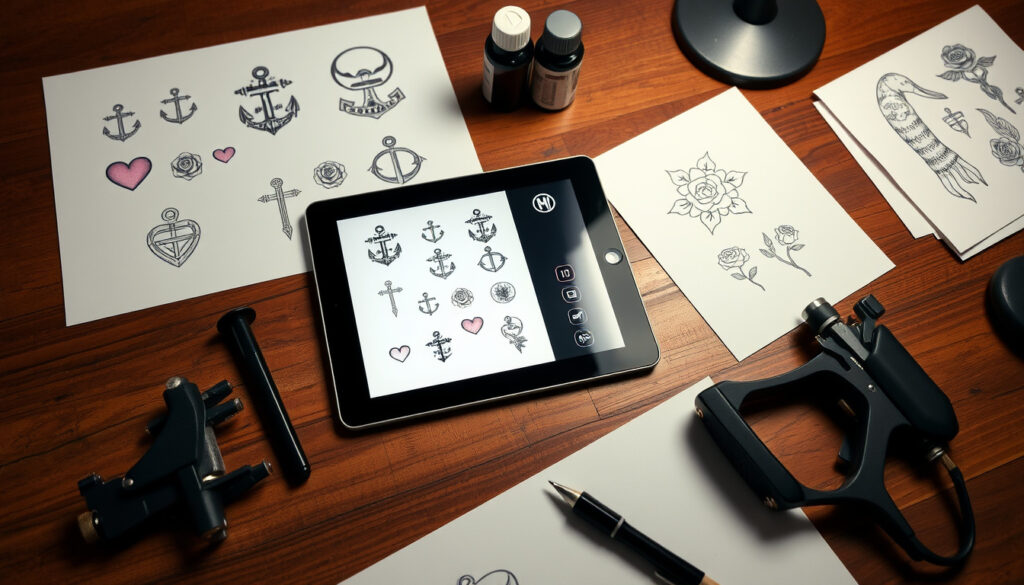
Tattoo Design: Free Apps, Rules, and Symbol Meanings
There’s a moment when a tattoo idea shifts from a vague thought into something you’d actually want on your skin forever. That transition—from inspiration to a design you can trust—is what this guide walks through.
U.S. adults with at least one tattoo: 32% (Pew Research, 2023) ·
Average hourly rate for tattoo artists: $150 (Tattoodo, 2025) ·
Tattoo designs cataloged on Tattoodo: 1.3 million+ (Tattoodo, 2025) ·
Monthly searches for ‘tattoo design’ (U.S.): Approximately 110,000 (Ahrefs, 2025)
Quick snapshot
- Brainstorm personal meaning (Hon Tattoo)
- Research symbols and styles (Tattoodo)
- Sketch or use digital tools (Adobe Firefly)
- Consult a professional artist (Tattoodo)
- Canva AI Tattoo Generator
- Tattoodo design database
- Procreate for drawing (Canva AI Tattoo Generator)
- Limitations: watermarks, limited customization (Canva AI Tattoo Generator)
- 1/3 rule for placement
- Three dots meaning
- 2% tattoo symbolism
- Other common iconography
Five key facts, one pattern: tattoo design is where personal meaning meets technical structure—and most guides skip the structure part.
| Label | Value |
|---|---|
| Definition | Tattoo design is the process of creating a visual representation for skin art, often incorporating personal meaning, style, and artist technique. |
| Common styles | Traditional, Japanese, Watercolor, Minimalist, Geometric, Tribal, Realism |
| Cost range | Design alone: $50–$200; hourly tattoo rates: $100–$300 |
| Popularity | 32% of U.S. adults have at least one tattoo (Pew Research, 2023) |
| Key design rule | 1/3 rule (rule of thirds) helps place tattoos to avoid distortion |
For someone getting their first tattoo, the biggest risk is picking a design that looks great on a screen but distorts badly on skin. The 1/3 rule exists precisely because skin is not a flat canvas—it moves, stretches, and shifts over time.
How can I design a tattoo?
- Start with brainstorming ideas and meanings
- Research symbols and styles
- Create a rough sketch or use design software
- Consult with a professional tattoo artist
Start with brainstorming ideas and meanings
Every great tattoo design starts with a question: what do you want this piece to say? Tattoo meaning guides from Hon Tattoo (tattoo meaning specialists) advise thinking first about what you want to remember, honor, or represent—rather than starting with a generic symbol. The meaning can evolve over time, so choose a design with awareness that your interpretation may shift.
Research symbols and styles
- Traditional: bold black outlines, limited color palette
- Japanese: large-scale, flowing compositions with waves and koi
- Watercolor: soft edges, color blends that mimic brushstrokes
- Minimalist: thin lines, negative space, small scale
- Geometric: precise shapes, symmetry, often blackwork
Some meanings are deeply personal and don’t need explaining to strangers (Hon Tattoo). The choice between public symbolism and a private personal layer shapes whether you pick an obvious icon or something more abstract.
Create a rough sketch or use design software
Once you have an idea, grab a pencil or open a digital tool. A practical workflow recommended by Adobe Firefly (AI design platform) is to ideate first, refine the concept, then save or share the design before booking the appointment. Free options like Canva (online design tool) let you generate multiple tattoo concepts from a text prompt.
Consult with a professional tattoo artist
A digital mockup is only the starting point. Professional tattoo artists adjust designs for skin placement, needle technique, and long-term wear. They’ll catch issues like lines that will blur together over time or colors that won’t hold well on certain skin tones. The Tattoodo (tattoo marketplace and community) database of over 1.3 million designs shows how much variety exists—your artist can help translate your idea into something that actually works as a tattoo.
A design that looks perfect on paper may become a muddy mess on skin in five years. The artist’s job is to bridge that gap—and their expertise costs a fraction of the removal fees you’d pay later.
Is there a free app to design a tattoo?
Top free tattoo design apps
Three tools stand out for free or low-cost tattoo design:
- Canva AI Tattoo Generator: Free to use. Describe your idea, get multiple concepts, then edit or download. Works in-browser, no app needed (Canva).
- Adobe Firefly: Free tier available. Supports text prompts and reference images. Start simple, iterate through visuals and styles (Adobe Firefly).
- BlackInk AI: Free mobile app. Creates concepts from text with controls for style, shape, and complexity (BlackInk AI).
The Apple App Store listing for “Tattoo AI – Tattoo Design” shows another option that generates designs in multiple styles including black and white, Japanese, and tribal.
Features to look for in a design app
- Text-to-image generation from detailed prompts
- Style presets (traditional, watercolor, minimalist, etc.)
- Editing tools (cropping, color adjustment, layering)
- Export options (high-res PNG or PDF)
Limitations of free apps
Free apps often carry watermarks, limit customization, or offer lower resolution exports. They’re excellent for brainstorming but rarely produce a final design ready for the tattoo chair. The catch: you still need a human artist to validate the design for skin placement and aging.
The pattern: free tools reduce the barrier to experimentation, but the final decision always rests with a professional.
Can ChatGPT create tattoo designs?
How ChatGPT generates design descriptions
ChatGPT creates text-based descriptions and concept ideas. It cannot output an actual image of a tattoo design, but it can help you brainstorm themes, refine symbolism, and compose a detailed prompt for an image generator. For example, you might type “a minimalist compass incorporating the 1/3 rule, with a personal meaning tied to travel,” and ChatGPT will suggest symbol combinations and placement ideas.
Using AI for tattoo ideas vs. final art
AI tools like ChatGPT and Adobe Firefly work best in the ideation phase—not the execution phase. Adobe Firefly recommends iterating through visuals, styles, and details until the design feels polished, but the final art should always come from a human artist who understands skin characteristics.
Pros and cons of AI-generated tattoo designs
Pros: Speed, variety, elimination of blank-page paralysis. You can generate dozens of concepts in minutes without drawing a line. Cons: AI cannot assess skin tone, body placement, or long-term ink behavior. Many tattoo artists report that clients arrive with AI designs that look great digitally but are technically unworkable on skin—lines too thin, details too small, placements that will distort.
Whether AI-generated tattoo designs are copyrightable remains unclear. If you use ChatGPT to generate a description and then feed it into an image generator, the legal ownership of the resulting design is a gray area—and some artists refuse to tattoo AI-generated art for this reason.
The catch: AI is a brainstorming partner, not a replacement for the artist’s judgment.
What is the 1/3 rule tattoo?
Explanation of the 1/3 rule for placement
The 1/3 rule (rooted in the rule of thirds from visual arts) helps place tattoos within the body’s natural proportions. Imagine dividing a body area—like the forearm or upper arm—into three equal vertical sections. The most visually balanced placement is often at the intersection of those lines, not dead center. This prevents distortion as the skin moves and stretches.
Why artists use it
Tattoo artists apply this rule because skin is dynamic. A design placed at a body’s natural third-point tends to sit correctly whether the arm is hanging down or raised. For large pieces like sleeves, Tattoodo experts emphasize the 1/3 rule as foundational—it stops the design from looking twisted or misaligned when the wearer changes position.
Examples of applying the rule
- Forearm: Place the focal point one-third of the way from the wrist to the elbow.
- Bicep: Position the center of the design at the upper one-third of the muscle.
- Shoulder blade: Align the main motif with the inner one-third of the bone structure.
What this means: the 1/3 rule turns a flat composition into one that works with the body’s movement.
What does a 3 dots tattoo on the finger mean?
Meanings of the three dots tattoo
The three dots tattoo carries multiple meanings depending on context. In some subcultures, particularly within Latino gang culture, it represents “mi vida loca” (my crazy life). In broader symbolism, the three dots can stand for past, present, and future—a chronological anchor. The placement on the finger makes it a discreet but visible piece, often chosen for its simplicity and layered meaning.
The 2% tattoo meaning
The 2% tattoo refers to the “two-percenter” motto within motorcycle club culture. It signifies that the wearer belongs to the 2% of motorcyclists who reject mainstream society’s rules—a direct reference to the American Motorcyclist Association’s claim that 99% of riders are law-abiding. The exact meaning outside motorcyclist culture is less clear; some wearers adopt it as a general symbol of nonconformity.
Other common symbolic tattoos
- Semper Fi (Marines): Represents the United States Marine Corps motto “Semper Fidelis” (always faithful).
- Anchor: Stability, nautical heritage, or a loved one who served in the navy.
- Infinity symbol: Eternity, endless love, or perseverance.
- Cross: Christian faith or a memorial for a loved one.
The pattern: symbols often carry multiple layers, so the wearer’s personal intent matters as much as the cultural origin.
Confirmed facts and what’s still unclear
Confirmed facts
- Three dots tattoo is commonly associated with “mi vida loca” in some subcultures
- 1/3 rule is a guideline for tattoo placement to avoid distortion
- Canva offers a free AI tattoo generator
- Adobe Firefly provides a free AI tattoo generator with text and reference image support
- 32% of U.S. adults have at least one tattoo (Pew Research, 2023)
What’s unclear
- Whether AI-generated tattoo designs are copyrightable
- What the 2% tattoo signifies outside motorcyclist culture
- Long-term skin reaction to AI-generated design suggestions is not studied
The implication: some questions remain open, but the known rules and tools provide a solid foundation for decision-making.
Expert perspectives on tattoo design
“The 1/3 rule is the difference between a tattoo that looks good in the mirror and one that looks good when you move. Large pieces like sleeves live or die by it.”
— Tattoodo (tattoo artist and community platform)
“Our AI tattoo generator is a starting point, not a replacement for an artist. We want people to explore, but the final design needs a human eye for skin.”
— Canva (online design platform)
“Tattoo prevalence among U.S. adults has risen steadily—from 21% in 2012 to 32% in 2023—driven largely by women and younger generations.”
“Start with a simple prompt, then iterate. The best AI-generated tattoos come from multiple rounds of refinement—not a single click.”
— Adobe Firefly (AI design platform)
The throughline across these voices: technology gives you options, but human artistry gives you a tattoo that lasts.
tattoostudiopro.com, tatspark.com, xactbodyart.com, inkdefensetattoo.com, facebook.com, facebook.com, vagaro.com
For those looking to streamline the process, free AI tattoo design tools can generate custom artwork based on your preferences in minutes.
Frequently asked questions
How long does it take to design a custom tattoo?
Most custom designs take 1–4 weeks, depending on complexity, artist workload, and how many revision rounds you need. Simple single-needle pieces may be sketched in a day; full sleeves can require multiple sessions over months.
Can I use a design I found online?
Legally, yes, if the design is licensed for use. Ethically, many tattoo artists discourage copying someone else’s work because tattoos are personal, and originality respects the original artist’s effort. Most professionals will redraw the concept into something unique for you.
Should I tip for the design consultation?
Tip policies vary, but custom design time is usually included in the tattoo price. If you have a separate consultation and the artist provides a detailed drawing, a 10–20% tip on the design fee is appreciated. Many artists consider the design part of the service.
What is the best style for a first tattoo?
Minimalist and traditional styles are forgiving for beginners because their bold lines and simple shapes age well. Watercolor and hyper-detailed realism require more maintenance and may fade faster. The best style is one that fits your body placement and personal taste.
How do I know if a design will fit?
Use paper stencils or temporary transfer paper before committing. Most artists apply a stencil during the consultation so you can see placement, size, and orientation on your actual body. Walk around, check mirrors, and ask for adjustments.
Are there copyright issues with tattoo designs?
Yes. Tattoo designs are protected by copyright as artistic works. Using an AI-generated design or copying someone else’s work without permission could create legal issues for both you and the artist. Many shops require a signed release for non-original designs.
The catch: every shortcut in the design phase can lead to long-term dissatisfaction; investing time upfront pays off.
For anyone putting a permanent mark on their skin, the choice is clear: invest time in the design phase, or spend years regretting a shortcut. The tools are plentiful—free apps, AI generators, and the world’s largest design database at Tattoodo—but only you and your artist can turn a good concept into a great tattoo.
More related posts
 Megan Katseye: Age, Nationality, Health, and Hiatus Facts
 Best Restaurants Melbourne – Top CBD Picks for Every Budget
 Virginia Bell: High Court Career and Royal Commission Role
 Jey Uso: Personal Life, Career, and Latest Updates (2025)
 Tom Daley: Biography, Olympic Medals, and Family
 Scooby-Doo Shaggy: Origin, Personality, and Fan Theories
 Mary Kay Letourneau: Biography, Case, and Unanswered Questions
 Chris Brown Vet: Biography, Career, and Drool Pet Brand
