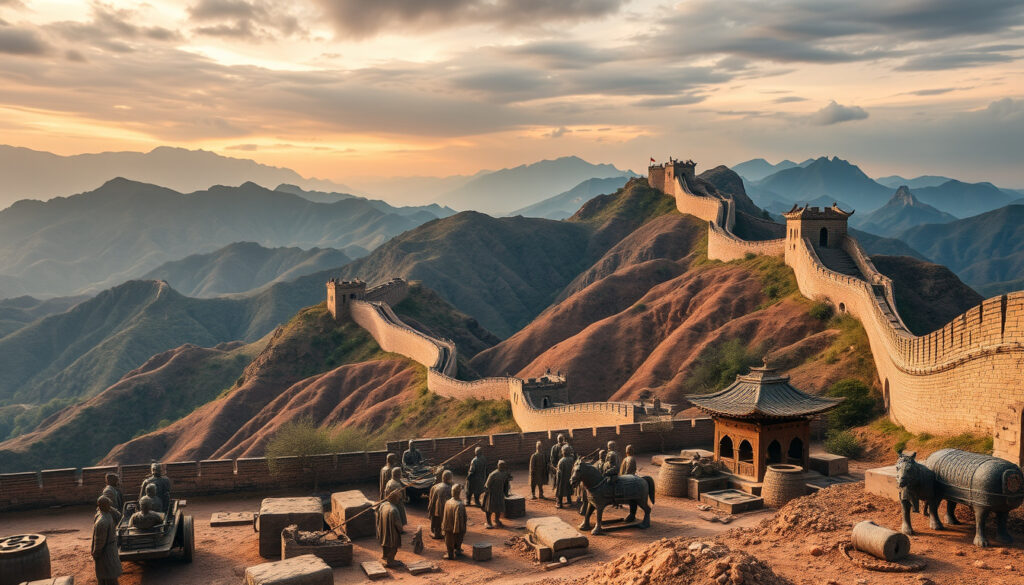
Qin Shi Huang: First Emperor of China and His Legacy
Mention the First Emperor, and most people picture the Terracotta Army—thousands of clay soldiers frozen in time. But the man who ordered them built, Qin Shi Huang, remains one of history’s most contradictory figures: a ruthless conqueror who unified China, yet obsessed with immortality to the point of drinking mercury. Here’s what archaeology and ancient texts actually tell us about his life, his power, and the myths that still surround him.
Born: 259 BC ·
Died: 210 BC ·
Title: First Emperor of China ·
Dynasty: Qin ·
Known for: Terracotta Army, unification of China ·
Tomb status: Unopened, reportedly contains mercury rivers
Quick snapshot
- First emperor of China, reigned 221–210 BC (Encyclopaedia Britannica)
- Founder of the Qin dynasty (Encyclopaedia Britannica)
- Unified warring states into one empire (Encyclopaedia Britannica)
- Standardized writing, currency, and measurements (Encyclopaedia Britannica)
- Built early sections of the Great Wall (Encyclopaedia Britannica)
- Commissioned the Terracotta Army—around 8,000 life-sized figures (Encyclopaedia Britannica)
- Burned books and buried scholars alive (Encyclopaedia Britannica)
- Consumed mercury pills in search of immortality (Chemistry World)
- Authoritarian legalist rule (Encyclopaedia Britannica)
- Featured in anime Record of Ragnarok (fan debates)
- Compared to Hades in fandom power rankings
- Subject of films and video games
Six key facts about this emperor, drawn from primary records and recent archaeology:
| Attribute | Value |
|---|---|
| Full name | Ying Zheng (born as Zhao Zheng) |
| Reign | 221–210 BC |
| Born | 259 BC, Qin state |
| Died | 210 BC, Hebei |
| Known for | First emperor, Terracotta Army, unification |
| Tomb | Unopened, reportedly contains mercury |
What was Qin Shi Huang known for?
Unification of China
- He conquered all rival states by 221 BC, ending centuries of warring kingdoms (Encyclopaedia Britannica).
- He abolished feudalism and divided China into 36 commanderies (Encyclopaedia Britannica).
- His legalist policies enforced strict control (Encyclopaedia Britannica).
The implication: Qin didn’t just conquer—he redrew the political map of China so completely that the concept of a unified empire became the norm for the next two millennia.
Standardization of writing and measures
- He standardized script, currency, and axle lengths across the empire (Encyclopaedia Britannica).
- Wheel ruts, coin shapes, and written characters all followed a single imperial template (Encyclopaedia Britannica).
Terracotta Army
- He commissioned the Terracotta Army for his tomb—around 8,000 life-sized soldiers and horses (Encyclopaedia Britannica).
- These figures are part of a funerary compound spanning about 20 square miles (50 km²) near Xi’an (Encyclopaedia Britannica).
- More than 6,000 of those statues had been excavated as of Britannica’s account (Encyclopaedia Britannica).
Qin Shi Huang built the most elaborate funerary monument in human history while desperately trying to avoid death itself. The Terracotta Army is a testament to his fear of the unknown—and his refusal to accept it.
How powerful was Qin Shi Huang?
Military conquests
- He conquered six rival states between 230 and 221 BC (Encyclopaedia Britannica).
- The Qin strategists employed assassination, espionage, and bribery alongside open warfare (Encyclopaedia Britannica).
Centralized bureaucracy
- He replaced feudal lords with appointed officials who reported directly to him (Encyclopaedia Britannica).
- He ordered the burning of historical records and philosophical works to control thought (Encyclopaedia Britannica).
Legacy of authoritarian rule
- His legalist framework favored harsh punishments and absolute obedience (Encyclopaedia Britannica).
- The Qin dynasty collapsed within four years of his death, partly due to the brutality of those policies (Encyclopaedia Britannica).
The pattern: Qin’s power was absolute but brittle. His authoritarian system held together only while he was alive to enforce it.
Who was the king who drank mercury?
Qin Shi Huang’s obsession with immortality
- He consumed mercury pills and elixirs, believing they would grant eternal life (Chemistry World).
- He sent expeditions to find the legendary island of the immortals (Encyclopaedia Britannica).
Mercury in his tomb
- Han dynasty historian Sima Qian wrote that the tomb chamber contains mercury fashioned into rivers—the Yellow River, the Yangtze, and the seas (Chemistry World).
- A 2020 lidar study measured atmospheric mercury above the tomb mound at up to 27 ng/m³, compared to local background levels of 5–10 ng/m³ (PMC: Emissions from the Emperor Qin Tomb in Xi’an Studied by Laser Absorption Lidar).
- The same study estimated an out-flux of about 5×10⁻⁸ kg/s of mercury from the mausoleum area (PMC: Emissions from the Emperor Qin Tomb in Xi’an Studied by Laser Absorption Lidar).
Historical accounts of mercury consumption
- He died at age 49 or 50 in 210 BC (Encyclopaedia Britannica).
- Some scholars suspect mercury poisoning contributed to his death (Chemistry World).
- The tomb chamber itself is believed never to have been opened or looted (PMC).
The mercury traces above the tomb are the closest thing we have to forensic evidence confirming Sima Qian’s ancient account. Eighteen centuries before modern chemistry, someone really did pour tons of liquid metal into an underground palace.
How many wives did Qin Shi Huang have?
Historical records on his harem
- The exact number of his wives and concubines is unknown (Encyclopaedia Britannica).
- Ancient records mention many palace women but don’t give a count.
- He had at least one known son, Fusu, who was exiled and later forced to commit suicide after Qin’s death.
The myth of 10,000 wives
- The claim that he had 10,000 wives is likely a later exaggeration, possibly conflating the size of his harem with symbolic numbers in Chinese tradition.
- No primary source supports a figure anywhere near 10,000.
Comparison with other emperors
- Many later Chinese emperors maintained large harems, but Qin’s records are too sparse for comparison.
- The “10,000 wives” trope appears mostly in modern pop-culture references, not in the Shiji or official histories.
The catch: We simply don’t know how many women were in Qin’s palace. The gap between rumor and evidence here is wide—and the rumor is the only thing that gets repeated.
Who tried to assassinate Qin Shi Huang?
Jing Ke’s failed assassination attempt
- Jing Ke attempted to assassinate him in 227 BC while presenting a gift to the king of Qin (Encyclopaedia Britannica).
- He concealed a dagger inside a scroll map but missed the emperor (Encyclopaedia Britannica).
- Jing Ke was killed on the spot.
Gao Jianli’s later attempt
- Gao Jianli, a musician friend of Jing Ke, tried to assassinate Qin Shi Huang by hiding lead weights inside a lute.
- He failed and was executed.
Other plots against the emperor
- At least three assassination attempts are recorded during the final years of his rule (Encyclopaedia Britannica).
- Qin’s own paranoia made him increasingly reclusive and suspicious (Encyclopaedia Britannica).
Timeline
Born as Ying Zheng in the Qin state
Became king of Qin at age 12 (PMC)
Conquered six rival states, unifying China (Encyclopaedia Britannica)
Proclaimed himself Qin Shi Huang (First Emperor) (Encyclopaedia Britannica)
Died during an eastern tour; tomb sealed (Encyclopaedia Britannica)
What’s confirmed and what’s unclear
Confirmed facts
- He unified China in 221 BC (Encyclopaedia Britannica)
- He died in 210 BC (Encyclopaedia Britannica)
- His tomb contains high levels of mercury detected in soil and air (PMC)
- He commissioned the Terracotta Army (Encyclopaedia Britannica)
What’s unclear
- Exact number of wives and concubines
- Whether he died from mercury poisoning or natural illness
- Full contents of his unopened tomb
What the experts say
According to Sima Qian’s account, the tomb chamber contained mercury used to fashion the Yellow River, the Yangtze, and the seas.
— Chemistry World
The excavation of the tomb revealed more than 6,000 life-size statues of soldiers still on guard.
— Encyclopaedia Britannica
The mausoleum construction period ran from 246 BCE to 208 BCE.
— PMC: Emissions from the Emperor Qin Tomb
New evidence suggests mercury in the mausoleum could have come from cinnabar mines in Xunyang, Shaanxi.
For anyone trying to separate the man from the myth, the evidence is clear: Qin Shi Huang was a brilliant but paranoid ruler whose quest for immortality consumed his final years—and may have killed him. The Qin dynasty fell apart within four years of his death, a testament to how much depended on one man’s iron will. For modern audiences sorting fact from fiction, the choice is between ancient texts and archaeology on one side, and centuries of embellishment on the other.
tiktok.com, reddit.com, facebook.com, britannica.com, reddit.com, en.wikipedia.org, record-of-ragnarok.fandom.com
Historians continue to debate the full extent of Qin Shi Huangs reign and legacy, but his unification of China and construction of the Terracotta Army remain unparalleled achievements.
Frequently asked questions
What was Qin Shi Huang’s real name?
His birth name was Ying Zheng (also recorded as Zhao Zheng, after his mother’s home state). He later styled himself Shi Huangdi, meaning “First Emperor.”
How did Qin Shi Huang die?
He died in 210 BC during an eastern tour. The cause is not definitively known, but mercury poisoning from his immortality elixirs is a plausible explanation supported by the high mercury levels detected above his tomb.
Is Qin Shi Huang’s tomb open to the public?
No. The main tomb chamber remains unopened—reportedly never looted—largely due to concerns about preservation and the potential risks of disturbing the mercury inside.
Why is Qin Shi Huang famous?
He is famous for unifying China into a single empire, standardizing writing and measurements, ordering the construction of early Great Wall sections, and commissioning the Terracotta Army.
Did Qin Shi Huang really drink mercury?
Yes, according to historical accounts. He consumed mercury-based pills and elixirs in his quest for immortality. Modern science has confirmed elevated mercury levels above his tomb, supporting the claim.
How many terracotta warriors are there?
Around 8,000 life-sized soldiers and horses, according to Britannica. More than 6,000 had been excavated as of their account.
What is the Records of the Grand Historian?
The Shiji, written by Sima Qian in the Han dynasty, is the primary historical source for Qin Shi Huang’s reign. It describes the mercury rivers in his tomb and remains the most authoritative ancient text on the First Emperor.
Related reading: Leonardo da Vinci: The Genius, the Myths, the Reality · Ancient Egypt History: Facts, Symbols, and Language
More related posts
 Gareth Bale: Retirement, Net Worth, Speed, Life After Football
 Topgolf Gold Coast – Location Hours Booking Guide
 Winter Spring Summer or Fall: Where to Watch & Reviews (2024)
 Julie Inman Grant: eSafety Commissioner & Dual Citizenship
 Warren Beatty: Life, Career, and Marriage to Annette Bening
 Kelly Brook Biography: Age, Husband, Model & Actress Facts
 Pattie Boyd: The Woman Who Inspired ‘Layla’ and ‘Something’
 Jim Chalmers: Biography, Qualifications, and Family
