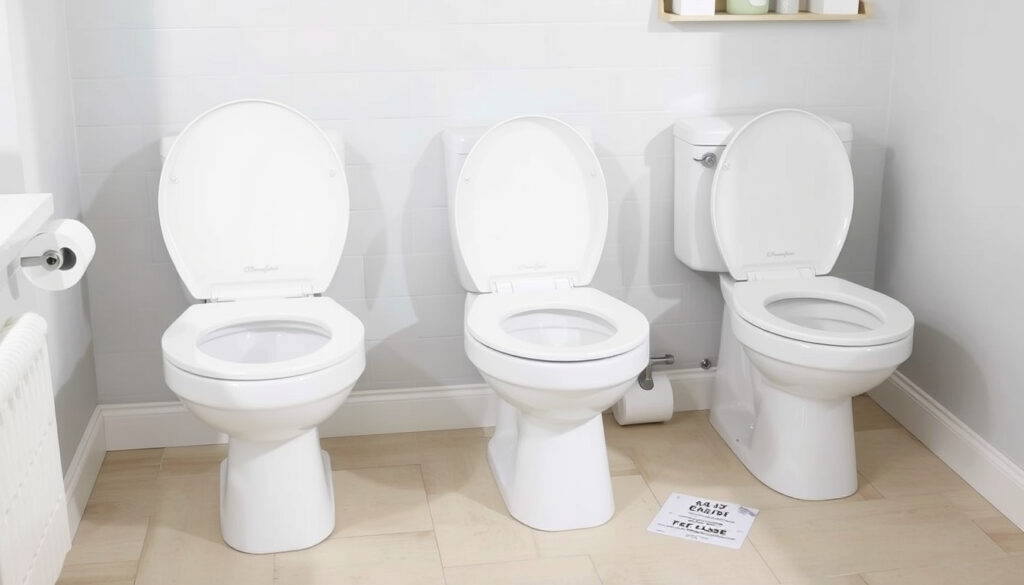
Toilet Seat Buying Guide: Fit, Types & Costs
A toilet seat is one of those things you don’t think about until it cracks, wobbles, or just looks beyond cleaning, but picking the wrong one can cost you time, money, and a second trip to the hardware store. This guide walks through how to measure, what shapes exist, when to call a plumber, and how to make the seat last.
Standard round seat length: 16.5 inches ·
Standard elongated seat length: 18.5 inches ·
Toilet seat shape types: 3 (round, elongated, D-shaped) ·
Average basic toilet seat cost: $15–$30 ·
Average plumber labor for replacement: $75–$150 ·
Typical toilet seat lifespan: 5–10 years
Quick snapshot
- Round (16.5 in) vs elongated (18.5 in) (Ferguson Home)
- D‑shaped for modern toilets (Ferguson Home)
- Soft‑close vs standard hinges (Ferguson Home)
- Materials: plastic, wood, resin (Ferguson Home)
- Remove old seat (Ferguson Home (American Standard))
- Measure length from front to bolt center (Ferguson Home (American Standard))
- Measure width at widest point (Ferguson Home (American Standard))
- Check bolt spacing (typically 5.5 in or 6 in) (Ferguson Home (American Standard))
- Basic seat: $15–$30 (Design Transition Studio)
- Premium seat (soft‑close, wood): $50–$150 (Design Transition Studio)
- Plumber labor: $75–$150 (Design Transition Studio)
- DIY saves $100+ (Design Transition Studio)
- Turn off water and drain tank if needed (The Home Depot)
- Unscrew old seat, remove washers (The Home Depot)
- Position new seat, align hinges (The Home Depot)
- Tighten bolts evenly, check stability (The Home Depot)
The following table summarizes the key specifications for toilet seat replacement.
| Fact | Value |
|---|---|
| Standard round seat length | 16.5 inches |
| Standard elongated seat length | 18.5 inches |
| Common bolt spacing | 5.5 inches or 6 inches |
| Average replacement interval | 5–10 years |
| DIY difficulty level | Easy (15–30 minutes) |
| Typical plumber charge | $100–$200 total |
Do all toilet seats fit any toilet?
No, toilet seats are not universal. The two main shape categories — round and elongated — are not interchangeable. A round bowl is typically about 16.5 inches long from the mounting holes to the front edge; an elongated bowl measures about 18.5 inches (Ferguson Home (plumbing supply retailer)).
Are toilet seats universal?
- Shape must match bowl shape — round and elongated seats do not swap (PlumbersStock Blog (trade knowledge)).
- Bolt spacing (center-to-center distance between mounting holes) varies: typically 5.5 inches or 6 inches (Target (retailer)).
- Some specialty toilets (wall-hung, bidet-integrated) require proprietary seats.
What shapes do toilet seats come in?
- Round: Compact, about 16.5 inches long. Saves floor space (BestToiletSeats.com (product comparison)).
- Elongated: Longer bowl, about 18.5 inches. More surface area for comfort.
- D‑shaped: Modern European-style with a flatter front edge. Less common but growing.
| Shape | Length | Typical Width | Bolt Spacing | Pros |
|---|---|---|---|---|
| Round | 16–16.5 in | 14–14.5 in | 5.5 in or 6 in | Compact, good for small bathrooms |
| Elongated | 18–18.5 in | 14–14.5 in | 5.5 in or 6 in | More comfortable for adults |
| D‑shaped | Varies (approx. 17–18 in) | 14–14.5 in | 5.5 in or 6 in | Modern design, flatter front |
Buying a round seat for an elongated bowl leaves a 2-inch gap at the front — uncomfortable and visually off. The reverse won’t fit at all. Shape match is non-negotiable.
The implication: measuring the bowl, not assuming a universal standard, is the only reliable path to a correct fit.
How do I know which toilet seat will fit my toilet?
The answer comes down to three measurements: length, width, and bolt spacing. A round soft-close seat from a major brand might measure 16.75 inches deep and 14.1875 inches wide (The Home Depot (home improvement retailer)).
How to measure your toilet seat
- Remove the old seat completely.
- Measure from the center of the rear mounting holes to the front edge of the bowl.
- Measure width at the widest point of the bowl.
- An American Standard round seat measures 16.6875 inches in length and 14.4375 inches wide, with a 5.5-inch hinge-center spacing (Ferguson Home (American Standard listing)).
How to measure seat bolt spacing
- Check the center-to-center distance between the two mounting bolts. Most toilets use 5.5 inches or 6 inches.
- Target listings for round soft-close seats specify a mounting-hole range of about 5.15 to 6.18 inches (Target (retailer)).
- Elongated seats from Amazon show dimensions around 18.7 inches long by 14.2 inches wide (Amazon (product listing)).
Manufacturers provide precise dimension specs online but product photos don’t show the measurement. Download the spec sheet or check the Q&A before buying.
Why this matters: a seat that doesn’t align with the bolts will wobble or crack the plastic within months. Measure first, buy second.
What are the three types of toilet seats?
Beyond shape, seats differ by feature and material. The choice determines noise, cleaning ease, and how long the seat lasts in a humid bathroom.
Round vs elongated toilet seats
- Round: Better for small bathrooms. Saves about 2 inches of floor space.
- Elongated: More comfortable for adults. Standard in newer homes.
- D‑shaped: Modern design with a squared front. Often found on European toilets.
Soft close vs standard
- Soft-close hinges use friction to slow the lid and seat, preventing slamming.
- Standard hinges are simpler and cheaper but can be noisy.
- Soft-close adds $10–$40 to the price.
Materials: plastic, wood, resin
- Plastic: Lightweight, easy to clean, $15–$30. Prone to cracking under weight over time.
- Wood: Warmer feel, sturdier, $30–$80. Can warp in high humidity if not sealed.
- Resin: Dense, heavy, and stain-resistant. Mid-range, $40–$90.
A soft-close mechanism adds moving parts. In a humid bathroom, the damping cylinder can fail after 3–4 years, while a standard hinge lasts the life of the seat.
The pattern: plastic is budget-friendly but short-lived; wood adds comfort but risks warping; resin sits in the middle with better durability.
How often should you replace a toilet seat?
Manufacturers and plumbers agree on a 5-to-10-year replacement window, but usage and material matter.
Signs your toilet seat needs replacement
- Cracks in plastic (sharp edges can cut skin).
- Discoloration or stains that don’t clean off.
- Looseness that persists after tightening bolts.
- Persistent odor from absorbed moisture or bacteria.
- Wobble from stripped screw holes.
How to clean and maintain your toilet seat
- Use non-abrasive cleaners; bleach-based products can yellow plastic over time.
- Wipe down hinges and bolts monthly to prevent mineral buildup.
- Avoid standing water on wood seats.
- Tighten bolts annually to prevent wobble that cracks the seat.
A cheap plastic seat may need replacement every 3–4 years in a high-traffic bathroom. A resin seat with stainless steel hinges can last the full 10 years, saving money and waste.
A cheap plastic seat may need replacement every 3–4 years in a high-traffic bathroom. A resin seat with stainless steel hinges can last the full 10 years, saving money and waste.
What this means: paying $30 more upfront can double the seat’s usable life, making the per-year cost lower than buying budget seats repeatedly.
How much would a plumber charge to change a toilet seat?
The cost breaks into two parts: the seat itself and the labor. A basic seat costs $15–$30; a premium soft-close wood seat runs $50–$150 (Design Transition Studio (cost analysis)).
Average cost of toilet seat replacement
- Basic round seat: $15–$30.
- Basic elongated seat: $20–$40.
- Premium soft-close seat: $25–$90 (Design Transition Studio (installation cost guide)).
- Plumber labor: $75–$150, for a total of $100–$200.
DIY vs hiring a plumber
- DIY cost: $20–$50 for a basic seat, plus 15–30 minutes of time.
- Pro-installed cost: $60–$320 depending on region and seat quality (Design Transition Studio (pro vs DIY costs)).
- DIY saves $75–$150 in labor every time.
Is an expensive toilet seat worth it?
- Soft-close seats reduce noise and prevent slamming — worth it for shared bathrooms.
- Antimicrobial coatings reduce bacterial growth, helpful in high-use households.
- Longer warranties (5–10 years vs 1 year) reduce replacement frequency.
- High-quality hinges prevent wobble, extending seat life.
A plumber callout costs more than the seat itself. If you can turn a screwdriver, the math is simple: $20 seat + 20 minutes beats $100 plumber + $30 seat every time.
A plumber callout costs more than the seat itself. If you can turn a screwdriver, the math is simple: $20 seat + 20 minutes beats $100 plumber + $30 seat every time.
For homeowners comfortable with basic tools, the decision is clear: DIY replacement saves $75–$150 per seat change. For renters or anyone with seized bolts, the plumber’s fee is the price of avoiding a broken toilet.
The average homeowner who installs a resin seat with soft-close hinges pays $50–$90 upfront and recoups the investment by avoiding a $125 plumber visit and a replacement every 3 years.
Upsides
- Replacing a seat yourself takes under 30 minutes.
- Soft-close seats reduce noise in shared bathrooms.
- Premium materials (resin, wood) last twice as long as plastic.
- Matching shape to bowl ensures a wobble-free fit.
Downsides
- Wrong shape selection means a second purchase.
- Stuck bolts can make DIY removal impossible without tools.
- Soft-close mechanisms can fail in high-humidity bathrooms.
- Wood seats can warp if not properly sealed.
How to replace a toilet seat yourself
A 15-minute task with one tool — a screwdriver — can save you a plumber’s hourly rate.
Step 1: Remove the old seat
- Turn off the water supply and flush to drain the tank (optional but recommended).
- Unscrew the bolt caps with a flathead screwdriver. If rusted, apply penetrating oil.
- Lift the old seat off the bowl.
Step 2: Clean the mounting area
- Scrub the bowl surface where the seat rests — grime and mineral deposits prevent a tight fit.
Step 3: Install the new seat
- Position the new seat over the mounting holes. Align hinges.
- Insert bolts and tighten evenly — alternating between the two until snug (not over-tightened, which cracks plastic).
Step 4: Test and adjust
- Check for wobble. Tighten bolts a quarter-turn more if needed.
- Test the slow-close mechanism (if equipped) to ensure it catches.
If the old bolts are rusted or the screw slot is stripped, a $10 bolt removal tool beats calling a plumber — but only if you own a drill.
For the average homeowner, the trade-off is clear: a 20-minute DIY job with a $25 seat versus a $125 plumber visit. The math favors the weekend warrior.
designtransitionstudio.com, jaspector.com, designtransitionstudio.com, fergusonhome.com, matthew.iws.edu
Frequently asked questions
What is the toilet seat rule?
The “toilet seat rule” isn’t a standard — it’s a social etiquette question about whether the seat should be left up or down. Most discussions center on household preference rather than code.
Should the toilet seat be up or down?
There is no universally correct position. Home etiquette guides suggest closing both lid and seat before flushing to prevent aerosolized bacteria, regardless of gender.
How do I clean a toilet seat properly?
Use a non-abrasive cleaner and a soft cloth. Avoid bleach or harsh chemicals on plastic seats — they cause yellowing and cracking over time.
What is the best material for a toilet seat?
Resin offers the best balance of durability, stain resistance, and weight. Wood is comfortable but can warp; plastic is budget-friendly but short-lived.
Can I install a soft-close seat on an older toilet?
Yes, as long as the bowl shape (round or elongated) and bolt spacing (5.5 or 6 inches) match. Soft-close hinges are universal in that sense.
How do I remove a stuck toilet seat bolt?
Apply penetrating oil (like WD-40), wait 10 minutes, then use pliers or a bolt extractor tool. If the slot is stripped, a hacksaw blade can cut the bolt.
Do all toilet seats come with soft-close features?
No. Soft-close is an add-on feature that typically adds $10–$40 to the price. Basic seats come with standard hinge mechanisms.
For a homeowner in the U.S., the choice is straightforward: measure the bowl shape and bolt spacing, pick a resin seat with soft-close hinges, and install it yourself in 20 minutes. Skip the plumber’s visit, and the savings will cover the next seat replacement in 8 years.
More related posts
 Jye Gray: Biography, NRL Career, and Key Facts
 ASX:BHP – Share Price, Performance and FY2025 Results
 The Ultimate Mini Crossword Guide: Free Puzzles, Tips & Sources
 Claudia Schiffer: Net Worth, Children, and Current Life
 Caleb McLaughlin: Stranger Things Actor Facts and Biography
 Emily Deschanel: Life, Career, and Bones Legacy
 Elsie Hewitt: Relationship History, Health Condition, and Career
