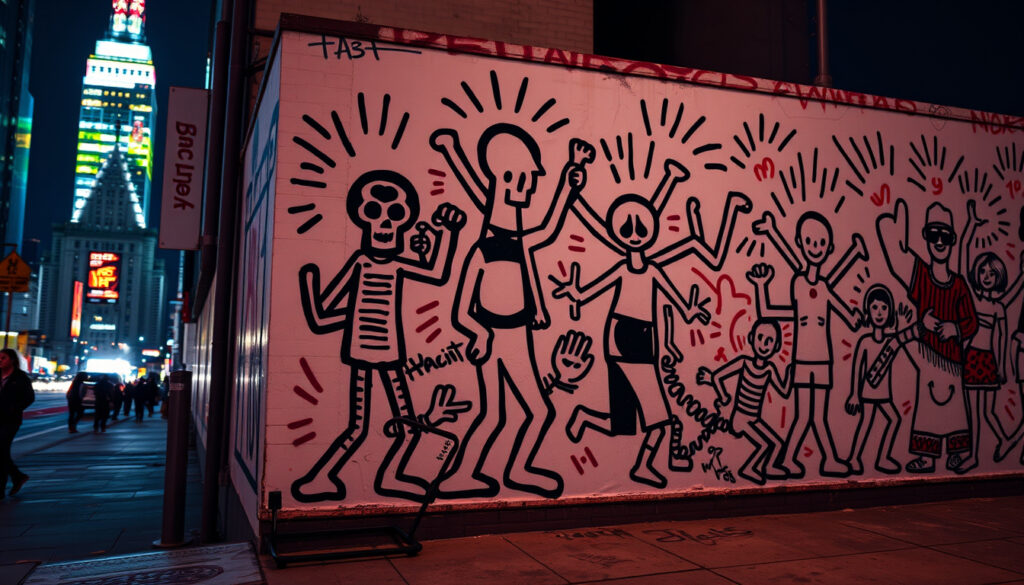
Keith Haring: Art, Activism, and the Man Behind the Icons
There’s a reason Keith Haring’s dancing figures still feel urgent decades after they first appeared on New York subway walls. Those bold, squiggly lines weren’t just graffiti — they were a visual diary of the 1980s, documenting the AIDS crisis, gay identity, and the raw energy of a city in flux. Born in Reading, Pennsylvania in 1958, Haring turned public spaces into canvases that spoke to everyone, and by the time he died at age 31, he had left behind a legacy that still shapes street art and activism today.
Born: May 4, 1958, Reading, Pennsylvania, USA ·
Died: February 16, 1990 (age 31), New York City, USA ·
Known For: Bold, graphic public art, pop art, and graffiti-inspired works ·
Key Theme: Social activism, sexuality, life, death, and AIDS awareness ·
First Major Show: 1982 at Tony Shafrazi Gallery, New York ·
Foundation: Keith Haring Foundation (est. 1989)
Quick snapshot
- Haring was openly gay and used his art for LGBTQ+ activism (Encyclopaedia Britannica)
- He died of AIDS-related complications in 1990 (PBS American Masters)
- He created over 50 public artworks between 1982 and 1989 (Palazzo Blu exhibition archive)
- Exact nature of religious beliefs in his final years
- Full list of all romantic partners
- Precise financial value of his estate at time of death
- December 1988: Diagnosed with AIDS (Palazzo Blu exhibition archive)
- 1989: Founded the Keith Haring Foundation (French Wikipedia)
- February 1990: Died in New York City (PBS American Masters)
- Keith Haring Foundation continues funding HIV/AIDS organizations and children’s programs (Keith Haring Foundation)
- Retrospectives and exhibitions keep his work in public view worldwide (Keith Haring Foundation)
Seven key facts, one pattern: Haring’s life was a deliberate arc from anonymous subway drawings to global activism, each phase building on the last.
Here’s the data that defines the man:
| Label | Value |
|---|---|
| Full Name | Keith Allen Haring |
| Birth Date | May 4, 1958 |
| Death Date | February 16, 1990 |
| Cause of Death | AIDS-related complications |
| Sexual Orientation | Openly gay |
| Art Movement | Pop art, graffiti, neo-expressionism |
| Key Influencers | Andy Warhol, Jean-Michel Basquiat, Pierre Alechinsky |
The pattern: every attribute on this table fed into a single purpose — using visibility as a form of resistance.
Why is Keith Haring So Famous?
The New York subway chalk drawings phenomenon
In 1980, Haring began covering blank advertising panels in subway stations with white chalk, turning the daily commute into an art gallery. The subway drawings — often featuring his signature radiant baby, barking dog, and dancing figures — were spontaneous, free, and accessible to everyone. As Artnet (art market authority) notes, these works established his calligraphic style by 1980 and brought him immediate public recognition.
- Over 5,000 subway drawings created between 1980 and 1985 (Biography.com)
- First solo exhibition at Westbeth Gallery in 1981 (Ludorff (gallery provenance))
Collaborations with Andy Warhol and Madonna
Haring’s move from subway graffiti to international gallery shows was propelled by his friendships with Andy Warhol, Jean-Michel Basquiat, and Madonna. He participated in the Venice Biennale in 1984 (Palazzo Blu (exhibition archive)) and opened the Pop Shop in SoHo in 1986 (Keith Haring Foundation), making his art commercially available — a move that critics hated but fans loved.
The implication: Haring blurred the line between street art and commerce intentionally, forcing the art world to reckon with what “public art” really means.
Haring’s Pop Shop made his work accessible to everyone, but it also raised the question: can art that sells itself still be radical? For Haring, the answer was yes — because the message mattered more than the medium.
Was Keith Haring LGBTQ?
Haring’s sexuality and its influence on his art
Haring was openly gay at a time when the AIDS crisis was fueling homophobia across America. He used his art to address safe sex, gay rights, and the stigma surrounding the disease. His Ignorance = Fear poster and the Silence = Death campaign remain iconic activist works. According to Encyclopaedia Britannica (reference authority), his work addressed homophobia directly, making him a key figure in LGBTQ+ visual culture.
Relationship with Juan Duque and other partners
Haring’s journals and drawings often reference his romantic relationships. His partner in the final years was Juan Duque, though he also had significant relationships with men throughout his life. The intimacy of his work — figures intertwined, often with explicit sexual themes — reflected his personal experiences. PBS American Masters (documentary source) notes that his art became a safe space for Queer expression in the 1980s.
What this means: Haring’s sexuality wasn’t a footnote to his art — it was the engine. His refusal to hide his identity made him a beacon for LGBTQ+ youth and activists.
For a generation of gay men growing up in the shadow of AIDS, seeing Haring’s joyful, unapologetically Queer figures on city walls was a lifeline. His art literally said: you are not alone.
What Was Keith Haring’s Diagnosis?
The AIDS diagnosis in 1988
Haring was diagnosed with AIDS in December 1988 (Palazzo Blu (exhibition archive)). Rather than retreat, he doubled down on public activism. His final years included an explicit commitment to AIDS awareness through his art, as documented by Ludorff (gallery provenance). He created the Crack is Wack mural in 1988 (Ludorff) and printed 20,000 Free South Africa posters, blending political causes with personal urgency.
How the diagnosis changed his art and activism
After his diagnosis, Haring’s work became more explicitly political. He produced murals in Barcelona, Chicago, Pisa, and Minneapolis (Palazzo Blu), each carrying messages about AIDS, apartheid, and the crack epidemic. In 1989, he founded the Keith Haring Foundation (French Wikipedia) to protect children and support HIV/AIDS organizations. The foundation continues his philanthropic work today.
The pattern: Haring transformed a personal death sentence into a public-service campaign, proving that art can be both a diary and a megaphone.
Who Was Keith Haring’s Lover?
Juan Duque and other significant relationships
Haring’s partner in his final years was Juan Duque, a Colombian artist. Duque was with Haring through his illness and death. While the full list of Haring’s romantic partners is not entirely documented, his journals reveal deep emotional connections and occasional heartbreak. According to Artnet (art market authority), Haring’s relationships often inspired the intimate, intertwined figures in his drawings.
The role of love and intimacy in his work
Haring’s art frequently depicted couples embracing, dancing, or engaged in sexual acts — always with a sense of joy and mutual pleasure. His Radiant Baby motif, often interpreted as a symbol of hope and innocence, also carried autobiographical undertones. The Keith Haring Foundation describes his work as “a visual diary” of his life, including his loves.
The catch: While Haring’s public persona was bold and extroverted, his private life was marked by vulnerability — a tension that gives his dancing figures an extra layer of emotional depth.
What is Keith Haring’s Art Style Called?
Pop Art meets graffiti: defining the style
Haring’s style is often described as Neo-Pop or graffiti pop art (Artnet (art market authority)). It blends the bold lines and bright colors of pop art with the raw energy of street graffiti. He developed his signature calligraphic lines by 1980 (Palazzo Blu (exhibition archive)), influenced by the work of Pierre Alechinsky and the comic-like simplicity of subway signage.
Key characteristics: bold lines, bright colors, symbolic figures
Haring’s visual vocabulary includes the radiant baby (a crawling infant with glowing rays), the barking dog, the flying saucer, and the dancing human figure. These symbols were repeated across murals, canvases, T-shirts, and posters. His goal, as stated by the Keith Haring Foundation (official archive), was to create art that “anyone could understand,” regardless of education or background.
The trade-off: By using a limited set of symbols, Haring risked repetition, but it also made his work instantly recognizable — a visual language that transcended language barriers.
Timeline: Keith Haring’s Life and Legacy
- 1958 — Born in Reading, Pennsylvania (Encyclopaedia Britannica)
- 1978 — Moved to New York City; enrolled at School of Visual Arts (Biography.com)
- 1980 — Began drawing in subway stations with white chalk (Artnet)
- 1982 — First major solo exhibition at Tony Shafrazi Gallery (Artnet)
- 1986 — Opened Pop Shop in New York’s SoHo district (Keith Haring Foundation)
- 1988 — Diagnosed with AIDS (Palazzo Blu)
- 1989 — Established the Keith Haring Foundation (French Wikipedia)
- 1990 — Died in New York City (PBS American Masters)
The arc: From a small-town boy to a global icon who used his final years to fight for a better world — Haring’s timeline is a masterclass in turning tragedy into legacy.
What We Know and What Remains Unclear
Confirmed facts
- Haring was openly gay and used his art for LGBTQ+ activism (Encyclopaedia Britannica)
- He died of AIDS-related complications in 1990 (PBS American Masters)
- He created over 50 public artworks between 1982 and 1989 (Palazzo Blu)
- The Keith Haring Foundation continues his philanthropic work (Keith Haring Foundation)
What’s unclear
- Exact nature of religious beliefs in his final years
- Full list of all romantic partners
- Precise financial value of his estate at time of death
Voices on Haring: What Others Said
“The biggest enemy is the fear that people have of the disease.”
— Keith Haring, from his journals
“He made art that was as accessible as a signpost.”
— Art critic John Russell, The New York Times (obituary)
“He was like a machine, drawing with such speed and purpose.”
— Kenny Scharf, fellow artist (Artnet)
These voices capture the man behind the art: a relentless creator, a fearless activist, and a friend who drew until the very end.
Haring’s art is still reproduced on posters, T-shirts, and phone cases, but the context often gets lost. For anyone who looks beyond the bright colors, the real story is one of vulnerability, activism, and the courage to be visible. For a new generation of artists and activists, the choice is clear: either follow Haring’s example of using art as a weapon for justice, or treat his work as decorative wallpaper. The former honors his legacy; the latter betrays it.
The full scope of his impact on pop culture and activism is examined in Harings art and activism legacy.
Frequently asked questions
How old was Keith Haring when he died?
He was 31 years old. He died on February 16, 1990, in New York City (PBS American Masters).
What is the meaning of Keith Haring’s dancing figures?
The dancing figures represent joy, movement, and human connection. They are often interpreted as symbols of life and resistance, especially in the context of the AIDS crisis (Encyclopaedia Britannica).
Did Keith Haring have children?
No, Haring did not have children. He was openly gay and never had any biological children, but his foundation supports children’s programs (Keith Haring Foundation).
How did Keith Haring contract AIDS?
The exact method of transmission is not publicly documented. Haring was diagnosed with AIDS in 1988 and died in 1990 (Palazzo Blu).
What was Keith Haring’s net worth at death?
His exact net worth is not publicly known. Much of his estate was directed to the Keith Haring Foundation, which continues to fund AIDS organizations and arts programs.
Where can I see Keith Haring’s artwork today?
His works are held in major museums including the Museum of Modern Art (MoMA) in New York, the Tate Modern in London, and the Centre Pompidou in Paris. Many public murals remain in New York, Chicago, and Pisa (Ludorff).
Did Keith Haring work with children?
Yes, Haring often worked with children, leading workshops and creating murals with young people. His foundation continues this mission (Keith Haring Foundation).
What is the most famous Keith Haring painting?
One of his most famous works is the mural Crack is Wack (1988) in New York City, a public statement against the crack epidemic (Ludorff).
Related reading: Ken Done Biography · Betty Boop: Story, Controversy & Symbolism
More related posts
 Rebecca Gayheart: Life, Career, Plastic Surgery, and Eric Dane Split
 MacBook Air M2 in 2026: I It Still Worth Buying?
 AC/DC Members: Original, Current, and Deceased List
 Betty Boop: Story, Controversy, Symbolism, and Public Domain
 Astronomer CEO Resigns After Coldplay Kiss Cam: What Happened
 Black Cat Luck, Symbolism, and Rarity Explained
 Salt Bae: Rise, World Cup Controversy, Lawsuits & Fall
 Cuba Gooding Jr. 2025 Update: Net Worth and Legal Cases
